Grey Zone Britain: The NCSC's Doctrinal Shift at CYBERUK 2026- 197
June 23, 2026
The United Kingdom currently faces a high-intensity cybersecurity environment characterized by four nationally significant incidents every week, primarily driven by hostile foreign states. This report outlines how the NCSC, under the leadership of Richard Horne, now defines cyberspace as a contested domain "between peace and war," where the traditional boundaries between espionage, disruption, and conflict have effectively collapsed for targeted organizations. By examining the distinct strategic approaches of China, Russia, and Iran, and the accelerating impact of frontier AI models on vulnerability discovery and exploit development, this analysis highlights the growing discovery gap that is consistently outpacing current defensive frameworks.
Four nationally significant cyber incidents every week. The majority originating from hostile foreign governments rather than criminal hackers. Britain's National Cyber Security Centre managing a caseload that, by Horne's own description at CYBERUK 2026, now places cyberspace "between peace and war" — a contested domain where the distinction between espionage, disruption, and acts of conflict has become operationally meaningless for the organisations on the receiving end. The figure itself had held steady since Horne first disclosed it the previous October. What had changed, and what the Glasgow conference made explicit, was the nature of what is generating that load.
The adversary picture Horne drew was deliberately differentiated. China's military and intelligence agencies he described as displaying an "eye-watering level of sophistication" — Beijing is not merely a capable threat actor but what he called "a peer competitor in cyberspace," a categorisation that carries specific strategic weight: peer competition implies an adversary whose ceiling is not obviously below your own, whose development trajectory matches or exceeds yours, and against whom the conventional assumption of Western technical superiority cannot be relied upon. Russia he framed differently — not as a peer in sophistication but as an exporter of operational doctrine, applying tactics developed and refined on the battlefields of Ukraine against states it considers hostile across Europe and beyond. Earlier this month the NCSC published a technical advisory on GRU compromise of home and small office routers, redirecting internet traffic through attacker-controlled servers to intercept credentials and map networks — a technique born in the Ukrainian theatre, now running against British infrastructure. Iran was the third actor, distinct from both in its targeting logic: cyber operations directed at British individuals on UK soil perceived as threats to the regime, a transnational repression model that makes the UK's domestic population a target not of mass collection but of specific, regime-motivated harassment and intimidation.
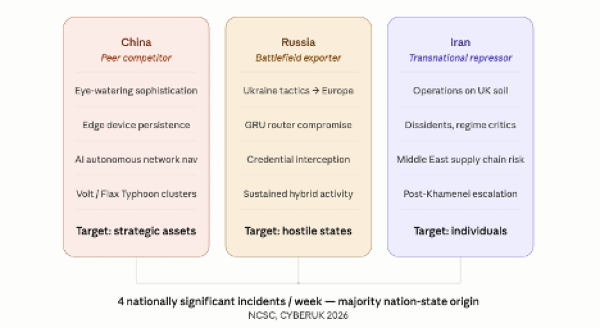
Three adversaries, three distinct models, all active simultaneously, and all being accelerated by the same technological development: AI at the frontier. Horne's explicit warning that frontier models are enabling adversaries to discover and exploit vulnerabilities at scale intersected at CYBERUK with the UK government's own experience of Anthropic's Mythos Preview — which Security Minister Dan Jarvis cited as having autonomously identified thousands of previously unknown software flaws, some undetected by human experts and automated tools for more than two decades. The AI Security Institute's assessment was characteristically careful: Mythos is more capable at cyber offence than any model previously evaluated, but test environments lack active defenders, monitoring, and detection risk, making real-world performance against hardened targets genuinely uncertain. What is not uncertain is the trajectory — AISI now estimates frontier AI cyber capability is doubling every four months, down from every eight months at the end of 2024. The competitive baseline is moving faster than any defense framework can adapt to, and the Chinese side of this race has already produced, according to leaked technical documents reported earlier this year, explicit efforts to build AI systems capable of navigating defended networks autonomously while evading detection. Jarvis's call for major AI companies to partner with government on national-scale, AI-powered cyber defense — "capabilities that can protect our nation's most critical networks by autonomously identifying and addressing vulnerabilities at a speed and scale no human can match" — is an acknowledgment that the human-speed defense model is already being outpaced.
The policy response announced at Glasgow — a £90 million investment package and a new Cyber Resilience Pledge asking major organisations to treat cybersecurity as a board-level responsibility — reflects a government that has concluded voluntary baseline compliance is no longer adequate but has not yet moved to mandatory frameworks. The Pledge, which the government intends to present to organisations for signature this summer, asks for commitments to NCSC Early Warning enrollment and Cyber Essentials certification for suppliers — hygiene measures, not transformative ones. The practitioner reading from the conference floor was frank: the Pledge sets a clearer marker for what "acceptable" looks like in any post-incident regulatory review, and boards that have not yet had an explicit cyber risk conversation at governance level now have a public document explaining why regulators will consider that a failure. Jaguar Land Rover's recent attack, which Jarvis invoked as illustration, carries the point: the physical equivalent, he said, would have been hundreds of masked criminals smashing up dealerships and driving cars from forecourts across the country. The infrastructure of modern industry is digital, the attacks on it are already at that physical scale of consequence, and the gap between current baseline practice and what the threat now demands has not closed.