Seeing Is No Longer Believing: How Synthetic Media Weaponizes Trust in Two Unrelated Worlds- 301

August 8, 2026
A flooded province in southern China and a subscription platform for adult content creators would seem to have nothing in common, and a year ago they largely wouldn't have. What connects them now is a single technical shift: generating a convincing fake video, voice, or witness account has become cheap enough, and good enough, that it barely matters who the target is or what the fraud is actually for. Two cases surfacing in the same week show the same underlying weapon pointed at entirely different problems — one at the legitimacy of a state's emergency response, the other at the income and physical safety of individual online creators — and both show that once synthetic content starts circulating, knowing it's fake stops being enough to neutralize the damage.
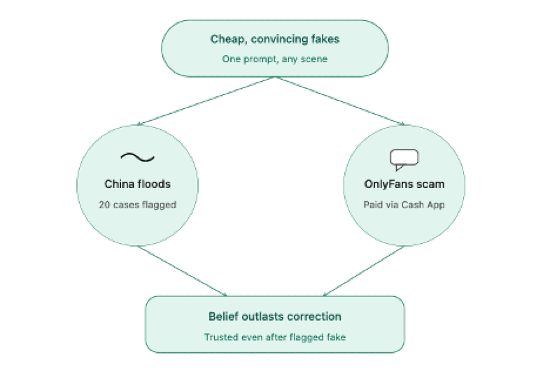
In China, the technical shift arrived on top of a real crisis. As storms and flooding intensified across several provinces in recent months, authorities found themselves fighting a second emergency layered on top of the first: a wave of AI-generated video depicting bodies in floodwater, escaped crocodiles, collapsed infrastructure in towns nowhere near the actual disaster, and fabricated dam-overflow footage complete with invented witness interviews. Some of it was old footage repurposed — watermarks stripped, subtitles altered, foreign or historical disasters relabeled as breaking news — but a growing share was generated outright using consumer AI tools, requiring, as one professor writing for the Communist Party's own Study Times put it, little more than a single prompt to turn a trending topic into convincing text, image, audio, or video. The consequences were not confined to social media: false claims of imminent power outages triggered panic-buying of emergency supplies in some regions, and fabricated rescue footage actively undermined public trust in the real emergency response while it was still underway. One case involved a 45-year-old man in Hebei province who generated a fake video showing floodwater collapsing the ground beneath vehicles in a county untouched by the storm, posted it to WeChat to build a following, and ended up triggering local panic and disrupting actual flood-prevention work in the process. Chinese authorities responded with a nationwide enforcement campaign, "Clean Net 2026," coordinated between the Cyberspace Administration and the Ministry of Emergency Management, and have already documented twenty cases involving fabricated disaster footage, recycled reports relabeled as current, and outright invented casualty claims, with penalties ranging from fines to detention. The state's response here is enforcement at scale — arrests, takedowns, a coordinated national notice — but it is running against a technical reality in which the barrier to producing the next fake clip has essentially disappeared.
Roughly seven thousand miles away and aimed at a completely different kind of victim, the same underlying capability is powering a quieter, more personal fraud. Scammers are building fake identities out of real OnlyFans creators' own material — photos lifted from their public accounts, paired with an AI-cloned version of their voice — and using the result to impersonate the creator on TikTok, where the fake account lures fans into what looks like a personal connection. The conversation is deliberately moved off TikTok to Snapchat, then toward a payment request routed through Cash App specifically because it is a peer-to-peer platform built for informal transfers between friends rather than commerce, with transfers that clear instantly and cannot be reversed once sent. By the time a fan realizes no live chat or exclusive content is coming, the money is gone and the fake account is blocked. Malwarebytes, which documented the scheme, notes that it produces two separate victims: the fans who lose money, and the real creators being impersonated, who lose the income those fans might otherwise have paid them directly, and who face a second-order risk entirely of the scammer's making — angry fans who believe the real creator scammed them personally, in at least one documented case showing up at a creator's home after the confusion, leaving her afraid to leave the house. The fakes are not always technically flawless — one impersonation of creator Elaina St. James, built by animating a single still photo with a cloned voice, showed the telltale distorted teeth and frozen eyebrows common to AI video generated from limited source material — but flawed does not mean ineffective. Enforcement here runs into a different wall than China's: the US Take It Down Act criminalizes non-consensual AI-generated explicit content and requires rapid platform takedowns, and the EU's AI Act requires disclosure when AI generates an image, but neither law reaches the overseas hosts where the stolen material and fake accounts actually sit, and jurisdiction stops at a border the fraud never respected in the first place. Malwarebytes points to a further complication that undercuts the entire premise of fighting this with better labeling or awareness campaigns: in three separate experiments this year, researchers at the University of Bristol found that most participants continued to rely on deepfake content even after being explicitly told it was fake.
That Bristol finding is the detail that ties both cases together more tightly than geography or subject matter would suggest. China's crackdown works by removing content and punishing its creators after the fact, and the creator-economy scam is defeated, when it is defeated at all, by a fan recognizing distorted teeth in a low-quality clip — but both responses assume that correcting the record, or spotting the artifact, actually undoes the belief the fake content created in the meantime. The Bristol research suggests that assumption may already be failing: once a synthetic video has done its work — triggering panic-buying in a flood zone, or convincing a fan that a real personal connection exists — a later correction, retraction, or arrest does not reliably reverse what people now believe they saw and heard. What China's floods and a fake OnlyFans account have in common is not the target or the motive, but a shared and increasingly uncomfortable fact: the technology for making something look and sound real has outpaced not just the legal and institutional tools built to catch it, but the basic cognitive habit of disbelieving something once you've been told it's false.