One Regime, Four Fronts: Inside North Korea's Parallel Cyber Enterprise- 302

August 8, 2026
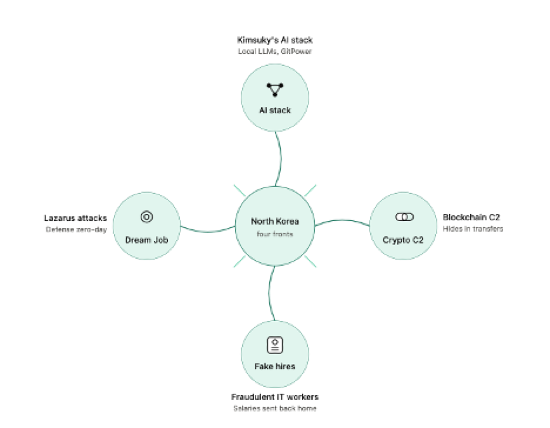
It would be easier to track North Korea's state-linked cyber activity if it all pointed in one direction. It doesn't. In the span of a single month, separate lines of reporting describe a Reconnaissance General Bureau unit quietly assembling a local AI development stack, a blockchain-based technique for hiding malware infrastructure inside meaningless-looking crypto transactions, a US government warning about North Korean operatives who have simply gotten themselves hired as remote IT staff, and a Lazarus Group campaign burning a Windows zero-day to break into European and Indian defense contractors. None of these four efforts appears to be the same operation, and they don't need to be. Taken together, they describe a state that no longer runs a single cyber program so much as an enterprise with parallel business lines — one producing hard currency, one producing access, one producing resilience, and one producing raw intelligence — all operating at the same time, largely independent of each other, and all improving in sophistication together.
The first line of business is building the tooling itself. Genians, the South Korean security firm that has tracked Kimsuky for years, spent months monitoring infrastructure linked to the group — a cyber-espionage unit subordinate to North Korea's Reconnaissance General Bureau — and found it quietly assembling a complete local AI development environment rather than simply querying public chatbots. The strongest evidence sat in three applications capable of running language models entirely offline: Ollama, GPT4All, and Msty, all of which Genians found configured and in active use rather than merely downloaded — Ollama had already generated the cryptographic keys tied to its initial setup, and GPT4All contained a populated "localdocs_v3.db" database supporting its retrieval-augmented-generation feature, meaning the operators had connected their own document collections to the model rather than leaving it as a stock install. Investigators recovered a request, of uncertain provenance, asking an AI system to analyze a dataset for cryptocurrency wallet information, Gmail credentials, and website-registration history — Genians could not confirm the request was ever actually submitted, but its presence on the same infrastructure says something about intent. Beyond the local-model tools, the researchers found a deliberately assembled software development stack: LLaMaSharp, Microsoft's Semantic Kernel, Microsoft.Agents.AI, and Microsoft.Extensions.AI, all frameworks for embedding AI capability into custom C# and .NET applications, alongside OpenAI Whisper files for speech-to-text transcription and traces of Cursor, an AI-assisted coding editor. Individually, none of this software is remarkable — it is the deliberate combination, spanning local model execution, document retrieval, development frameworks, and external AI service integration, that led Genians to conclude the group was building a specific tool for a specific purpose rather than experimenting out of curiosity. The infrastructure ties directly into Operation GitPower, an active Kimsuky campaign that uses public GitHub repositories as command-and-control channels within an LNK-to-PowerShell infection chain, delivering encrypted AsyncRAT payloads disguised as ordinary image files; the same phishing operation now uses AI to generate decoy documents — fake meeting requests, research reports, and materials themed around virtual assets and finance — written in natural, polished language specifically to defeat the poor grammar and awkward translation that have long served as phishing red flags, while obfuscating the malicious payloads themselves through Base64 encoding, string splitting, and custom decoding routines. Genians stresses what it did not find: no evidence Kimsuky has trained its own model, and no confirmation the AI stack has yet been deployed against a real victim. The activity reads as preparation rather than an active AI-driven campaign — assembling every component of the pipeline before switching it on — and Genians' practical recommendation follows from that: stop evaluating phishing threats by the quality of the prose, since AI has already erased that signal, and correlate behavior instead — LNK execution followed by PowerShell activity, scheduled-task persistence, and GitHub-based communications.
The second line of business is keeping infrastructure alive once it exists, and it runs through the blockchain rather than around it. Researchers at OpenSource Malware identified a technique, which they named NullReceiver, embedded inside two malicious npm packages — bianira-ui and fluid-type-ui — both built to impersonate legitimate Tailwind CSS plugins and tied to the DPRK-linked Contagious Interview operation, which has repeatedly used trusted-looking open-source packages to compromise developers. The technique itself is almost elegant in its simplicity: rather than pointing infected systems to a fixed web domain or server address that defenders can seize or blacklist, the malware reads the recipient address from the latest outgoing transaction of an attacker-controlled Ethereum wallet, where the address bytes are deliberately chosen so that part of the value decodes into the IP address of the actual command-and-control server. Critically, the transaction itself carries no payment value, no input data, and no smart-contract call — nothing that would flag it to a security tool scanning blockchain activity, because it looks exactly like an empty, meaningless transfer. This is a narrower tool than the previously documented EtherHiding technique, which stores richer command data inside transaction calldata or smart contracts and can therefore carry more information — but that richness comes at a cost, since EtherHiding's fixed destination addresses are precisely the kind of predictable indicator defenders can monitor from day one. NullReceiver trades capacity for invisibility: it can only really smuggle something as small as an IP address, but it is cheaper to operate and leaves defenders with almost nothing distinctive to watch for. The broader significance is less the specific npm packages than the pattern — North Korean-linked operators treating public blockchain infrastructure as a resilient, censorship-resistant utility layer for command-and-control, a use of crypto rails that sits alongside, though is technically distinct from, the more familiar picture of North Korea laundering stolen funds through the same infrastructure.
The third line of business runs through the hiring process itself, and its most distinctive feature is that the fraud succeeds even when every individual background check passes. In July, the US State Department issued an alert describing North Korean IT workers who impersonate nationals of other countries specifically to obtain remote employment, then route their salaries back to parent agencies in North Korea; the FBI has separately warned that once inside an organization, these workers may copy source-code repositories, exfiltrate proprietary data, and in some documented cases attempt to extort their former employers by threatening to publish stolen material after being discovered or dismissed. The operation succeeds by exploiting a specific gap that most hiring processes never close: a résumé can be credible, a laptop can arrive at a legitimate domestic address, and neither of those facts proves that the person who was interviewed is the same person who receives the device or who ultimately logs in. North Korean operators exploit that gap methodically — falsifying nationality and identity through forged documents or proxy registration, using AI to build professional profiles and social-media presences that match the tone and language of genuine IT professionals, avoiding direct-deposit payment in favor of money transfers or cryptocurrency (in some cases paying a third party specifically for the use of that party's bank account to receive salary), using VPNs and remote-desktop software to disguise the fact that the work is happening from abroad, and relying on overseas facilitators who physically receive employer-issued laptops, keep them powered on and network-connected, and let the actual worker control them remotely from North Korea or a third country. Standard employment verification — confirming an identity exists, that the named person is eligible to work, that a laptop reached an approved address — was never designed to catch any of this, because each individual control can be satisfied honestly while the underlying assumption, that the interviewee, the device recipient, and the daily user are the same person, quietly fails. The proposed fix treats identity as something to be re-proven rather than filed away once at hiring: government-issued document validation paired with biometric liveness detection, confirming both that an identity document is genuine and that a real, physically present person — not a photograph, recording, or deepfake — is the one completing onboarding.
The fourth line of business is the one that looks most like traditional state-sponsored espionage, and it shows Lazarus Group operating with undiminished technical sophistication even as its sister operations experiment with entirely different tradecraft. Since early July, Lazarus has been exploiting a Windows zero-day, CVE-2026-68820 — a use-after-free flaw in the Windows Ancillary Function Driver for WinSock that lets a locally authenticated attacker trigger a race condition and gain full SYSTEM privileges without any further user interaction — as part of a fresh wave of the long-running Operation Dream Job campaign, which lures employees at defense, aerospace, and aviation organizations with fraudulent recruitment offers. Check Point, tracking the campaign, found the exploit built specifically for Windows 11 builds 26100 and 26200 and incorporated into an updated version of the FudModule kernel-mode rootkit, which now adds Smart App Control tampering to its established capabilities for disabling EDR telemetry and interfering with security software — this is not the first time Lazarus has used an AFD.sys zero-day to deploy FudModule, suggesting the group treats this particular driver as a reliable, reusable privilege-escalation target. The same campaign wave introduced a new backdoor called Troy, supporting seventeen distinct commands, and separately involved scanning for vulnerable Roundcube webmail installations, which the attackers compromised — likely using previously leaked credentials — via an authenticated PHP object-deserialization flaw to gain remote code execution and install a new PHP web shell, RelayShell, now found on at least seventeen servers. In one documented case, the group compromised an organization in France and used its infrastructure to run spear-phishing attacks against additional targets, part of a campaign Check Point describes as having genuinely global reach, with confirmed activity extending into Brazil and successful compromises across Western Europe. The sector focus is unambiguous — organizations working on military surveillance sensors, drones, and robotics — and the operational pattern, abusing compromised but entirely legitimate webmail infrastructure to conceal malicious communications, reflects a group Check Point assesses has grown stealthier and more adaptive to its targets' specific environments over time, even as its use of fraudulent recruitment as an entry vector remains unchanged from years of prior Dream Job activity.
What ties these four fronts together is not a shared target or a shared technical signature, but a shared exploitation of the gap between appearing legitimate and actually being verified — and in two of the four cases, that exploitation runs through the hiring process itself, from opposite directions. Operation Dream Job uses the appearance of a genuine recruiter reaching out to a real employee; the fraudulent IT-worker scheme uses the appearance of a genuine job candidate applying to a real employer. Kimsuky's AI stack is built to make its phishing lures pass the scrutiny that grammar and formatting used to provide. NullReceiver is built to make a piece of command-and-control infrastructure pass as an utterly meaningless blockchain transaction. None of these four operations required a technical breakthrough so much as a clear-eyed read of which specific verification humans and automated systems currently rely on — and a deliberate, well-resourced effort to satisfy the letter of that verification while defeating its purpose entirely.
Update, 17 October 2026. Check Point’s full report details the two infection chains behind the latest Dream Job wave. In the first, victims receive an encrypted archive containing a legitimate signed PDF viewer and a malicious DLL that displays a convincing Lockheed Martin job description while silently loading MISTPEN, a lightweight downloader that talks to its operators through the Microsoft Graph API and OneDrive, runs reconnaissance, triggers the AFD.sys exploit for SYSTEM privileges, and installs the ForestTiger backdoor, also known as ScoringMathTea, together with FudModule 3.1. In the second, closer to a 2025 campaign against the drone sector, targets are steered to download “SecurityPDF,” a trojanized viewer from sites impersonating the privacy firm Enveil, which decrypts and launches Troy in memory whenever a PDF carrying a hidden marker is opened. Germany joins France, Brazil and India among the confirmed target countries. The timeline underlines how short the window was: Check Point reported the flaw on 28 July, Microsoft confirmed it three days later, and the fix for CVE-2026-68820 shipped with the 11 August Patch Tuesday.