The Long Gap: What Five Healthcare Breaches Reveal About Who's Actually Watching- 303
August 9, 2026
Five healthcare-linked data breaches surfaced in the same few weeks of reporting, and no two of them share a cause, a perpetrator, or even a type of victim — one is a community hospital held for ransom, one is a physician group undone by a server nobody remembered still existed, one is a billing vendor whose single breach outnumbers the other providers combined, one is a biotech giant compromised through its own cloud contractors, and one is a foreign military's medical imaging system left exposed for months through nothing more sophisticated than an open network port. What unites them is not the how but the when: in every case, the gap between the intrusion itself and the moment patients actually learned about it stretched from months into more than a year, and in at least two cases the affected individuals never had a direct relationship with the company that lost their data in the first place.
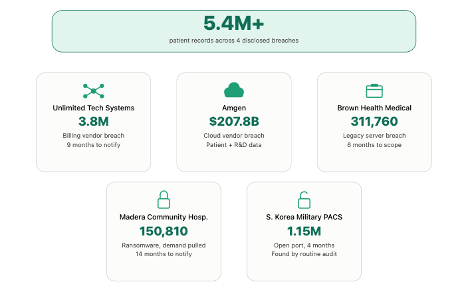
The scale problem is clearest at Unlimited Technology Systems, an Ohio-based billing and revenue-cycle technology provider serving more than 4,500 oncology practices and over 6,500 specialty healthcare providers across the country. The company detected unauthorized activity in its commercial data center on October 19, 2025, and its investigation determined attackers had accessed files for a five-day window earlier that month, stealing names, addresses, Social Security numbers, medical record numbers, diagnoses, dates of service, insurance policy and claims information, and scanned identity documents — though notably not full medical records, imaging, or payment card data. Unlimited did not begin notifying affected patients until July 1, 2026, roughly nine months after discovering the intrusion, and when it finally reported the breach to the US Department of Health and Human Services, the number came to 3,803,750 people — a single vendor incident larger than the other three US provider breaches in this set combined. Because Unlimited processes data on behalf of healthcare organizations rather than treating patients directly, most of the 3.8 million people receiving a breach notice from a company they've never heard of have no prior relationship with it at all, making the notice itself confusing before a recipient even gets to the question of what to do about it. No ransomware or extortion group has publicly claimed the intrusion, and Unlimited has not identified who was responsible.
Amgen's breach shows the same vendor-concentration risk from the opposite direction — not a company whose breach cascades outward to patients of its clients, but a company whose own patients were exposed because of a contractor it chose to trust. In a filing with the Securities and Exchange Commission, the California biotech giant, with a market capitalization of $207.8 billion, disclosed that it detected unauthorized activity in July involving data held in cloud environments operated by external service providers, and that the resulting investigation confirmed attackers had exfiltrated company information including proprietary data and patients' protected health information. Amgen has not disclosed how the attackers gained access, which cloud providers were involved, or who was behind the intrusion, and says it is still assessing whether confidential business information, intellectual property, and research and development data were also taken — a detail that matters because it means a single breach at a third-party cloud provider can simultaneously expose patient privacy and a pharmaceutical company's competitive research position, two harms that used to belong to entirely separate risk categories. Amgen maintains the incident is not reasonably likely to materially affect its financial condition, a securities-law judgment call that exists in a completely different regulatory register than the HIPAA breach notifications governing the other four cases in this set, even though the underlying failure — trusting a third party's infrastructure without full visibility into its security — is the same one running through Unlimited's case as well.
Brown Health Medical Group-MA's breach shows a third failure mode: not a vendor relationship at all, but an old piece of infrastructure nobody had gotten around to retiring. Lifespan Physician Group of Massachusetts, doing business as Brown Health Medical Group-MA, identified unauthorized access to what it describes as a historic file server at its Hawthorn location, with the intrusion itself occurring over a single day in mid-December 2025. The organization is emphatic that its actual electronic health record system was never touched — the exposure sat entirely in a legacy server that had, evidently, kept accumulating sensitive data long after it stopped being anyone's primary system of record. That data turned out to be substantial: names, dates of birth, Social Security numbers, driver's license and other government ID numbers, medical and disability-related records, financial account and card information, and — notably — internal personnel and human resources records, including payroll, compensation, and staff licensure and credentialing information, meaning the organization's own employees were caught up in the same exposure as its patients. Brown Health didn't determine the full scope of what had been affected until June 22, 2026, more than six months after the intrusion, and has not named a threat actor; no ransomware or extortion group has claimed responsibility. The pattern here is one every organization running decades of legacy infrastructure should recognize: the system that actually matters can be perfectly secure while a forgotten file server sitting a few switches away quietly holds the data that ends up in the breach notice.
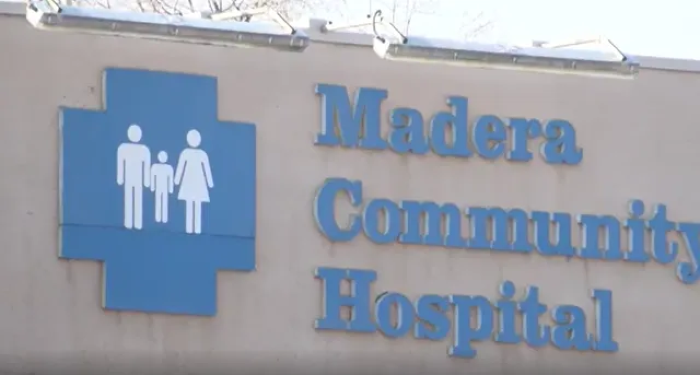
Madera Community Hospital's case shows the same long gap between intrusion and disclosure, but with a criminal actor who behaved in a way ransomware groups rarely do. The California hospital says hackers accessed its network for two days in May 2025 and likely exfiltrated files containing names, Social Security numbers, account credentials, financial information, treatment and insurance records, and limited biometric data — but the hospital's data-review firm didn't deliver its final results until April 2026, and patient notification didn't begin until mid-July of that year, a gap of well over a year between the intrusion and the moment affected patients actually learned what had happened. What makes this case distinctive is what happened with the extortion demand itself: according to the hospital, the group responsible ultimately withdrew its ransom demand, telling the hospital it did not want to harm patients. Whether that claim reflects genuine restraint, a calculation that hospital extortion draws disproportionate law-enforcement attention, or something else entirely, the hospital has no way to independently verify it, and the fourteen-month gap before notification meant patients spent well over a year unaware their Social Security numbers and biometric data might already be circulating regardless of what the attackers ultimately did with the files.
The final case shows that even an organization actively looking for intrusions can already be behind by months before it starts looking. South Korea's Armed Forces Medical Command discovered, during an April security inspection led by the Defense Counterintelligence Command, that its mobile Picture Archiving and Communication System — the imaging platform used by six military hospitals to view X-rays, CT scans, and MRIs, holding records tied to roughly 1.15 million people — had been accessed without authorization between November and December 2025. Investigators traced the point of entry to a single open network communications port that had sat exposed from November 2025 until March 2026, a four-month window during which nobody noticed. Based on network traffic volume rather than a confirmed list of accessed files, officials estimated roughly 8 gigabytes of medical data — equivalent to nearly a thousand X-ray images — may have been viewed, though they have not confirmed whether any information actually left the network, and they stress that the 1.15 million figure represents everyone whose records existed in the system, not a confirmed count of victims. What makes this case land differently than the other four is the mechanism: not a sophisticated intrusion chain, not a ransomware negotiation, not a third-party vendor relationship gone wrong, but a single misconfigured network port, discovered only because someone happened to go looking during a routine inspection rather than because any automated system flagged the activity while it was happening.
None of these five organizations share an attacker, a data type, or even a country, and that is precisely what makes the pattern across them worth taking seriously rather than dismissing as five unrelated news items. In every single case, the gap between when the intrusion actually happened and when the people affected found out about it ran from many months to well over a year — and in two of the five, the affected individuals had never done business with the breached organization at all, learning only after the fact that a billing vendor or a cloud contractor they'd never chosen had been holding their most sensitive information the whole time. Healthcare data now flows through a chain of hospitals, physician groups, billing processors, and cloud infrastructure providers long enough that no single patient can meaningfully audit it, and these five cases together suggest that the organizations managing that chain often can't fully audit it either — not until a forensic firm finishes its review, a routine inspection stumbles onto an open port, or a filing deadline finally forces the question of what, exactly, happened to the data months or years after it already occurred.
Update, 20 October 2026. A sixth case fits the pattern almost exactly. Aesto, a Birmingham, Alabama-based company that migrates and archives electronic health records for medical practices changing systems or being acquired, told the Department of Health and Human Services at the start of September that 9,540,683 people were affected by a breach of its Amazon Web Services infrastructure. The intrusion ran from about 2 to 18 December 2025, when it was discovered; only on 26 May 2026, after forensic investigation and manual document review, did the company confirm that protected health information may have been accessed or taken, and it began notifying client healthcare organisations, at least thirty of them, on 26 June. The exposed data includes names, dates of birth, medical and health-insurance information, driver’s licence and government ID numbers, financial account details, taxpayer identifiers and, for a limited number of people, Social Security numbers. No group has claimed the attack, and Aesto says it has seen no evidence of identity theft or fraud. The case adds a structural twist to the long gap: archiving vendors hold legacy records that patients may not know still exist, so the breach of a single back-office provider can expose people who never dealt with it directly. It also arrived amid a run of similar disclosures, including 2.8 million people affected at Baylor Genetics and 3.7 million in a March incident at CareCloud.