Fifteen Years in the Making: The Sentencing of Ransomwareas- a-Service's Original Architect- 309

August 7, 2026
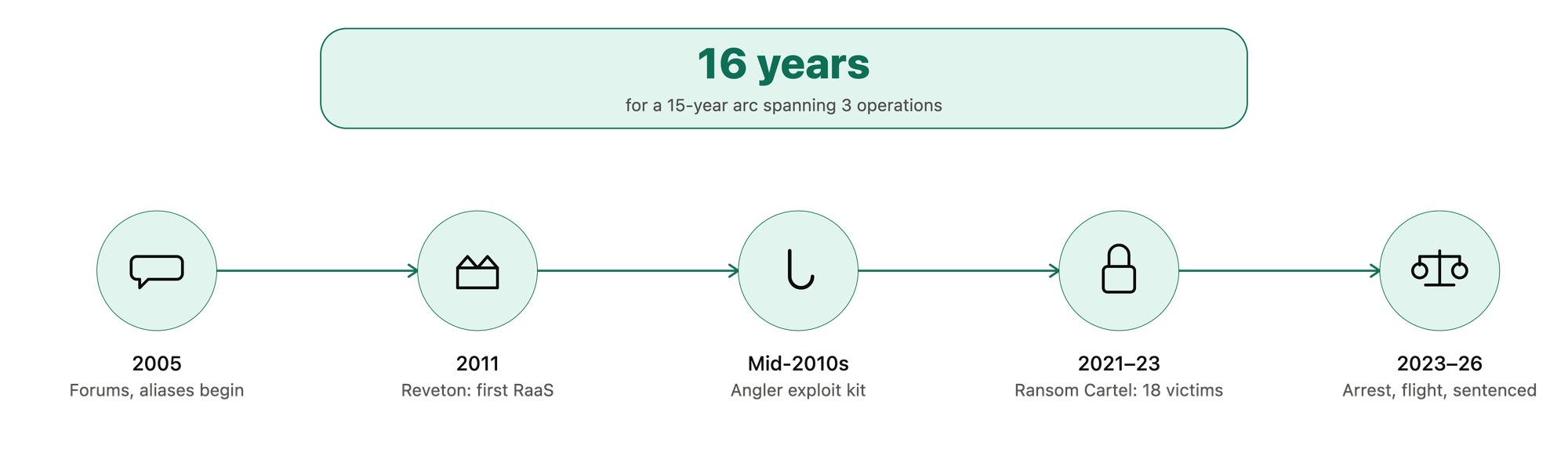
When a US federal judge in the Eastern District of Virginia sentenced Maksim Silnikau to 16 years in prison this week for his role running the Ransom Cartel ransomware operation, the case being closed was considerably older and larger than the 18 companies named in the indictment. Britain's National Crime Agency has previously called Silnikau one of the world's most prolific Russian-speaking cybercriminals, and the record behind that description spans not one criminal operation but three, running consecutively across roughly fifteen years — a trajectory that makes Ransom Cartel less a debut than a late-career return to a business model Silnikau had a hand in inventing.
That earlier chapter begins in 2011, when Silnikau, working with Belarusian-Ukrainian national Vladimir Kadariya and Russian national Andrei Tarasov — both charged in absentia and still at large — built a product called Reveton, which prosecutors describe as the first ransomware-as-a-service business model: a package that let low-skilled criminals rent a working ransomware operation for a fee rather than build one themselves. Between 2012 and 2014, Reveton extorted roughly $400,000 a month from victims. Silnikau is separately believed responsible for developing the Angler exploit kit, one of the most widely used cybercrime tools of the mid-2010s, distributed through malicious advertisements that silently infected visitors to otherwise legitimate websites and generated tens of millions of dollars annually. Alongside this, he had been active on Russian-speaking cybercrime forums since at least 2005 under aliases including "J.P. Morgan," "targa," "xxx," and "lansky," and belonged to the Direct Connection cybercrime marketplace from 2011 until its administrator's arrest forced its closure in 2016.
Ransom Cartel, the operation that ultimately brought Silnikau's career to an end, began development in May 2021 and launched publicly that December, built as a fully-featured ransomware-as-a-service platform rather than a tool Silnikau operated alone. He recruited affiliates through underground forums and supplied them with stolen credentials, access to compromised networks obtained through initial access brokers, and the ransomware software itself, while separately running a hidden affiliate website where members coordinated attacks, negotiated with victims, and split the resulting proceeds. Researchers noted early on that Ransom Cartel's encryptor shared code similarities with the REvil ransomware, whose own operation had largely collapsed in 2021 under international law enforcement pressure; the relationship between the two remains genuinely unresolved, with some analysts theorizing Ransom Cartel was built by a former core REvil member who lacked access to the group's complete source code — a theory consistent with the newer malware's noticeably weaker obfuscation compared to REvil's — while investigators more broadly describe it as unclear whether Ransom Cartel was a direct successor or simply a separate operation built on leaked or reused code.
Between 2021 and 2023, Ransom Cartel affiliates attacked at least 18 organizations, including companies in California, New York, and Nebraska alongside victims outside the United States, stealing corporate data before encrypting systems and demanding payment for either a decryption key or a promise that stolen material would stay private. Prosecutors put the group's attempted extortion at a minimum of $5.2 million and identified at least $6.7 million in confirmed losses across the 18 known victims — a figure they believe understates the true total, since some victims never reported being attacked at all. Two cases illustrate the practical cost behind those numbers: an August 2022 attack disrupted operations at a medical technology startup developing robotic surgical technology for two months, and a May 2023 wave against law-firm infrastructure knocked out business operations for periods ranging from several days to multiple months, with one firm paying a $125,000 ransom after nearly a month of disruption and another suspending operations for close to a month before paying $300,000 — combined losses from that single wave of law-firm attacks alone reaching approximately $2.2 million. Throughout, Silnikau is said to have personally handled ransom negotiations and payment collection, routing proceeds through cryptocurrency mixers specifically to frustrate law enforcement tracing efforts.
The operation's end came in stages rather than all at once. Silnikau was arrested in Spain on July 18, 2023, as part of a coordinated international law enforcement action, but fled while awaiting extradition and was recaptured attempting to cross from Poland into his native Belarus. He ultimately consented to extradition and was transferred to the United States via Poland to face prosecution, and prosecutors say Ransom Cartel's operations were significantly disrupted once his arrest took him out of the picture. He was convicted on charges of conspiracy to commit offenses against the United States, conspiracy to commit wire fraud, and aggravated identity theft, resulting in this week's 16-year sentence. Kadariya and Tarasov, his co-conspirators from the original Reveton operation more than a decade earlier, remain charged in absentia and, as far as public reporting shows, still at large — meaning the sentencing closes the book on one architect of ransomware-as-a-service while leaving the model's two other original builders formally unaccounted for.