The Extortion Machine: How ShinyHunters Engineered the Pay-or-Leak Economy- 196
June 22, 2026
The spring 2026 extortion campaign conducted by the ShinyHunters group represents a critical stress test of a specific structural hypothesis: that a well-timed, massive data theft involving information held on behalf of millions of third parties creates a "coercive geometry" that makes ransom payment a rational choice for the targeted organizations. The group’s methodology consistently prioritizes identity-based attacks—such as vishing to compromise single sign-on (SSO) accounts—and the exploitation of supply chain dependencies, effectively demonstrating that an organization's true perimeter is now the aggregate of its third-party integrations, vendor tools, and OAuth applications rather than its own internal systems.
The ShinyHunters extortion campaign of spring 2026 is best understood not as a series of individual breaches but as a stress test of a specific structural hypothesis: that a sufficiently large, sufficiently well-timed data theft, directed at organizations holding data on behalf of millions of third parties, creates a coercive geometry that makes ransom payment the rational choice regardless of what every law enforcement agency on earth advises. The Canvas breach confirmed the hypothesis. The pattern of victims that preceded it shows how methodically the group had been building toward it.
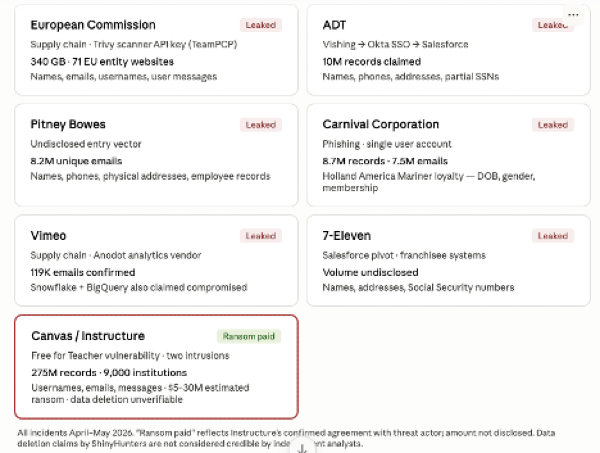
The methodology is consistent across targets and has been for over a year. ShinyHunters begins with identity, not infrastructure. Vishing campaigns — voice phishing calls targeting employees and business process outsourcing agents — compromise Okta, Microsoft Entra, or Google SSO accounts. A single compromised identity provider credential is not a perimeter breach; it is a master key. SSO by design connects to everything: Salesforce instances, Microsoft 365 environments, Google Workspace, Snowflake data warehouses, Dropbox, Slack, Adobe, Zendesk, Atlassian. ShinyHunters pivots across whichever connected applications yield the most extractable data, exfiltrates at volume, and then lists the victim on its Tor-based leak site with a deadline, a claimed record count, and a threat to publish unless payment is received. ADT — whose Okta account was compromised through vishing, yielding access to its Salesforce instance and an alleged ten million customer records — is the cleanest example of the baseline model. 7-Eleven's breach followed the same Salesforce access pattern, exposing names, addresses, and Social Security numbers from franchise documents. Pitney Bowes lost 8.2 million unique email addresses, names, phone numbers, and physical addresses.
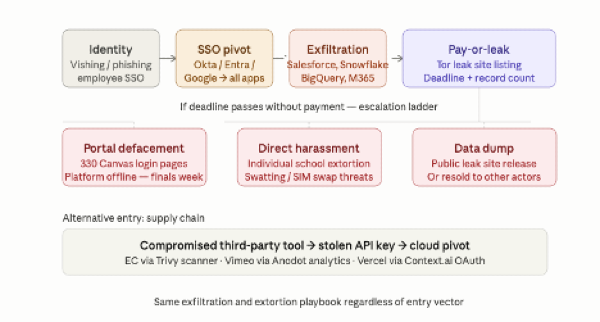
Supply chain dependency creates a parallel entry vector the group has exploited with equal facility. The European Commission's 340-gigabyte loss originated not in a direct attack on Commission systems but in a compromised API key from Aqua Security's Trivy vulnerability scanner, poisoned upstream by the TeamPCP hacking group and delivered through normal software update channels. Using the compromised key, attackers created new access credentials, launched TruffleHog to scan for additional secrets, and exfiltrated data from cloud infrastructure hosting websites for 71 EU and EU-affiliated clients before ShinyHunters added the material to its leak site. Vimeo's breach traced to Anodot, a third-party analytics vendor whose integration gave attackers access to video metadata, technical data, and over 119,000 customer email addresses — with ShinyHunters claiming, in communications seen by the press, that Snowflake and BigQuery instances were also compromised through the same Anodot vector. The structural lesson is the same one running through the China botnet cluster: the perimeter of an organization is not its own systems but the aggregate of every third-party integration, vendor tool, and OAuth application connected to it.
Canvas is where the methodology reached its logical apex. ShinyHunters exploited a vulnerability in Instructure's Free for Teacher product in late April, extracted what the group claimed was 3.65 terabytes of data covering 275 million student, teacher, and staff records across approximately 9,000 institutions — including Harvard, Columbia, Stanford, Georgetown, and Rutgers — then set a pay-or-leak deadline. When the deadline passed without payment, the group switched tactics. It defaced 330 Canvas school login portals with ransom messages, forcing Instructure to take the entire platform offline. The timing was not coincidental: finals week, Advanced Placement testing, enrollment season — the moments at which a learning management system going dark inflicts maximum institutional harm. The pressure was not technical. It was operational and reputational, engineered to collapse the refusal calculus by making non-payment indistinguishable, from a harm perspective, from the data leak itself. Instructure paid. The company announced it had "reached an agreement" with the threat actor and received "digital confirmation of data destruction." The estimated ransom sits between five and thirty million dollars. Not a single security expert interviewed by the press believed the data was deleted.
That gap — between the corporate assurance and the forensic reality — is the ransomware trust paradox in its clearest form. ShinyHunters has a documented history of recycling data from incidents where destruction was claimed: material from earlier intrusions has resurfaced on criminal forums months and years later. CrowdStrike's survey data shows that 83 percent of organizations that paid a ransom were attacked again, and 93 percent lost data regardless of payment. Chainalysis found the proportion of victims paying in 2025 dropped to an all-time low of 28 percent even as attack volume hit record highs. And yet Instructure paid — for the same reason PowerSchool paid roughly $2.85 million in bitcoin the previous December after a breach affecting tens of millions of students, only to see individual schools extorted again five months later by the same or affiliated actors. The FBI issued guidance urging organizations not to pay ShinyHunters specifically; the guidance landed after Instructure had already paid.
The education sector's structural vulnerability is not accidental. As one analyst observed, four vendors — Canvas, PowerSchool, Infinite Campus, and Blackboard — collectively hold records on something approaching every American student. Three of the four have been breached at multi-million-record scale within eighteen months. The concentration of sensitive data, the mission-critical nature of the platforms during high-stakes academic periods, and the locked-in multi-year contracts that prevent rapid vendor switching create the conditions ShinyHunters is explicitly exploiting. The economics are straightforward: Instructure paid, PowerSchool paid, and every other education technology vendor's board is now calculating its own number. The pattern, as one security architect put it, is established. ShinyHunters does not need a new technique. It needs only the next school term.