The Shadow Economy: Pig-Butchering and the Industrialization of Trust Fraud- 195
June 22, 2026
For years, the cybercrime phenomenon known as "pig-butchering" was comfortably categorized by security taxonomies as a consumer-level fraud—a crime driven by social engineering rather than sophisticated technical intrusion. However, a wave of law enforcement actions, financial data, and threat intelligence spanning from late 2025 into 2026 reveals that this classification is dangerously obsolete.
What we face today is a highly structured, transnational shadow economy. Operating at a staggering industrial scale, this criminal ecosystem is physically anchored in governance-weak jurisdictions, shielded by paramilitary protection, and fueled by a cryptocurrency laundering infrastructure designed to outpace global regulatory frameworks. Rather than dismantling these operations, enforcement pressure has simply displaced them, causing the crisis to spread geographically.
In the taxonomy of cybercrime, pig-butchering has long been classified as fraud — a consumer-level harm driven by social engineering rather than technical intrusion. That classification no longer captures what the phenomenon has become. The cluster of law enforcement actions, financial data, and threat intelligence published across a six-month window from late 2025 into 2026 describes something structurally different: a transnational shadow economy, operating at industrial scale, physically anchored in governance-weak jurisdictions under paramilitary protection, laundering through cryptocurrency infrastructure that outpaces every regulatory framework designed to contain it, and now spreading geographically as enforcement pressure displaces operations rather than dismantles them.
The scale figures establish the context. Americans lost $16 billion to Southeast Asia-based romance and investment schemes in 2024, rising to $21 billion in total cybercrime losses in 2025 according to FBI IC3 data, with cryptocurrency fraud alone accounting for $11 billion of that figure. The FTC documented $2.1 billion in social media scam losses in 2025 — an eightfold increase since 2020 — with nearly one in three Americans who reported losing money to scammers having been contacted through a social media platform, predominantly Facebook. Globally, estimates place pig-butchering losses above $63 billion annually. These are not the figures of opportunistic fraud. They are the output of an organized industry.
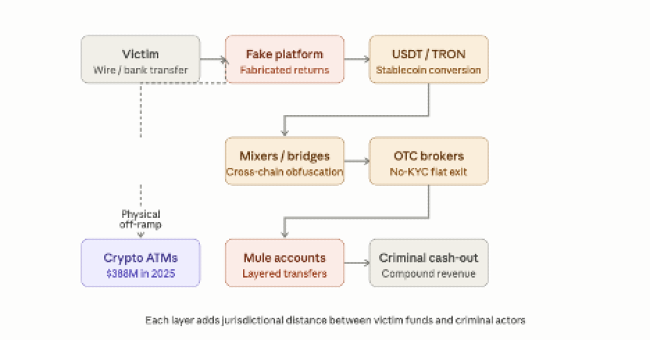
What CYFIRMA's threat intelligence report makes clear, and what the law enforcement actions across three continents confirm, is that the industry is structured accordingly. Scam compounds in Southeast Asia — Myanmar's KK Park and Tai Chang, Cambodia's Shwe Kokko, Laos's Golden Triangle Special Economic Zone — operate as business process outsourcing centers: shift workers managing multiple victim personas simultaneously, supervised by team leaders tracking engagement metrics, supported by dedicated technical teams building and maintaining fake trading platforms that pull real-time market data from legitimate exchanges to create convincing dashboards. Behind the operators are money laundering teams cycling victim funds through stablecoins — predominantly USDT on the TRON network for its low fees and high liquidity — across mixers, cross-chain bridges, and OTC brokers operating in regulatory grey zones, before eventually cashing out through mule account networks. Cryptocurrency ATMs have become a critical physical off-ramp: the FBI documented $388 million in losses through crypto kiosks in 2025, a 58 percent increase over 2024, with more than half involving victims over 50. States are now banning the machines outright — Tennessee, Indiana, and a pending measure in Minnesota — while Massachusetts, Iowa, and Washington DC have filed lawsuits against kiosk operators alleging they profit from the scam ecosystem rather than merely facilitate it.
The physical infrastructure of this economy is protected by armed force. The Treasury Department's sanctions against Myanmar's Democratic Karen Benevolent Army — one of several armed groups providing security to scam compounds in exchange for a share of revenues — document beatings, electric shocks, and dark-room detention of trafficked workers forced to conduct scams under threat of violence. The DKBA partners with Chinese organized crime on drug, human, arms, and wildlife trafficking alongside its scam center operations, with revenues funding an ongoing civil war. The US Attorney described the ecosystem as "creating a generational wealth transfer from Main Street America into the pockets of Chinese organized crime." Several US government experts have additionally documented explicit financial commingling between Chinese state-backed investment projects and scam compound development — a detail that blurs the line between pure criminal enterprise and something with state adjacency, even if direct state direction remains unconfirmed.
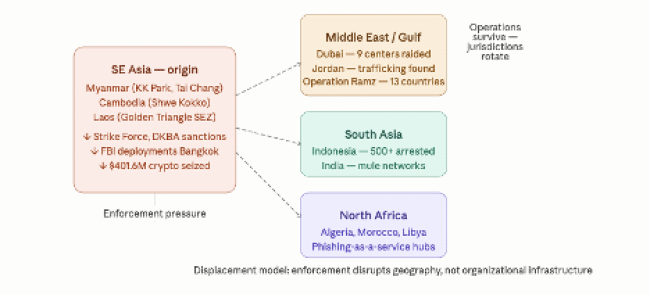
The most analytically significant development in this reporting cycle is geographic displacement. As the US Scam Center Strike Force escalated pressure across Myanmar, Cambodia, and Laos — seizing $401.6 million in cryptocurrency, sanctioning armed groups, deploying FBI agents to Bangkok — operations began migrating. Interpol's Operation Ramz, backed by Qatar and the EU and spanning thirteen countries across North Africa and the Middle East, found the same model replicating: a Jordan compound staffed entirely by trafficked workers from Asia whose passports had been confiscated, fake financial trading platforms, layered financial infrastructure. Indonesia arrested more than 500 people running scam operations in a single month and moved to review visa rules after identifying the 30-day visa-free window as an entry mechanism. The enforcement response, however coordinated, is operating on a slower cycle than the operational adaptation it is trying to contain.
The geopolitical signal embedded in the Dubai operation cuts against this pessimism in one specific way. The joint US-China raid on nine scam centers resulting in 276 arrests represents an operational convergence between two governments that cooperate on almost nothing in the cyber domain. Chinese organized crime controls the vast majority of these compounds; Chinese victims are also targeted by them; and Beijing has executed scam kingpins repatriated from Myanmar. The alignment is tactical, limited, and unlikely to resolve broader disputes over state-sponsored intrusions and cyber espionage. But it is real, and it reflects a shared recognition that the pig-butchering ecosystem has grown large enough to threaten financial stability at a systemic level — not just in the United States but in China's regional financial architecture as well.
That systemic threat is no longer theoretical. The collapse of Heartland Tri-State Bank in Kansas — where CEO Shan Hanes was manipulated over months into authorizing $47 million in wire transfers to cryptocurrency wallets controlled by scammers, draining the bank's liquidity until it failed — is now the canonical case study in what CYFIRMA's analysts describe as the emerging organizational targeting hypothesis. Pig-butchering's psychological engine — extended grooming, fabricated trust, escalating financial commitment — does not distinguish between a retail victim and a C-suite executive with fiduciary authority over institutional funds. The techniques that extract life savings from retirees can extract tens of millions from a bank, and the harm cascades differently: depositors, shareholders, regulators, and the broader confidence in supervised financial institutions. Hanes received over twenty years in federal prison. The scammers who built the system that manipulated him are operating in the next compound under a different name.