The Discovery Gap: How AI Is Breaking the Economics of Cybersecurity- 194

June 22, 2026
The traditional economics of cybersecurity are currently undergoing a destabilizing shift, driven by the unprecedented acceleration of AI-assisted vulnerability discovery. For decades, the industry relied on the tacit assumption that remediation efforts could effectively match the pace of vulnerability identification; however, recent evidence—such as the rapid emergence of vulnerabilities like Copy Fail, Dirty Frag, and PinTheft—demonstrates that AI tools are now outstripping human capacity, forcing organizations into a cycle of urgent, large-scale patching. This report explores how the rapid evolution of frontier AI models is creating a "discovery gap," where the speed of automated research is transforming from a supportive tool into a disruptive force that challenges both corporate maintainers and global governance frameworks.
For decades, the patch cycle has operated on a tacit assumption: that the rate at which vulnerabilities are discovered roughly matches the rate at which the industry can remediate them. Skilled researchers find flaws, responsible disclosure gives vendors time to prepare fixes, and administrators apply updates in an orderly if imperfect sequence. The assumption was never exactly true, but it was approximately true enough to sustain an industry built around it. Artificial intelligence has made it false.
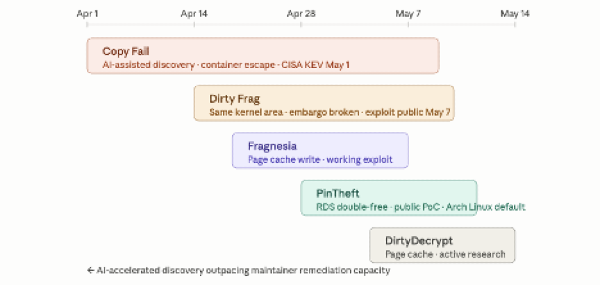
The evidence accumulated across a single fortnight in May 2026 is worth reading as a system rather than a series of separate incidents. The UK National Cyber Security Centre warned that AI tools were beginning to expose the accumulated "technical debt" embedded in critical infrastructure at a speed that would force organisations to patch at unprecedented velocity. Within days of that warning, its premise was confirmed in practice. Copy Fail, a Linux kernel vulnerability discovered with AI tooling by the security firm Theori, provided attackers with an escape route from cloud containers — a compromised application breaking out of its supposedly isolated environment to seize control of the host server. Before the patch cycle for Copy Fail had completed, Dirty Frag appeared: a second major Linux vulnerability in the same area of the kernel, discovered independently, with a working public exploit released after a disclosure embargo broke under circumstances that remain unclear. Then PinTheft, a third Linux local privilege escalation in the same wave, joining Fragnesia and DirtyDecrypt in a cluster of page-cache write vulnerabilities that Linux administrators are now managing simultaneously, some with working exploit code already publicly attached. CISA added Copy Fail to its Known Exploited Vulnerabilities catalogue on May 1st, ordering federal agencies to patch within two weeks. Real attackers are using these techniques in the wild. HackerOne paused its open-source bug bounty programme, citing a "worsening imbalance" between the speed of AI-accelerated discovery and the capacity of volunteer and corporate maintainers to remediate what is being found.
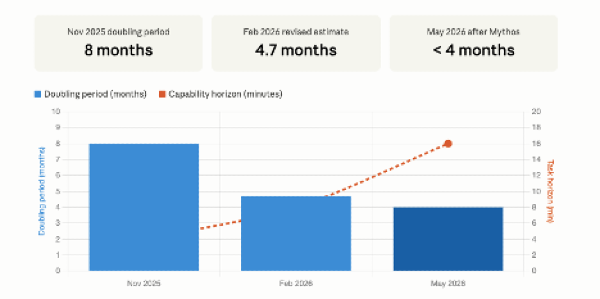
The scale of what is driving this is documented in the UK AI Security Institute's benchmarking work, which measures how much cybersecurity work AI models can do relative to a human expert. In November 2025, the AISI estimated that frontier models were doubling their effective capability horizon every eight months. By February 2026 it had revised that to every 4.7 months. With the arrival of Anthropic's Mythos Preview and OpenAI's GPT-5.5, it revised downward again — closer to four months, and possibly shorter still. Mythos Preview solved six of ten attempts at a simulated thirty-two step corporate network attack; it completed a previously unsolved seven-step industrial control system challenge in three of ten attempts. Claude Sonnet 4.5, a model below the frontier, can already complete tasks that would take a human cybersecurity expert sixteen minutes around eighty percent of the time. Mozilla's deployment of Mythos through Project Glasswing — Anthropic's controlled access programme for forty major organisations — produced fixes for 271 Firefox vulnerabilities in a single update cycle, each one a flaw that, in Mozilla's own assessment, a human researcher could have found given enough time, but that collectively represent more vulnerability discovery than years of conventional research would typically yield.
The governance response has been rapid, internationally uncoordinated, and in several cases explicitly framed around Mythos as the triggering event. India's Securities and Exchange Board issued an advisory directing participants across nineteen categories of financial institution to immediately revisit their security posture, establish AI-focused taskforces, and recalibrate their risk models for AI-accelerated threats. The US Treasury and Federal Reserve convened emergency sessions with the chief executives of nearly all major American banks. Singapore, Australia, and Hong Kong issued parallel guidance to their financial sectors. Jamie Dimon, chief executive of JPMorgan, said publicly that Mythos had revealed that "a lot more vulnerabilities need to be fixed" and that it made cybersecurity "worse" — not because the model is malicious but because it has made the scale of unaddressed exposure visible. Financial markets are already pricing in this exposure: cybersecurity, banking, and cryptocurrency stocks all fell on Mythos's announcement, the first instance of a model's vulnerability-finding capability becoming a direct input to equity valuation.
The governance challenge is compounded by proliferation dynamics that Anthropic itself has acknowledged. Dario Amodei has estimated that open-source models and Chinese competitors could reach Mythos-level cybersecurity capability within six to twelve months. RunSybil's chief executive argued at Black Hat Asia that coordinated workflows of open-source models can already approximate Mythos's results through what he called scaffolding — multiple models operating in concert rather than a single frontier system. Qihoo 360, one of China's largest security firms, claimed its own AI model identified more than a thousand vulnerabilities during the Tianfu Cup hacking competition, and independent analysis concluded the capability is approaching Mythos-level without yet having reached it. The NSA, meanwhile, is reportedly using Mythos through Project Glasswing despite the Pentagon having designated Anthropic a supply chain risk — a contradiction that illustrates how rapidly the capability has outpaced the policy frameworks meant to govern it.
There is a structural irony embedded in all of this that deserves to be stated plainly. The same AI generation producing Mythos is also producing increasingly vulnerable code. Veracode's testing of Anthropic's models found that Opus 4.7 introduces a security vulnerability in 52 percent of coding tasks — up from 50 percent for earlier Claude models, and notably worse than OpenAI's models at around 30 percent. TrustedSec's chief executive Dave Kennedy, a former NSA analyst, reported that code quality from Claude's models had degraded 47.3 percent relative to initial release performance, to the point of being "unusably bad" for security-sensitive development. AI is simultaneously excavating old technical debt — exposing latent vulnerabilities accumulated over decades of accumulated insecure code — and generating new technical debt at scale through vulnerable AI-assisted development. Defenders who adopt AI tooling to find vulnerabilities faster are, in many cases, building on codebases that AI tooling helped make more vulnerable in the first place.
The NCSC's patch wave framing is useful precisely because it names a systemic condition rather than any individual vulnerability. The discovery gap — the widening distance between the rate at which AI can surface flaws and the rate at which the human and institutional infrastructure of software maintenance can address them — is not a temporary imbalance waiting to be corrected. It is a structural feature of a landscape where capability doubles in months, remediation capacity is constrained by the same human bandwidth it has always been constrained by, and the tools finding vulnerabilities are indistinguishable, at the capability level, from the tools that would exploit them.