The Gentlemen Ransomware Operation: Industrialized Intrusion and SystemBC-Driven Expansion- 167

April 24, 2026
The activity attributed to the “The Gentlemen” ransomware group reflects the ongoing transformation of ransomware into a scalable, service-driven ecosystem. Rather than isolated attacks, the operation relies on affiliates, shared malware infrastructure, and pre-compromised networks to accelerate intrusion cycles and broaden its reach. Central to this model is the use of supporting tools such as SystemBC, which enables stealth communication, persistence, and rapid deployment of additional payloads within enterprise environments. The result is a fast-moving and highly adaptable threat structure capable of combining credential abuse, lateral movement, and multi-platform encryption into a single coordinated intrusion chain.
The operation attributed to “The Gentlemen” illustrates a ransomware ecosystem that is no longer centered on a single intrusion model but on a distributed, service-oriented structure where affiliates, shared tooling, and pre-existing malware infrastructure converge into a continuous attack pipeline.
At the center of this activity is a ransomware-as-a-service model that has scaled rapidly since its emergence in 2025. Rather than relying on a tightly controlled internal operator team, the structure appears to function as an ecosystem of affiliates who are responsible for initial access, lateral movement, and in some cases the deployment of supporting tools. This modularity allows the group to expand operational reach while maintaining plausible deniability over specific intrusions.
A key enabler observed in multiple incidents is SystemBC, a proxy malware that establishes encrypted SOCKS5 tunnels inside compromised environments. Once installed, it acts as a stealth communication layer between infected hosts and external command-and-control infrastructure. The use of RC4-based encryption for C2 traffic, combined with its ability to download and execute additional payloads either on disk or directly in memory, makes it particularly effective as a staging mechanism. Its presence in a large botnet exceeding 1,500 compromised systems suggests that ransomware operators may be leveraging an already mature infection network rather than building infrastructure organically during each intrusion.
Initial access patterns associated with the campaign remain consistent with broader ransomware trends. Exposed internet-facing services and compromised credentials appear to be the most common entry points, after which attackers establish a foothold and begin internal reconnaissance. From this stage, the activity shifts toward credential harvesting, system discovery, and lateral movement across domain environments. In several observed cases, Group Policy Objects are abused to propagate changes across entire enterprise networks, enabling domain-wide execution of malicious commands.
Once internal control is achieved, the operation transitions into a structured disruption phase. Defensive controls are actively targeted, particularly endpoint detection systems. PowerShell scripts are used to disable real-time protection, introduce broad system exclusions, and weaken firewall configurations. Legacy protocols such as SMB1 are sometimes reintroduced, and authentication constraints are relaxed to facilitate broader access across the environment. This phase is designed not only to prevent detection but also to degrade recovery capability before encryption begins.
In parallel, infrastructure-level targeting extends the scope of impact beyond traditional endpoints. Virtualized environments, particularly VMware ESXi, are increasingly targeted due to their concentration of enterprise workloads. In these cases, virtual machines are shut down prior to encryption, persistence mechanisms are established through scheduled tasks, and recovery pathways are intentionally disrupted. This reflects a clear shift toward maximizing operational paralysis rather than simply encrypting individual hosts.
The final stage of the intrusion combines data exfiltration and encryption under a double-extortion model. Sensitive data is extracted to increase leverage, while ransomware payloads are deployed across the environment. The encryption tooling itself is reported to be multi-platform, targeting Windows, Linux, NAS systems, and BSD environments, which significantly broadens the attack surface.
While SystemBC has been observed in ransomware contexts for several years, its precise operational relationship with The Gentlemen remains ambiguous. It is unclear whether it is formally integrated into their core toolkit or deployed opportunistically by affiliates for persistence and communication. However, its consistent presence in compromised environments suggests at minimum a strong functional dependency within the broader intrusion chain.
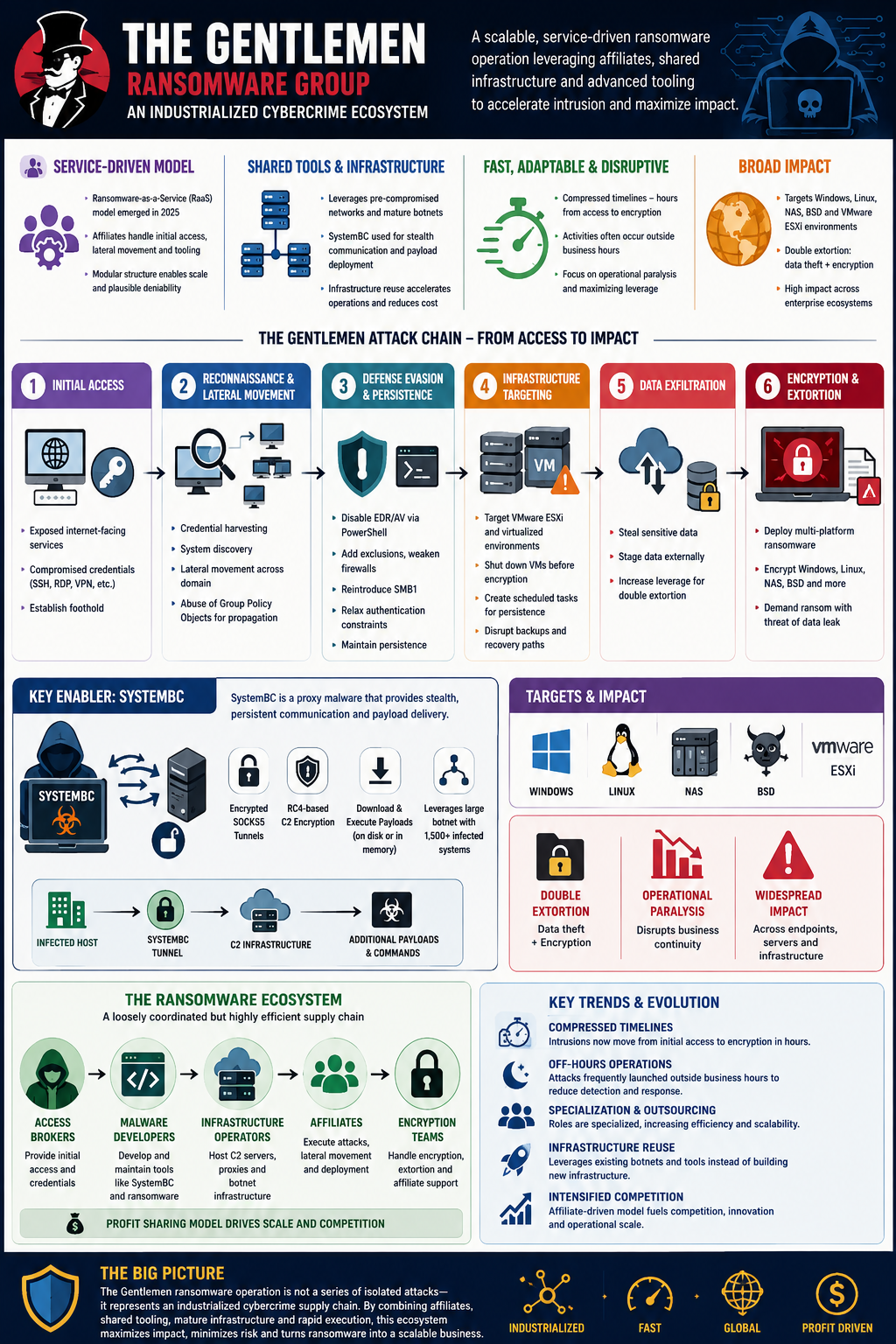
At a macro level, the activity reflects a broader evolution in ransomware operations. The ecosystem is increasingly characterized by specialization, rapid execution, and infrastructure reuse. Attack timelines have compressed significantly, with some intrusions progressing from initial access to encryption within hours. Operations are frequently timed outside business hours to reduce defensive response capacity, and affiliate-driven models have intensified competition and operational scale.
Overall, the observed pattern is less indicative of isolated ransomware incidents and more representative of an industrialized cybercrime supply chain, where access brokers, malware developers, infrastructure operators, and encryption teams function as loosely coordinated but highly efficient components of a single economic system.
Victimology
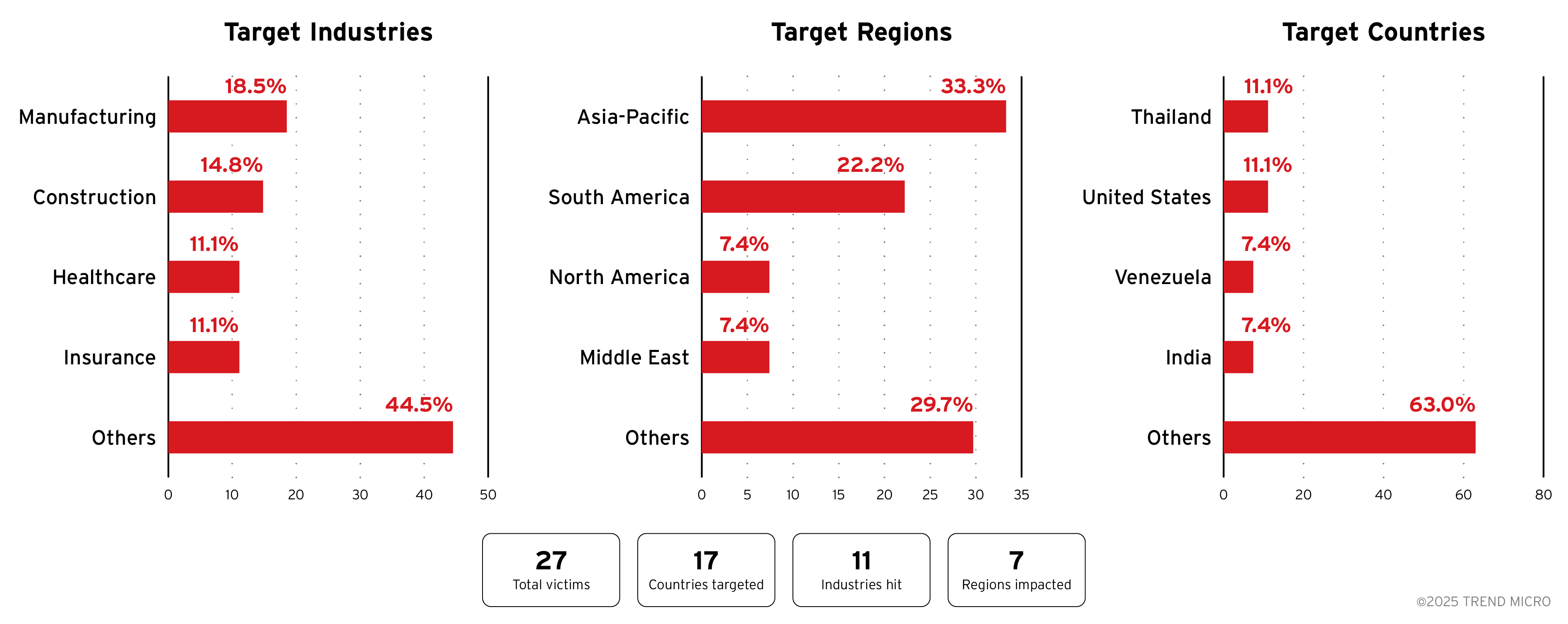
The Gentlemen ransomware group has been targeting organizations across multiple sectors, with a particular focus on the Asia-Pacific region. The manufacturing industry has been the hardest hit, followed closely by construction, healthcare, and insurance. The group’s attacks on essential services such as healthcare highlights its disregard for critical infrastructure and its potential public safety implications. Key target countries include Thailand and the United States, with a total of 17 countries affected.