The Convergence of Global Risk: Redefining Corporate Insurance in an Age of Interconnected Exposures- 166

May 20, 2026
The global corporate risk landscape is undergoing a profound structural shift, driven by the simultaneous acceleration of geopolitical instability, cyber exposure, and regulatory fragmentation. As detailed by Luke Baker, Director UK Global at Allianz Commercial, these modern threats no longer sit neatly within traditional, isolated insurance lines. For large multinational corporations, a single disruptive event can trigger a cascade of operational and financial consequences that blur historical policy definitions. Consequently, the insurance industry faces a mandate to evolve from a passive provider of capital limits into an active, integrated resilience partner. The strategic discussion is moving away from standalone, monoline policies toward integrated risk programs designed to respond to exposures that cross multiple operational and financial boundaries simultaneously.
In this rapidly changing environment, the historical role of the insurer must evolve from simply providing capital capacity to actively helping clients manage resilience and navigate operational complexity.
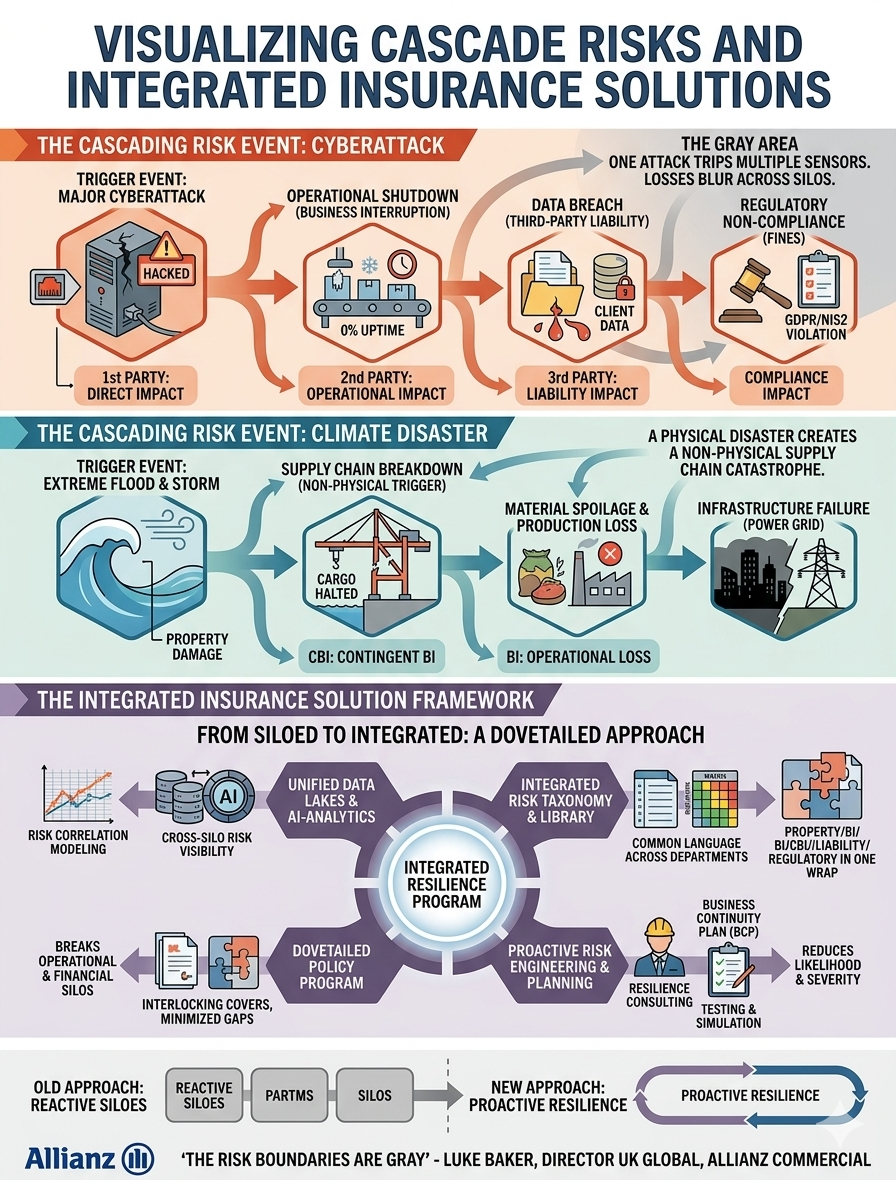
One of the most significant changes facing large corporate clients is the extent to which risks now overlap, creating what Baker terms an increasing degree of grayness in loss scenarios. In the past, property losses, business interruption, cyber exposure, and third-party liability could be managed as separate, independent exposures. Today, however, these risks regularly intersect in ways that were highly uncommon a decade ago. A single triggering event—such as a sophisticated cyberoffensive or an escalating geopolitical conflict—can trip multiple risk vectors at once, causing claims to span several areas of cover simultaneously. This convergence makes traditional product silos incredibly difficult to maintain and exposes corporate buyers to dangerous coverage gaps if their policies are not seamlessly aligned.
This blurring of risk boundaries is further compounded by macro-environmental pressures that make global risk coordination more difficult than in previous years. Geopolitical fragmentation, protectionist trade policies, and diverging regional regulations are placing unprecedented pressure on multinational insurance programs. While emerging technologies like artificial intelligence and shifting cyber threat vectors continue to command significant attention, geopolitical risk has rapidly risen to the board level as a primary area of focus for corporate leadership. Managing these overlapping operational and regulatory complexities across multiple jurisdictions requires a cohesive multinational framework, yet delivering that cohesion has become increasingly challenging for global insurers.
To survive in this new era, the insurance market must transition away from an overly siloed, monoline approach and embrace a highly integrated, dovetailed solution framework. As Baker emphasizes, the insurance products that corporations purchase must be deeply interconnected to ensure that complex claim scenarios do not fall between the cracks of traditional underwriting departments. When an organization faces a cascading crisis, it cannot afford to navigate internal insurance disputes or conflicting policy exclusions. By shifting toward holistic, dovetailed programs that provide comprehensive visibility and interlocking coverages, insurers can eliminate the friction of traditional silos and offer the proactive, unified resilience that modern multinational enterprises require to safeguard their global operations.