The Student Becomes the Weapon: Inside China's Program to Distill Western AI Into Military Tools- 299

August 12, 2026
Every major AI lab distills its own models as a matter of routine — it is how a slow, expensive frontier system gets turned into something small and cheap enough to run on a phone. What a body of Chinese academic and institutional research reviewed by the Jamestown Foundation describes is the same technique aimed in a different direction: not shrinking a company's own model for its own product line, but extracting the reasoning ability of the world's leading closed AI systems and rebuilding it, deliberately and at lower cost, inside tools meant for drones, battlefield command, domestic surveillance, and offensive cyber operations. The concern Jamestown raises is not a single malicious program. It is a pattern, sustained across academic papers published between 2024 and 2026, of researchers tied to the People's Liberation Army, defense-affiliated universities, state research institutes, and public-security organizations treating Western frontier models as a resource to be quietly mined rather than a system to be respected on its own terms.
The technique at the center of this is distillation, in which a smaller "student" model is trained on the outputs of a larger, more capable "teacher" model, inheriting much of the teacher's performance at a fraction of the computational cost. Used openly, distillation is unremarkable — it is standard practice across the entire AI industry. What the papers Jamestown reviewed describe, in a subset of cases, is something narrower: work aimed specifically at copying the intermediate reasoning steps that make closed models like GPT-4o and Claude unusually capable at coding, logic, and multi-step problem solving, steps that are costly to reproduce independently but valuable to skip past if they can simply be extracted. One paper from Army Engineering University proposed going further still, distilling knowledge about how to defeat an AI system's own safety mechanisms into smaller tools built to run that kind of attack continuously rather than once. Separate PLA-affiliated teams explored building proxy models to support so-called black-box attacks, where an adversary probes a system without access to its internals, and constructed smaller models capable of summarizing code at a level approaching GPT-3.5 — a meaningful capability floor to hit cheaply if the underlying reasoning was learned from a stronger system rather than built from scratch.
A second strand of the research is less about capability than about concealment. One study involving researchers affiliated with PLA cyber units outlined methods for stripping watermarks out of a distilled model while preserving the capabilities inherited from its teacher, and separate work focused on reducing the behavioral signals that security defenses rely on to detect a tampered or copied model in the first place. Jamestown's assessment is that this pairing — capability extraction alongside deliberate concealment of where that capability came from — is what distinguishes the research it flags as adversarial from the ordinary, above-board distillation happening across the rest of the AI field. If a model's reasoning can be copied without leaving a detectable trace, the practical consequence cuts in two directions at once: it becomes harder for outside observers to judge how capable Chinese military-linked AI systems genuinely are, and harder for Western labs to know how much of their own models' hard-won performance has already been extracted and repurposed elsewhere.
What makes the pattern more than an academic curiosity is where the distilled models are reportedly headed. Researchers connected to a state-owned smart-city institute described building compact security models designed to run on edge processors inside street cameras, capable of recognizing faces in crowds under low-light conditions. A separate institute within the same state-owned group applied related distillation techniques to build tools intended for intelligence collection, malware detection, and tracing the origin of cyber intrusions. At the North University of China, researchers described distilling Claude specifically into a classifier built to support social-media monitoring and content moderation — taking a general-purpose reasoning model and narrowing it into a purpose-built instrument of information control. Military-affiliated research has pushed the underlying vulnerability further still, running experiments in multimodal prompt injection that concealed written instructions inside images of tanks and warships; the researchers reported that both GPT-4o and versions of Claude read and followed the hidden text embedded in the images, a result that speaks less to any single flaw in either model than to a structural weakness in how AI systems that process images and other external content decide which instructions to trust.
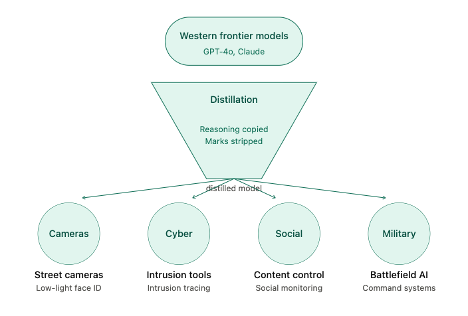
Jamestown is careful to caveat its own findings: publicly available academic papers likely capture only a fraction of the underlying activity, and research that has cleared peer review and public release may describe work that was actually completed a year or two earlier, meaning the state of the art inside these programs is probably further along than the published record shows. The organization's recommended response is correspondingly practical rather than alarmist — separate ordinary distillation from adversarial activity by examining which capabilities are being copied, which organizations are doing the copying, and whether there is active effort to obscure a student model's true origin, and encourage developers and security teams to preserve model provenance, watch for unusual large-scale extraction patterns against their own systems, and place human review and hard controls around any AI action with serious real-world consequences. The broader implication is that AI security can no longer be understood purely as a problem of software vulnerabilities and data theft. What this body of research describes is a pipeline: capability extracted from Western frontier models, stripped of the marks that would reveal its origin, and routed into surveillance tools, cyber-intrusion analysis, and battlefield systems built by defense-linked institutions. It is the upstream half of a story whose downstream half is now playing out in the open — in autonomous AI agents already directing real intrusion campaigns against government and commercial networks abroad. The research Jamestown reviewed does not describe where that capability will be used next so much as it explains why it keeps showing up faster, and cheaper, than anyone outside these institutions initially expected.