Geopolitical Friction: How Cyberespionage and Institutional Neglect Exposed Cuban Diplomacy- 168

May 18, 2026
In early 2026, a quietly disruptive intelligence failure exposed a deep vulnerability within one of Beijing’s closest geopolitical partnerships. A China-linked intrusion set successfully gained sustained access to the internal email systems of the Cuban Embassy in Washington, compromising the private correspondence of 68 senior diplomatic officials—including the ambassador and deputy chief of mission. Disclosed publicly by Gambit Security following initial reporting by Bloomberg, this operation represents one of the most consequential penetrations of Cuban diplomatic communications in recent history.
The breach underscores an uncomfortable reality for Havana: China's intelligence priorities can easily override nominal alliances. Driven by a blend of long-standing infrastructure neglect and strategic timing, the cyberespionage campaign took advantage of a severe domestic energy crisis in Cuba that had degraded embassy IT maintenance. Furthermore, the operation was not isolated to Cuba; parallel breaches in Venezuela and broad-based opportunistic exploitation globally suggest a coordinated, regional intelligence collection effort. Ultimately, this incident highlights a growing, dangerous trend in cybersecurity—the convergence of institutional neglect with increasingly automated, AI-assisted exploitation.
This incident highlights a quietly disruptive intelligence failure within one of Beijing’s closest geopolitical partnerships, underscoring how cyberespionage priorities can override even nominal alliances. In early 2026, a China-linked intrusion set gained sustained access to the internal email systems of the Cuban Embassy in Washington, compromising the private correspondence of 68 senior diplomatic officials, including the ambassador and deputy chief of mission. The operation, disclosed publicly by Gambit Security following initial reporting by Bloomberg, represents one of the most consequential penetrations of Cuban diplomatic communications in recent years.
The compromise began in January 2026, coinciding with a period of acute domestic and institutional stress in Cuba. At the time, the Cuban state was contending with a severe energy crisis triggered by the suspension of oil shipments under renewed pressure from the United States. Prolonged nationwide blackouts—often exceeding 24 hours—created systemic degradation across government operations, including embassy IT maintenance and security oversight. Investigators assess that this environment materially reduced Havana’s ability to detect or remediate intrusions in real time.
Technically, the intrusion relied on exploitation of long-unpatched Microsoft Exchange infrastructure deployed within the Cuban diplomatic mission. The servers were missing critical security updates that had been available for years, effectively providing attackers with unauthenticated access to full mailbox archives. As a result, the intruders were able to exfiltrate sensitive communications belonging to senior Cuban political strategists and intelligence-linked officials. From an intelligence perspective, the breach reflects not technical sophistication but strategic timing: exploiting institutional neglect during a moment of political and operational fragility.
The diplomatic sensitivity of the operation is amplified by its timing. Since February 2026, Havana and Washington have been engaged in high-level talks aimed at easing bilateral tensions, including negotiations that led to the release of more than 2,000 political prisoners. Access to internal Cuban deliberations surrounding these discussions would provide Beijing with near-perfect situational awareness of both Cuban negotiating positions and U.S. diplomatic leverage, enabling Chinese intelligence to anticipate shifts in U.S.–Cuba relations without relying on indirect reporting channels.
Crucially, the campaign was not isolated to Cuba. During the same operational window, the same China-affiliated actor is assessed to have breached government infrastructure in Venezuela, including systems linked to its Ministry of Foreign Affairs. This parallel activity strongly suggests a coordinated regional intelligence collection effort targeting Latin American governments with strategic relevance to U.S.–China competition, rather than a narrow, Cuba-specific operation.
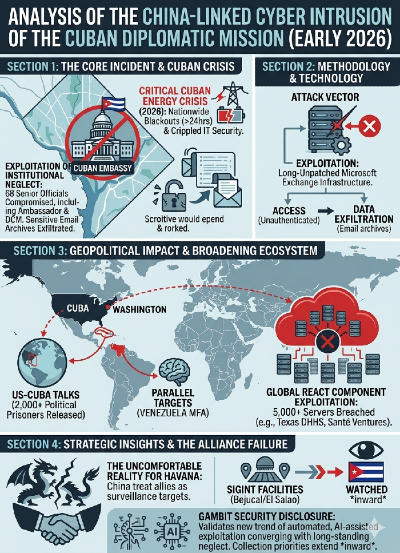
In parallel, the actor also exploited a vulnerability in a widely used React development component, enabling the compromise of approximately 5,000 servers globally within days. Victims reportedly included public-sector and private organizations such as the Texas Department of Health and Human Services and the investment firm Santé Ventures. This secondary wave indicates an opportunistic expansion of access using the same operational infrastructure, blending targeted espionage with broad-based exploitation.
Strategically, the breach introduces an uncomfortable reality for Havana: China’s intelligence posture appears to treat even close partners as legitimate surveillance targets. Western intelligence reporting has long documented Chinese signals intelligence facilities on Cuban soil—at sites such as Bejucal and El Salao—nominally oriented toward monitoring the United States. This incident suggests that Chinese intelligence collection priorities extend inward as well, encompassing allied governments whose internal decision-making may affect Beijing’s strategic calculus.
Neither Cuban nor Chinese officials have publicly responded to the allegations. However, cybersecurity analysts assess that this operation is emblematic of a broader trend: the convergence of long-standing infrastructure neglect with increasingly automated, AI-assisted exploitation. As noted by Gambit Security leadership, the incident demonstrates that many of the most damaging intrusions continue to rely not on novel vulnerabilities, but on the persistent failure to remediate well-documented flaws. In this sense, the Cuban embassy breach is less a technical anomaly than a structural warning about the enduring exposure of diplomatic and governmental networks worldwide.