The Financial Data Layer: Shadow AI, Product Integration, and a Bank That Reported Itself- 189
June 16, 2026
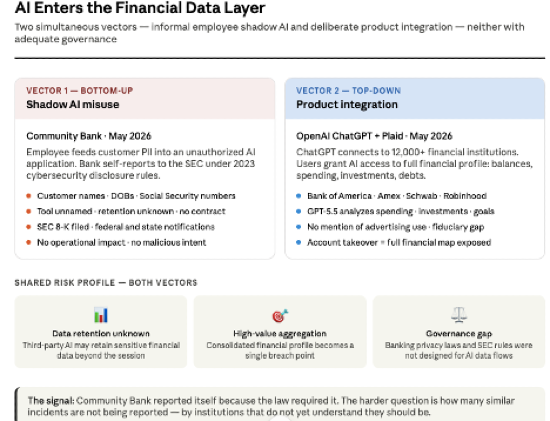
A bank employee used an AI tool they weren't supposed to. The bank caught it, reported it to the SEC, and became — probably without intending to — the first public data point in what will be a long series of mandatory disclosures about AI misuse inside regulated financial institutions. The same week, OpenAI announced that ChatGPT would now connect directly to more than 12,000 banks and brokerages through Plaid, giving a generative AI chatbot a consolidated view of users' entire financial lives. One incident is shadow AI producing a regulatory event. The other is a product designed to make the same data relationship legitimate at scale. Neither has adequate governance yet.
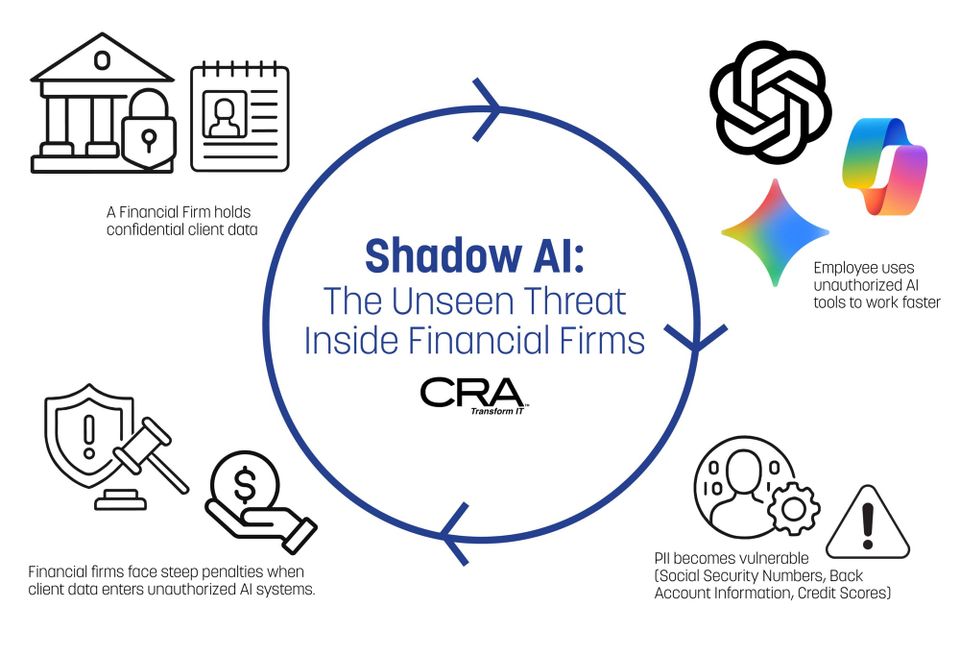
A community bank in southwestern Pennsylvania filed a disclosure with the Securities and Exchange Commission in May 2026 to report that one of its own employees had fed customer data — names, dates of birth, Social Security numbers — into an unauthorized AI application. No systems were disrupted. No customers lost account access. The bank caught the incident, reported it, and began the required regulatory notification process. What makes the filing significant is not its scale but its category: a financial institution formally disclosing to its regulator that sensitive customer data was transmitted to an AI tool outside the institution's approved systems, with unknown implications for how that data was retained, processed, or used by a third-party provider it had no contractual relationship with. Community Bank did not name the application. It did not need to. The pattern is familiar enough that the specific tool is less important than the structural condition it represents.
Shadow AI — the informal, unauthorized use of publicly available AI tools by employees handling sensitive data — has been a compliance risk in the financial sector since generative AI entered mainstream use. What the Community Bank disclosure signals is that the SEC's 2023 cybersecurity incident reporting rules are now producing mandatory regulatory transparency about AI misuse incidents that would previously have been managed internally, if they were managed at all. An employee entering customer PII into ChatGPT, Gemini, or any comparable tool outside an enterprise agreement is not, in most cases, acting maliciously. They are acting conveniently — using a tool they trust from their personal life in a professional context where the governance framework has not caught up with the technology's availability. The result is a data flow that crosses institutional boundaries in ways that trigger banking privacy laws, state notification requirements, and, as Community Bank discovered, SEC disclosure obligations.
The timing of the disclosure sits in an uncomfortable relationship with OpenAI's announcement, in the same month, of ChatGPT's new personal finance integration feature. Through a partnership with Plaid, the financial data aggregator, ChatGPT can now connect to more than 12,000 financial institutions — Bank of America, American Express, Charles Schwab, Robinhood — giving subscribers a consolidated dashboard of portfolio performance, spending patterns, subscriptions, and payment obligations, analyzed by GPT-5.5. The product is designed to do deliberately and at scale what the Community Bank employee did informally: put financial data into an AI system for analysis. The difference is consent, contractual structure, and product design. But the risk concerns raised by privacy and cybersecurity experts about the ChatGPT feature map directly onto the risk the Community Bank case demonstrates. A consolidated view of a user's financial life inside a single AI platform creates, as one security expert put it, a high-value target for account takeover attacks — a detailed map of net worth, spending habits, investment positions, and financial vulnerabilities accessible to anyone who compromises the AI account rather than the individual financial institution. The Center for Democracy and Technology's senior policy counsel Ridhi Shetty noted that OpenAI's announcement does not address whether the financial data could eventually be used to support advertising or commercial targeting, and that the chatbot operates without the professional obligations that licensed financial advisors carry toward client privacy and fiduciary duty.
The two developments are not in direct relationship with each other. But they describe the same underlying condition from opposite directions: AI is entering the financial data layer from the bottom, through informal employee behaviour that bypasses institutional controls, and from the top, through product integrations designed to make that data relationship legitimate and scalable. Neither direction has adequate governance architecture yet. Regulators are receiving disclosures about incidents they do not yet have clear frameworks to evaluate. Users are being asked to weigh convenience against privacy risks in a product context where the long-term data use terms are not fully specified. Financial institutions are updating their acceptable use policies in response to incident reports rather than in anticipation of the AI tools their employees are already using. Community Bank reported itself because the law required it. The harder question is how many similar incidents have not been reported, because the institutions involved did not yet understand that they should be.