Humanitarian Cover: Operation HumanitarianBait and the Surveillance Campaign Nobody Has Attributed- 190
June 15, 2026
A humanitarian aid application form, written in Russian, realistic enough that someone waiting for assistance would read it carefully. That is exactly what the victim does — while, in the background, a surveillance platform installs itself, maps their browser credentials, starts logging their keystrokes, extracts their Telegram sessions, and opens a silent remote desktop connection to an attacker who is watching everything. Operation HumanitarianBait has been active since at least May 2026, targeting Russian speakers with Russian-language lures in a campaign that Cyble's researchers cannot attribute — and that attribution gap is the most analytically significant thing about it. Someone is running precision surveillance against Russian-speaking individuals using their own humanitarian bureaucracy as bait. The question of who is left deliberately open.
Someone is targeting Russian speakers with Russian-language humanitarian aid documents. The lure — a realistic PDF application form titled "O predostavlenii gumanitarnoy pomoshchi," meaning a formal request for the provision of humanitarian assistance — is convincing enough to hold a victim's attention while a surveillance platform installs itself silently in the background. Cyble Research and Intelligence Labs, which documented the campaign in May 2026, cannot attribute it. That inconclusive attribution is not a gap in the analysis. It is the most analytically significant thing about the operation.
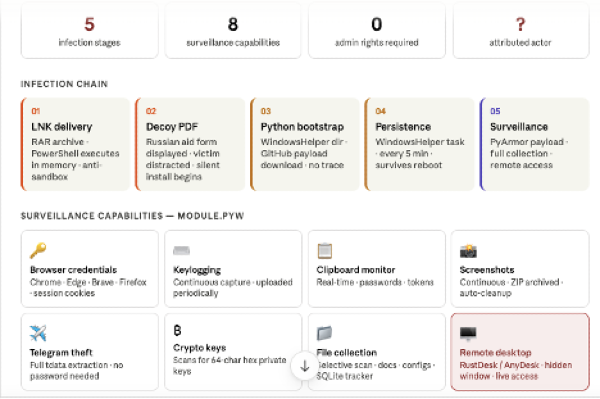
The infection chain is technically disciplined. Phishing emails deliver a RAR archive containing a malicious LNK shortcut file that is significantly larger than a normal Windows shortcut because it carries obfuscated code embedded within its body. PowerShell reads that code from a specific offset and executes it in memory — a deliberate anti-sandbox technique, since the malware will not execute if the original file is absent from disk, presenting as entirely clean to automated scanning tools that separate the file from its execution environment. Once triggered, the malware downloads the decoy PDF from the attacker's command-and-control server and displays it to the victim. While the victim reads a form about humanitarian aid, a self-contained Python environment is being constructed in the background inside a folder named WindowsHelper — chosen to mimic a legitimate Windows system component — without requiring administrative privileges. The payload is downloaded from a dedicated GitHub account using GitHub Releases rather than repository code, a deliberate choice since release artifacts receive less automated scrutiny than committed code, and the same account hosts clean legitimate files alongside the malicious payload, making the entire download chain appear as normal software traffic to network monitoring tools.
The payload, module.pyw, is obfuscated with PyArmor v9.2 Pro — a commercial-grade tool that resists static analysis and decompilation — and operates as a full-spectrum surveillance platform once deployed. It harvests browser credentials and session cookies across every major Chromium-based browser and Firefox, using AES-GCM decryption to handle Chrome's newer encryption schemes. It captures keystrokes continuously, monitors clipboard contents in real time, takes periodic desktop screenshots, extracts Telegram session data giving the attacker full access to the victim's Telegram account without a password, scans user directories for 64-character hexadecimal strings consistent with cryptocurrency private keys, and silently installs RustDesk or AnyDesk for persistent interactive remote desktop access — hiding the application window from the victim and transmitting connection credentials to the C2 server. Persistence is established through a Windows Scheduled Task that relaunches the implant at short recurring intervals, surviving system reboots. The payload on GitHub is updated frequently, with its SHA-256 hash changing across versions, confirming the campaign is active and in continuous development.
The targeting profile is what resists clean interpretation. The lures are written in Russian. The humanitarian aid form references a real administrative process that would be recognizable and credible to someone involved in aid distribution, civil administration, or government functions in a Russian-speaking context. The campaign is documented as active as of May 2026 — deep into the third year of a conflict whose humanitarian consequences have created exactly the kind of documentary ecosystem this campaign exploits. Cyble assesses the intended targets as Russian-speaking individuals or entities, without speculating further. The population of actors who might want persistent surveillance access to Russian-speaking aid workers, civil administrators, or conflict-adjacent government personnel is not small, and the humanitarian lure is effective precisely because the context in which it operates is real.
The technical markers — PyArmor Pro licensing, a custom Flask C2 panel, correct handling of Python's embedded distribution requirements, the anti-sandbox LNK technique — indicate a technically skilled operator investing in operational longevity rather than a quick credential-harvesting campaign. This is surveillance infrastructure built to persist. Whether it is being operated in a geopolitical intelligence context or a financially motivated one, and on whose behalf, remains an open question that the artifacts alone cannot resolve.