Dark Caracal Puts a Smart Contract to Work: Blockchain as a Fallback Channel for an Old Lebanese Espionage Toolkit- 336

September 1, 2026
Dark Caracal has been running intelligence-gathering operations out of Lebanon's General Directorate of General Security since at least 2012, long enough that its playbook — phishing lures, trojanized mobile apps, the commercially available Bandook remote-access trojan — has become a known quantity to researchers who track it. What makes its latest campaign worth attention isn't a change in who it targets or how it gets in the door; both remain familiar. It's a new malware framework, tracked as GoCaracal, whose most capable variant can fall back on an Ethereum smart contract to recover its command-and-control address if its primary infrastructure goes dark — a resilience mechanism that borrows directly from how cryptocurrency systems are designed to survive precisely the kind of takedown effort that normally disrupts espionage operations like this one.
Arctic Wolf Labs identified GoCaracal while investigating a June 2026 intrusion at a communications organization in Venezuela, which it links to Dark Caracal with medium confidence. The delivery mechanism is one the group has used before: phishing emails carrying financial or tax-themed lures drop weaponized SVG attachments that redirect victims, through a URL shortener, to an attacker-controlled staging site — in this case getpdfdigital[.]cloud — which serves a 7-Zip archive containing a lightweight Go-based implant. That initial foothold isn't the objective; it pulls in a Delphi loader that delivers both an updated build of Bandook and a more capable, extended version of GoCaracal. The two GoCaracal profiles divide the labor cleanly. The lightweight build handles host profiling, encrypted command-and-control, a remote shell, and payload download and execution — enough to establish and confirm access. The extended build is where the actual intelligence-gathering happens: file management, browser credential and cookie theft, keylogging, targeted file search, a WebRTC-based remote desktop capability, hidden browser sessions, a SOCKS5 proxy, and persistence mechanisms designed to survive reboots and routine remediation.
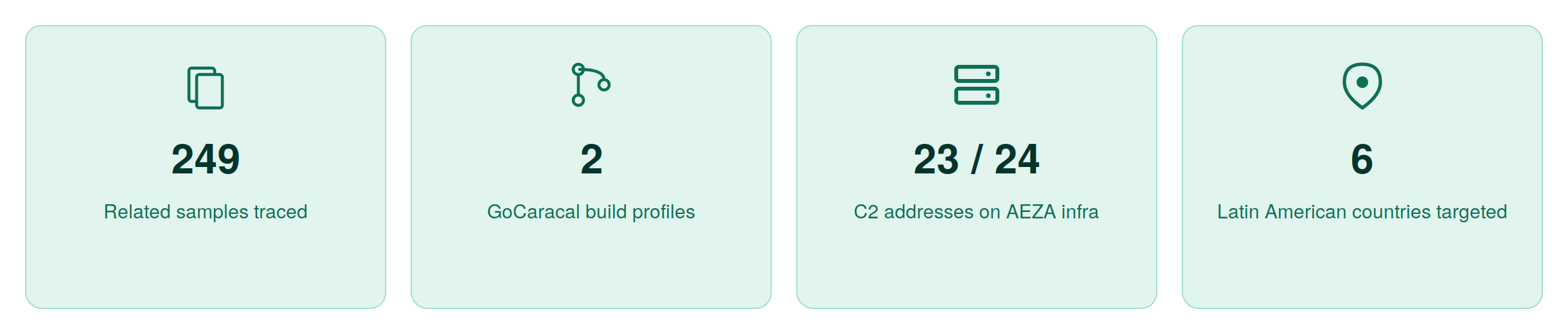
Arctic Wolf traced 249 related samples between January and July 2026 and reconstructed a clear development arc: GoCaracal began as a narrow access implant, became modular, then accumulated broad post-compromise capability, and only in its most recent iteration gained the Ethereum fallback — all while both build profiles stayed in active use rather than one superseding the other. That fallback is the detail that separates this from a routine toolkit refresh. The extended GoCaracal configuration can carry an Ethereum smart-contract address alongside its conventional host-and-port values; if the malware fails to reach its primary command server after repeated attempts, it queries a public Ethereum JSON-RPC endpoint, reads a value stored in the contract, and updates its in-memory C2 address before retrying. Arctic Wolf identified the specific contract — a custom Solidity contract named BulletproofC2 — that stores a changeable address modifiable only by its owner. Transaction records show the operators actually changed that stored address to a live public IP, and the same wallet had earlier deployed near-identical contracts on Ethereum's Sepolia test network, cycling through both public and private IP values, before some of that activity moved to the mainnet. Read together, that sequence indicates deliberate testing and operational use of the mechanism, not dormant code left unused in the malware.
The practical effect is that Dark Caracal's operators can now relocate their command infrastructure without pushing a new malware build to already-compromised hosts — they simply update a value in a smart contract that a public blockchain, not a server the group controls, makes available to the implant. Because that lookup travels through a decentralized, publicly auditable network rather than a domain or IP that defenders can seize or sinkhole, it complicates one of the more reliable disruption tactics against espionage infrastructure: taking down the command channel. Ethereum itself doesn't carry the actual command traffic — it's strictly a backup pointer to wherever the real C2 server currently sits — but that's precisely what makes the design efficient rather than gimmicky.
The rest of the campaign shows the same instinct toward compartmentalization rather than wholesale reinvention. The June 2026 Bandook sample carries deliberate anti-analysis tweaks — sequential command identifiers that once ran predictably from @0001 through @0136 have been replaced with randomized strings, and plugin export names that used to follow recognizable conventions are now generic and obfuscated, changes that preserve functionality while degrading signature-based detection built around the malware's older naming patterns. Arctic Wolf identified seven related Spanish-language, document-themed domains supporting the campaign's SVG delivery chain, two previously linked to Dark Caracal and one newly registered in July 2026. Infrastructure hosting is kept deliberately separate: of 24 unique GoCaracal C2 addresses identified, 23 sit on networks operated by AEZA Group, while Bandook's C2 addresses run on AlexHost, a provider with its own history of Dark Caracal association — a separation that limits how much of the operation is exposed if either hosting provider is disrupted. Geographically, the current campaign concentrates on Latin America, with artifacts and infrastructure tied to Brazil, Ecuador, Chile, Colombia, El Salvador, and Uruguay, assessed with moderate confidence as part of a broader regional footprint still being mapped.
Arctic Wolf's own framing is worth taking at face value: this looks less like Dark Caracal abandoning its established toolkit than expanding and compartmentalizing it. GoCaracal is running alongside Bandook, not replacing it, at least for now — which suggests an operation with enough resourcing and patience to build out redundant capability rather than one under pressure to consolidate. For a group whose core objective has always been persistent, undetected access rather than smash-and-grab theft, that patience is arguably the more informative signal than any individual technical feature. The blockchain fallback is a genuinely novel piece of engineering for a group this old — but it's in service of an operating model that hasn't changed at all since 2012: get in quietly, stay long, and make sure a single point of failure never ends the operation.