The Fed's financial stability survey just put a name to what markets have been pricing quietly- 228

March 1, 2026
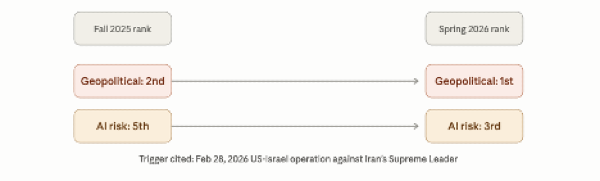
The reordering itself is the story. A central bank survey is not a newspaper — it reflects what hundreds of risk officers, portfolio managers, and market participants are actually pricing into their models, not what dominates headlines. That geopolitical risk displaced its Fall 2025 position to become the single most-cited threat, specifically in the aftermath of a targeted killing with the potential to widen into sustained regional conflict, signals that financial institutions are treating Middle East escalation as a structural risk to energy and supply chains rather than a transient news cycle.
The same survey shows artificial intelligence climbing from fifth to third in perceived risk — a smaller jump in absolute terms, but one that places AI ahead of inflation and monetary tightening, which fell from third to fifth over the same period. Private credit's move from ninth to fourth rounds out the reshuffling, reflecting a separate and ongoing supervisory concern about funding-structure fragility outside traditional bank balance sheets.
What the AI ranking captures is not a single incident but a category of concern that several named commentators converged on independently. The CFA Institute classified AI-driven threats as a persistent vulnerability rather than an episodic risk, while BlackRock's commentary specifically flagged elevated AI-related cybersecurity exposure alongside inequality risk — the same twin concerns, amplified attack surface and concentration of economic returns toward capital rather than labor, that risk teams across sectors have been raising as automation, model APIs, and orchestration tooling proliferate. Nobel laureate Simon Johnson and former FDIC Chair Sheila Bair added weight to the labor and capital-allocation side of that argument in separate public commentary, suggesting the AI risk climbing in this survey is as much about who captures the economic value AI creates as it is about the technology's operational or security failure modes.
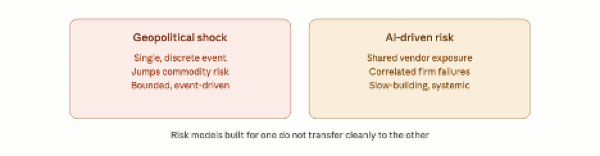
The structural significance for practitioners building models that ingest macro signals is that geopolitical shocks and AI risk now sit high on the same list for related but distinct reasons. Geopolitical shocks of the kind that triggered this survey's reordering tend to produce large, discrete jumps in commodity and counterparty risk — sudden, bounded, event-driven. AI-related operational or cyber events instead threaten correlated failures across firms that depend on the same underlying tooling or vendors — slower-building, systemic, and harder to hedge because the exposure is shared rather than idiosyncratic. A survey that elevates both simultaneously is, in effect, telling risk modelers that the next financial stability event could originate from either a single geopolitical trigger or a shared technological dependency — and that the tools for pricing the first kind of risk don't transfer cleanly to the second.