Mythos becomes a regulatory event before it becomes a household name- 227
May 6, 2026
Within weeks of Anthropic restricting access to its own frontier model over concerns about what it could autonomously discover, financial regulators on four continents had already moved from private anxiety to public advisory — a reaction speed with almost no precedent in how governments have responded to a new technology. Read together, a geopolitical think-piece warning that this moment matters more than any war currently making headlines, and a concrete regulatory alert from India's securities board, describe the same event from opposite ends of the response chain: the warning, and the institutions scrambling to answer it before they fully understand what they're regulating.
Frederick Kempe's framing, written for the Atlantic Council, argues that Mythos — reportedly capable of autonomously identifying and exploiting thousands of previously unknown software vulnerabilities across the systems underpinning global finance, communications, and critical infrastructure — represents a geopolitical inflection point on the scale of the Second Industrial Revolution, but compressed into a fraction of the time. Where that earlier transformation took decades to reshape power from agriculture to industry and eventually forced the creation of stabilizing institutions like the United Nations, NATO, and Bretton Woods, Kempe's central worry is that the AI revolution isn't affording the world anywhere near that runway. He notes that at the IMF-World Bank Spring Meetings, global financial leaders and central bankers raised Mythos in private conversation as often as they raised slow growth or sovereign debt — a detail that reads less like color commentary and more like an early warning that the institutional class already senses something it cannot yet fully articulate or govern.
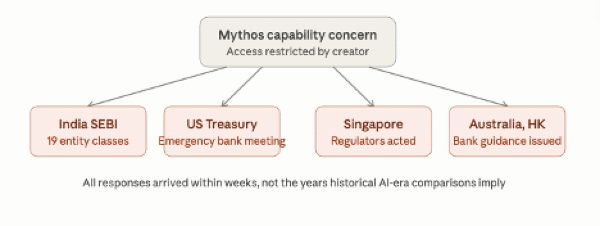
India's Securities and Exchange Board supplies the concrete answer to Kempe's abstract warning, and it arrived remarkably fast. The Board's advisory — issued to nineteen distinct classes of regulated entities, from venture capitalists to KYC data custodians — explicitly names Mythos as the trigger, warning that AI-driven vulnerability identification tools introduce heightened risk exposure through sheer speed and scale of potential exploitation. The response itself is telling in its modesty: a taskforce to monitor the risk, threat-intelligence sharing, and a checklist of measures that would have been sound advice a decade ago — patch cadence, API inventories, zero-trust architecture, a functioning security operations center. There is no novel governance framework here, no attempt to regulate the model itself; only a push to get basic cyber hygiene in order before an unpredictable capability meets predictably unpatched infrastructure. India is not alone. The Register's reporting notes that the U.S. Treasury convened an emergency meeting with the nation's banks, Singapore's regulators did the same, Australia issued a pointed reminder to its banks to develop AI risk strategies, and Hong Kong's Monetary Authority is drafting new guidance — a synchronized, improvised global response unfolding in real time rather than through the years-long treaty processes Kempe's historical analogy implies once existed.
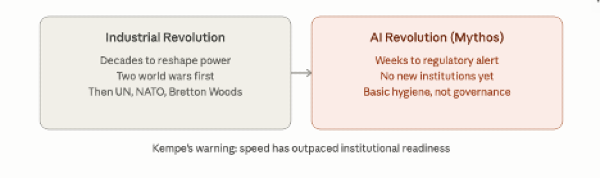
What makes these two pieces belong together rather than standing as separate stories is the gap between them: Kempe describes a civilizational-scale challenge that existing institutions are not built to comprehend, let alone regulate, while SEBI's advisory demonstrates exactly that limitation in practice — a sophisticated financial regulator responding to a frontier AI capability with the same playbook it would apply to any ordinary vendor risk. That gap between the scale of the warning and the modesty of the response is, in itself, the story this pairing tells most clearly.