Poland's Signal exodus reveals a pattern too consistent to call coincidence- 230

June 28, 2026
Poland has told its government officials to abandon Signal for a state-built alternative — not because the app's encryption failed, but because officials themselves kept failing, one phishing message at a time, to a campaign Warsaw attributes to Russian-backed APT groups. The move places Poland alongside Germany and the Netherlands in a quiet European realignment away from Signal, and it exposes an uncomfortable truth this publication has tracked across other clusters this batch: the weakest point in secure communications is rarely the cryptography, and almost always the human being holding the phone.
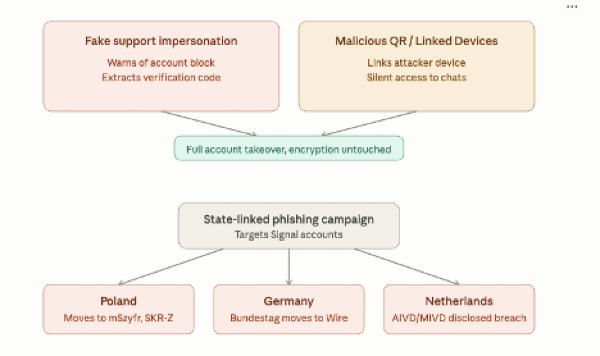
The attack pattern Poland's national CSIRTs documented is neither novel nor especially sophisticated, which is precisely what makes it effective at scale. Attackers impersonate Signal's own support staff, warning targets that their account has been blocked or flagged for suspicious activity, and using that manufactured urgency to extract verification codes or PINs — credentials that hand over full account control without ever touching Signal's encryption itself. A second vector abuses the platform's Linked Devices feature: a malicious QR code silently connects an attacker-controlled device to the victim's account, granting quiet access to private chats, group messages, and full conversation history. Both techniques target public figures, military personnel, and government employees specifically, and Polish authorities frame the resulting exposure as a direct threat to national security rather than an ordinary privacy incident.
Poland's replacement architecture reflects a deliberate push toward full domestic control, though it carries its own contradictions. mSzyfr Messenger, developed by the Ministry of Digital Affairs alongside the National Research Institute NASK, is billed as the first secure instant messenger fully under Polish jurisdiction, handling general government communications, while a separate system, SKR-Z, is reserved for classified material up to the Restricted level. Both replace Threema, which Poland had endorsed since 2022 — though the encrypted nature of the outgoing and incoming platforms means no message history transfers between them. The sovereignty claim, however, has a gap: mSzyfr's multi-factor authentication relies on Microsoft, Google, or FreeOTP, and its own installation guidance recommends storing recovery keys in a password manager, many of which are foreign-owned or open source. A platform built to escape dependence on U.S.-based infrastructure still leans on U.S. megacorps for its authentication layer — an irony Poland's own FAQ documentation does not address.
Poland is not acting in isolation, and that pattern matters more than any single national decision. Germany's Bundestag has directed lawmakers toward Wire following its own phishing incidents, while Dutch intelligence agencies AIVD and MIVD disclosed a large-scale campaign against their government officials with some compromises succeeding, describing likely Russian access to sensitive information affecting both officials and journalists. The FBI, CISA, and Germany's federal information security office have each issued near-identical warnings, suggesting Western governments are converging independently on the same diagnosis: state-backed actors have learned that targeting the user is more reliable than attacking the protocol. Signal has responded with in-app warnings designed to help users spot impostors, but for governments operating under sustained state-level pressure, that mitigation is being judged insufficient — even though moving to a domestically controlled platform trades the broad testing and auditing of an established protocol for the narrower assurance of national oversight. The argument over which trade-off is wiser is likely to keep spreading to other capitals facing the same adversary and the same vulnerability: not the app, but the person using it.