WannaCry at nine years: the day a stolen NSA tool became a lesson in negligence- 231

May 12, 2026
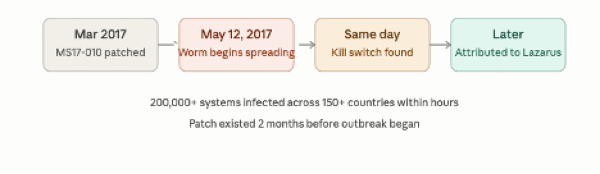
Nine years on, WannaCry remains the starkest illustration of a principle this publication returns to often: the most devastating cyberattacks rarely require novel technique, only the convergence of a known flaw, a leaked weapon, and an unpatched world. On May 12, 2017, a piece of ransomware built from a stolen NSA exploit infected more than 200,000 systems across 150 countries within hours — not because its cryptography was innovative, but because Microsoft had shipped the fix two months earlier and much of the world simply hadn't installed it.
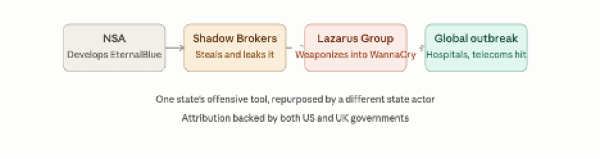
The exploit at WannaCry's core, EternalBlue, targeted a flaw in the SMBv1 protocol underlying Windows file sharing, tracked as CVE-2017-0144, allowing remote code execution without any authentication. Microsoft had patched the vulnerability in March 2017 via update MS17-010 — a full two months before the outbreak. What made the exploit dangerous was its provenance: EternalBlue was not a criminal discovery but an offensive tool developed by the National Security Agency, later stolen and published by the hacker group known as Shadow Brokers. That lineage transformed WannaCry from an ordinary ransomware campaign into something closer to a worm, capable of scanning networks and propagating autonomously between vulnerable machines with no phishing email or human interaction required — a mechanism that let it outrun conventional ransomware by orders of magnitude in both speed and reach.
The global footprint of the outbreak reflected exactly where unpatched Windows systems, particularly aging Windows XP installations, remained most concentrated: Spain, the UK, the US, China, Portugal, Vietnam, Russia, and Ukraine bore the heaviest impact, with British hospital IT systems and Spanish telecommunications networks among the most visibly disrupted. Italy's response was handled by CNAIPIC, the cybercrime operations center of the Polizia Postale, one node in what became a genuinely international incident-response effort. The ransom demand itself was almost incidental to the story — roughly $300 in Bitcoin, escalating over time to pressure faster payment — since the attack's real damage came from operational disruption to critical services rather than the extortion economics behind it.
WannaCry's spread was ultimately slowed not by patching or law enforcement action but by an accident of code: security researcher Marcus Hutchins, working under the handle MalwareTech, noticed the malware attempting to connect to an unregistered domain before executing its payload. Registering that domain activated what turned out to be a kill switch — likely built as an anti-analysis technique to detect sandboxed environments, but functioning instead as an inadvertent global off-switch that measurably slowed the worm's propagation. Subsequent investigation attributed the attack to North Korea's Lazarus Group, an assessment later backed by both U.S. and U.K. governments — turning what began as a technical postmortem into a demonstration of how intelligence-grade cyber weapons, once they escape the custody of the state that built them, can be repurposed by an entirely different state actor for criminal or hybrid ends.
The lessons WannaCry forced onto the industry remain the same ones this publication has watched recur in nearly every subsequent critical-infrastructure incident: patch management failures translate directly into systemic risk regardless of how long a fix has been publicly available, network segmentation failures let a single point of entry cascade into an organization-wide outage, and international cooperation in incident response measurably limits damage when it happens fast enough. What WannaCry added uniquely to that list was a harder geopolitical question that has never been fully resolved — what happens when a state's own offensive cyber arsenal is stolen and turned back against the world, and who bears responsibility when it is.