Platform Down, Market Open: The Crimenetwork Lesson in Enforcement Durability- 176
May 30, 2026
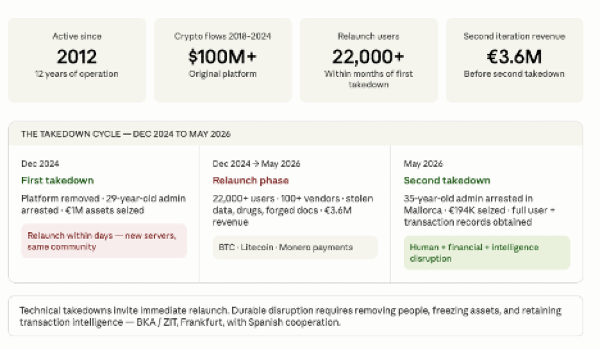
German authorities took down the largest German-speaking criminal marketplace in December 2024. Within days, it was back. Same community, new servers, same economy — as if the operation had never happened. Six months later, with 22,000 users and €3.6 million in fresh revenue, it was taken down again. This time the administrator was arrested in Mallorca. The difference between the two operations is the difference between removing infrastructure and removing people — and it is the most important lesson in cybercrime enforcement that the Crimenetwork case has to offer.
In December 2024, German authorities dismantled Crimenetwork — by their own description the largest German-speaking criminal marketplace, active since 2012, through which more than $100 million in cryptocurrency had flowed between 2018 and 2024 alone. A 29-year-old suspected administrator was arrested, roughly €1 million in assets seized, and the platform taken offline. Within days, a successor appeared on new infrastructure, with the same criminal community migrating to it. By May 2026, the relaunched Crimenetwork had accumulated more than 22,000 registered users, over a hundred active vendors, and revenues exceeding €3.6 million — all before German authorities, working with Spanish partners, shut it down a second time and arrested a 35-year-old suspected administrator in Mallorca.
The six-month interval between the first takedown and the second is the analytically significant figure. It is not the speed of the relaunch that matters — criminal marketplaces have demonstrated repeatedly that new infrastructure can be stood up in days — but the fact that the second operation was structurally different from the first. Where the December 2024 action removed a platform, the May 2026 action removed a person, seized €194,000 in assets connected to the marketplace's operation, and obtained extensive user and transaction records now being analyzed to identify vendors, buyers, and support actors who remained active across both iterations.
A marketplace is not merely software. It is a community held together by administrators who manage disputes, payment systems that handle cryptocurrency escrow, trust mechanisms that allow strangers to transact, and a stable enough environment that sellers invest in reputation and buyers return. Technical infrastructure is the cheapest component of that system to replace — new servers, new domains, new onion addresses. The human and financial architecture behind a functioning marketplace is considerably harder to reconstitute under sustained investigative pressure, particularly when investigators now hold the transaction history of both iterations and can work outward through the network of participants.
The Crimenetwork case sits within a broader pattern of German law enforcement activity against cybercrime infrastructure — the BKA and ZIT have become among the most operationally effective agencies in Europe at darknet marketplace disruption, applying a consistent methodology of following cryptocurrency flows, identifying administrators, and working with foreign partners to reach suspects who believed offshore presence provided protection. The Mallorca arrest follows the same logic as a Finnish airport detention of a Scattered Spider member: geography is no longer the sanctuary it once appeared.
The lesson Crimenetwork offers to both law enforcement and the criminal ecosystem it targets is the same: technical takedowns without human consequence invite immediate relaunch. The cost of disruption rises only when investigators remove people, freeze assets, and retain the intelligence necessary to keep pressure on the network that rebuilt. The first Crimenetwork takedown was a demonstration of capability. The second may be the beginning of actual disruption.