Inside the Machine: What The Gentlemen Ransomware Leak Reveals- 177
May 30, 2026
Ransomware groups rarely find themselves on the receiving end of their own methodology. In early May 2026, The Gentlemen did. A breach of their hosting infrastructure exposed 44 megabytes of internal data — chat logs, affiliate rosters, ransom negotiations, tooling inventories — that collectively constitute one of the most detailed intelligence windows into a functioning criminal enterprise available to date. What the leak reveals is less about malware and more about management: how a modern ransomware operation recruits, prices, delegates, and thinks.
The Gentlemen launched around mid-2025, founded by a Russian-speaking operator known across forums as hastalamuerte and zeta88. Before building his own operation, hastalamuerte ran an affiliate crew under the Qilin ransomware program. The split came publicly in July 2025, when he filed an arbitration complaint on the RAMP underground forum accusing Qilin's operators of withholding roughly $48,000 in unpaid commission from a corporate negotiation. The complaint was the visible trigger, but the leaked data tells a different story: the earliest known Gentlemen ransomware sample was uploaded to VirusTotal on July 17, five days before the arbitration post went live. hastalamuerte was building his own operation while still formally affiliated with Qilin. The dispute was an exit, not a cause.
What the internal chats reveal above all is organizational discipline. The Gentlemen is not a loose collective of hackers but a structured operation with defined roles, internal accountability, and a clear division of labour. At the centre, zeta88 functions simultaneously as administrator, developer, and active operator — the leaked logs show him managing affiliate payouts, assigning targets, purchasing hardware for under-resourced members, and still personally participating in encryption events, posting messages like "I'm locking" into active operations. Around him is a stable of operators with distinct responsibilities: one handles large-scale scanning of vulnerable internet-facing devices; another owns dedicated credential-testing hardware; a third develops custom browser data extraction tools; a fourth wrote and distributed an internal tradecraft guide covering post-compromise techniques and how to avoid detection. Sensitive communications happen over encrypted channels rather than the main platform. The ransomware source code and control panel are never distributed to affiliates — only controlled access through the panel is granted, limiting the damage any single insider could do.
The group's approach to victim selection and ransom pricing is where the organizational sophistication is most visible. The Gentlemen maintain a live dashboard tracking thousands of internet-facing security appliances — reachable or not, with direct login links — and run credential testing on dedicated hardware the moment valid access is confirmed. Once a target is identified as viable, the group cross-references it against commercial business intelligence databases and calibrates their ransom demand to match what they believe the victim's cyber insurance policy will cover. In a documented negotiation, an initial demand of $250,000 settled at $190,000 — a discount structured to keep the victim just below their insurance ceiling, maximizing the probability of payment without triggering a claim review that might complicate the process. The group offers affiliates a 90/10 revenue split — 90 percent to the operator who conducts the attack, 10 percent to the group — deliberately generous to attract experienced operators away from competitor programs.
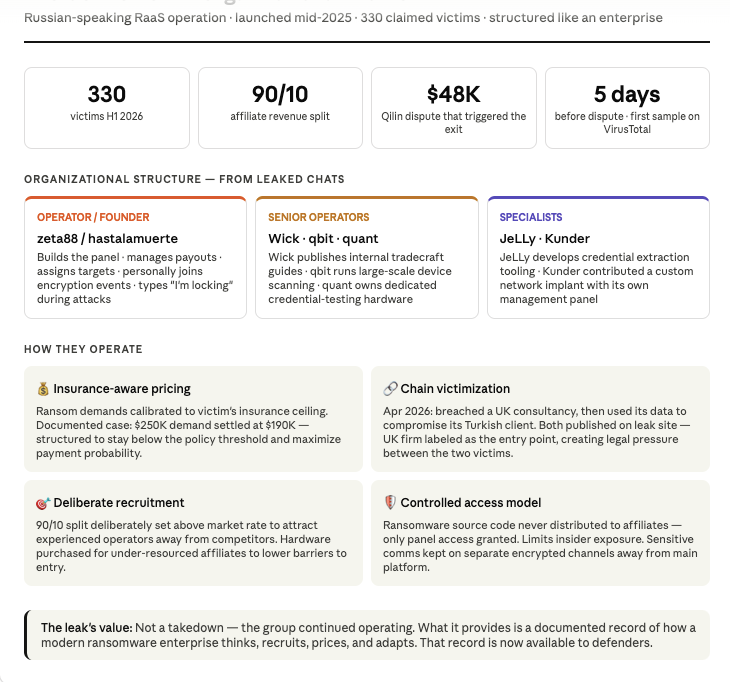
Perhaps the most operationally sophisticated element of the leak is a case from April 2026. The Gentlemen breached a UK software consultancy, then used the access and documentation found inside to compromise one of that consultancy's own clients in Turkey. Both organizations were published on the leak site, with the UK firm explicitly labeled as the entry point for the Turkish attack — a deliberate pressure tactic designed to create legal and reputational conflict between victim and sub-victim, increasing the probability that at least one would pay to contain the fallout.
The breach that produced this intelligence did not stop The Gentlemen. The operator responded with a dismissive tone and a list of planned infrastructure changes. The affiliates, the scanning infrastructure, and the access pipelines do not disappear because internal chats became public. What the leak provides is something rarer than a takedown: a documented record of how a modern ransomware operation actually works — how it recruits, prices, delegates, and adapts. That record is now available to defenders, and it reads less like a criminal investigation file than like a case study in organizational design.