The Authentication Trap: How Device Code Phishing Became the Credential Theft of Choice- 178
June 8, 2026
Multifactor authentication was supposed to make credential phishing obsolete. It did not. It made credential phishers more creative
Multifactor authentication was supposed to make credential phishing obsolete. It did not. It made credential phishers more creative. Device code phishing — a technique that exploits Microsoft's own legitimate authentication flow to capture valid session tokens without ever touching a password — has gone from a specialist red team method to a commodity criminal service in under twelve months, and Proofpoint's research from spring 2026 documents both the speed of that transition and its structural causes.
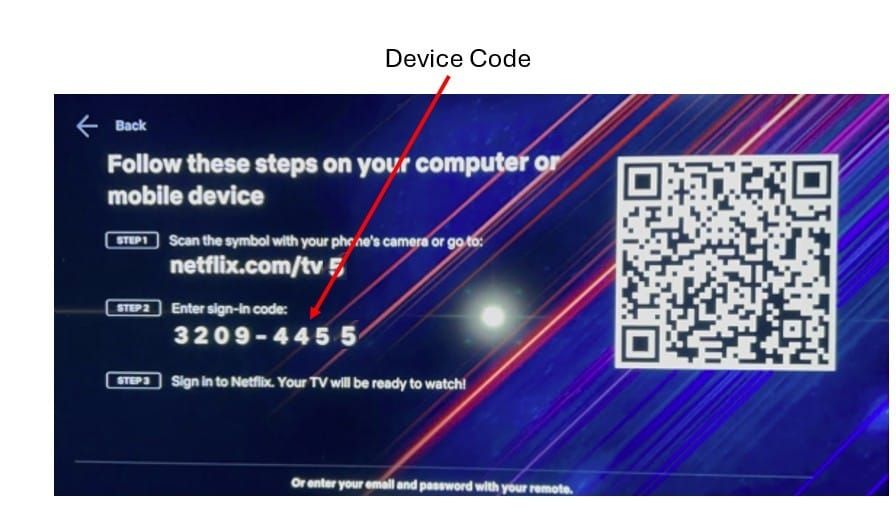
The technique itself exploits the OAuth 2.0 device authorization grant flow, a mechanism designed to allow devices without browsers — smart TVs, printers, IoT hardware — to authenticate against enterprise accounts by displaying a short code that the user enters at Microsoft's own portal. The attack inverts this: the criminal generates a device code and delivers it to a victim through a phishing email, a PDF attachment, or a QR code. The victim, directed to what appears to be a legitimate authentication page, enters the code at the real Microsoft portal, microsoft.com/devicelogin. The token that Microsoft generates upon successful entry goes to the attacker rather than a legitimate device. MFA has been satisfied. The account is compromised. The victim completed every step of what looked like a normal login.
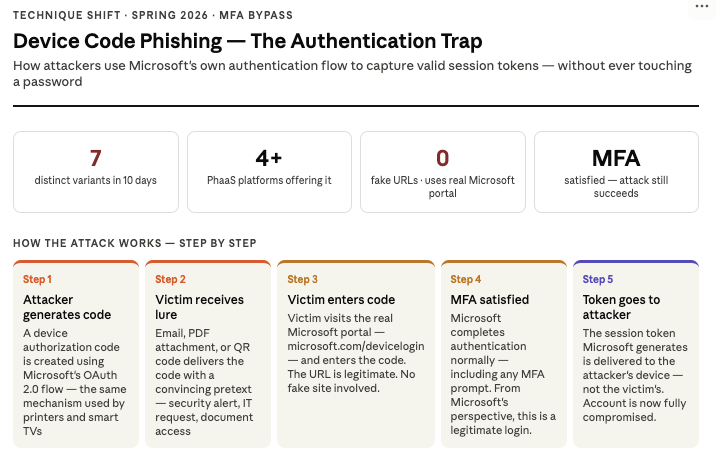
Until fall 2025, this technique required enough technical fluency that its use was effectively self-limiting. The publication of criminal device code phishing toolkits in that window changed the calculus. EvilTokens, first advertised on Telegram in February 2026, is assessed by Proofpoint as having been built and maintained using AI vibe coding techniques — generated, refined, and packaged into a PhaaS offering that handles landing page creation, on-demand code generation, and token capture as a managed service. The on-demand code generation is the key innovation. Earlier implementations generated codes in advance and sent them to victims directly, imposing a fifteen-minute expiration window that left the attacker at the mercy of the victim's email habits. Current implementations generate the code dynamically when the victim clicks the initial link — the expiration clock starts only when the attack chain begins, removing the time pressure that previously allowed distracted or cautious targets to escape by simply waiting.
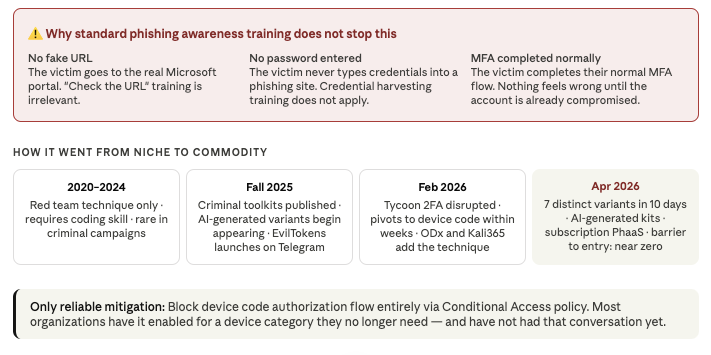
The proliferation that followed was rapid enough to be documented in days rather than months. In a ten-day window in April 2026, Proofpoint researchers identified seven distinct device code phishing variants — different API endpoints, different HTML headers, functionally identical attack chains. The variants proliferated through two mechanisms simultaneously: criminal operators purchasing PhaaS subscriptions from EvilTokens, ODx, Kali365, and ARTokens, and independent operators using AI tools to generate near-identical kits from scratch without purchasing anything. Proofpoint notes it is unclear whether these operators are copying EvilTokens or independently generating similar kits through similar AI prompts — and that both are likely occurring simultaneously, which is itself the diagnostic signal. When a technique is simple enough that AI generation produces equivalent outputs regardless of whether the prompt was written by the original developer or a copycat, the barrier to entry has effectively reached zero.
The ecosystem churn is visible in the major PhaaS platforms' own trajectories. Tycoon 2FA, one of the most established adversary-in-the-middle phishing services, was significantly disrupted in February 2026. Within weeks, its operator had pivoted to device code phishing as a primary offering, adding device code capabilities to the same platform that previously specialized in AiTM techniques — a supplier responding to market signals faster than most legitimate software companies would. ODx, tracked also as Storm-1167 and FlowerStorm and currently one of the most widely used AiTM kits, added device code capabilities through integration with the Kali365 platform, offering customers both techniques through a single service. The boundaries between what were once distinct attack categories are dissolving at the platform level.
The actor TA4903 illustrates what this looks like operationally. Previously known for business email compromise and government entity impersonation campaigns, TA4903 transitioned to device code phishing almost exclusively by March 2026. April campaigns showed the group sending salary notification emails with PDF attachments containing QR codes that routed through Cloudflare Workers to custom device code landing pages — and in several instances, sending those PDFs with entirely blank email bodies, suggesting automated campaign generation where the social engineering component was either forgotten or deprioritized. The blank lures are an operational failure, but they are an operationally revealing one: at sufficient scale and automation, even sloppy campaigns find victims.
The defensive implication is structurally uncomfortable. Device code phishing succeeds because it uses Microsoft's own authentication infrastructure as its delivery mechanism. Users are not entering credentials on a fake site. They are entering a code on the real Microsoft portal, completing a real authentication flow that generates a real token. Traditional phishing awareness training — check the URL, look for misspellings, verify the sender — does not address this attack because none of those signals are present. The URL is legitimate. The portal is real. The code was provided by an attacker. Blocking device code flow entirely through Conditional Access policy is the most direct mitigation, but it requires organizations to first recognize that they probably do not need a mechanism designed for printerless devices to be enabled for their entire workforce. Most have not had that conversation yet.