North Korea's Two-Tier Crypto War: Precision Heists and Industrial Harvesting- 209

June 18, 2026
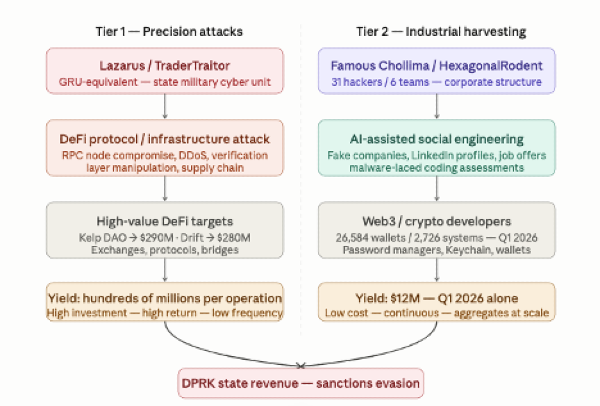
North Korea does not hack cryptocurrency platforms for profit in the way criminal groups do — opportunistically, in pursuit of whatever yield a given target offers. It does so as a matter of state fiscal policy. With conventional revenue streams severed by sanctions and legitimate foreign exchange access essentially eliminated, Pyongyang has constructed a parallel financial infrastructure built entirely on the systematic theft of digital assets. What two incidents from April 2026 reveal, read together, is that this infrastructure operates on two simultaneous tiers: precision state-level attacks on DeFi protocols capable of extracting hundreds of millions in a single operation, and an industrialized mass-harvesting apparatus targeting individual developers at scale, running continuously in the background. The combination is not accidental. It is a diversified revenue model designed for resilience — if one tier faces disruption, the other continues producing.
On April 18, 2026, a hacking operation attributed to Lazarus Group's TraderTraitor subunit executed what security researchers described as a new category of state-level blockchain attack — one that targeted not the core protocol but the verification infrastructure surrounding it. The target was Kelp DAO, a decentralized finance platform built on Ethereum that allows users to earn compounded rewards through liquid restaking. The attack did not exploit a flaw in Kelp's smart contracts or in the LayerZero cross-chain messaging protocol it relies on for transaction verification. It targeted something more fundamental: the RPC nodes — the independent servers that LayerZero's verification layer uses to validate transactions across chains.
The operation was constructed in stages. The attackers first obtained the list of RPC nodes used by LayerZero's Decentralized Verifier Network. They then compromised two of those nodes — independent servers running on separate clusters with no direct connection between them — replacing the binaries running the operational Ethereum nodes with malicious versions. Unable to compromise the DVN instances directly due to least-privilege architecture, they used the compromised nodes as a pivot point to execute an RPC-spoofing attack: fabricating transaction messages that appeared legitimate to the verification layer. They then launched a distributed denial-of-service attack against the remaining uncompromised nodes, forcing the system to route verification through the already-compromised ones. Malicious transactions passed as valid.
The root cause of the breach was not a failure of LayerZero's protocol — the company was explicit that its infrastructure and modular design functioned as designed — but a configuration decision by Kelp DAO to operate with a single verifier, a "1-of-1" DVN setup that created a single point of failure. Industry best practice, which LayerZero had explicitly communicated to Kelp, requires multiple independent verifiers so that the compromise of any single node cannot unilaterally authorize transactions. Kelp had chosen not to implement multi-DVN configuration. The result was a $290 million drain executed through infrastructure the attackers had effectively hijacked from the outside, without ever touching the core protocol. A second attempt — a $95 million follow-on using a falsely verified phantom packet — was blocked after Kelp detected the anomaly, paused contracts across Ethereum mainnet and Layer 2 networks, and blacklisted the exploiter's wallets. The broader DeFi ecosystem felt the impact regardless: Aave, one of the largest DeFi lending protocols, lost nearly $8 billion in market value as contagion fears spread.
The sophistication of the Kelp DAO operation — compromising geographically separate infrastructure nodes, weaponizing DDoS to control verification routing, exploiting configuration weaknesses rather than protocol flaws — reflects the evolution of Lazarus Group's technical methodology over several years of cryptocurrency targeting. The group has moved progressively up the stack, from exchange hacks exploiting known vulnerabilities to supply chain compromises to, now, attacks on the off-chain verification infrastructure that DeFi protocols depend on but rarely secure with the same rigor as their core contracts. Each evolution exploits the gap between where the security community focuses its attention and where the actual points of failure lie.
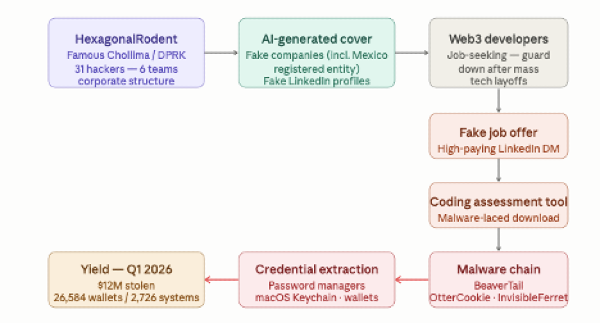
Running concurrently with this precision operation was a campaign of an entirely different character — lower per-incident yield, but industrialized at a scale that makes it cumulatively significant. Incident responders at Expel, led by researcher Marcus Hutchins, uncovered the full architecture of an operation they designated HexagonalRodent, linked to the North Korean cluster tracked as Famous Chollima. Between January and March 2026, the group stole approximately $12 million in cryptocurrency from 26,584 wallets held on 2,726 infected systems — not through protocol exploitation but through social engineering targeted at Web3 developers.
The operation was organized with the structure of a corporate enterprise. Internal documents obtained by Expel showed 31 hackers divided across six teams, with evidence that former members had previously split off to establish their own derivative operations. The attack vector was consistent: fake high-paying job offers delivered through LinkedIn, backed by AI-generated fake companies — in one documented instance, the operators registered a fictitious company in Mexico to add legal credibility to the fiction. Victims contacted through these channels were asked to download a coding assessment tool that deployed a malware chain combining BeaverTail, OtterCookie, and InvisibleFerret — strains previously attributed to North Korean actors by multiple incident response firms. Once installed, the malware extracted credentials from password managers, the macOS Keychain, browser storage, and cryptocurrency wallet applications, funneling the proceeds to operator-controlled infrastructure.
Hutchins noted a structural factor that has made this approach increasingly effective: the wave of technology industry layoffs over the past four years has produced a large population of software engineers applying to hundreds of positions without response. "With developers applying to hundreds or thousands of jobs without receiving a call back, they're likely to have their guard down when that one job offer finally comes in," he wrote. The economic conditions of the technology labor market have become, inadvertently, a force multiplier for North Korean social engineering operations. The use of generative AI to create convincing fake company profiles, refine malware code, and produce credible LinkedIn personas has further reduced the operational cost of running these campaigns at scale — more targets can be approached with less manual effort per contact.
The two operations illuminate the strategic logic of North Korea's cryptocurrency doctrine from both ends. The precision attacks — Kelp DAO at $290 million, the Drift platform at $280 million in the same period, a series of exchange and protocol heists in prior years totaling billions — represent the high-value tier, requiring significant technical investment but capable of generating budgetary-scale returns in a single operation. The industrialized harvesting campaigns — HexagonalRodent and its predecessor and derivative operations — represent the continuous baseline tier, generating smaller but steady flows that aggregate to significant sums across thousands of victims and do not depend on identifying and exploiting a specific high-value target. Together they constitute a portfolio approach to state revenue generation through cybercrime, diversified across attack vectors, target profiles, and yield scales.
The cryptocurrency industry's structural vulnerabilities enable both tiers. DeFi protocols introduce complexity at every layer — cross-chain messaging, verification networks, restaking mechanisms — and each layer represents a potential attack surface that may be secured less rigorously than the core contracts. Individual developers represent a perpetually renewable target population, particularly in economic conditions that increase their susceptibility to social engineering. And the pseudonymous, borderless nature of cryptocurrency transactions continues to complicate fund recovery and attribution in ways that make North Korea's operations not merely profitable but largely consequence-free. The question the Kelp DAO incident poses most sharply is not whether Pyongyang will continue — the answer is structurally yes — but whether the DeFi ecosystem will close the configuration and verification gaps that make precision attacks of this kind possible before the next operation finds the next single point of failure.