The 8200 Pipeline: How Israel's Military Intelligence Became the Architecture of Global Cybersecurity- 210
June 19, 2026
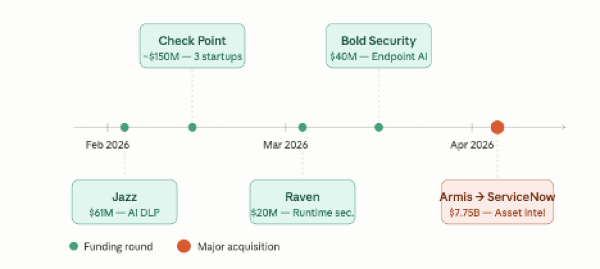
Five funding announcements and acquisitions published between February and April 2026 might, read individually, fill the venture capital column of a technology trade journal. Read together, they reveal something structurally more significant: the near-completion of a decades-long conversion of Israeli military intelligence human capital into commercial cybersecurity infrastructure that the global market is now absorbing at historic scale. What is happening is not a funding cycle. It is a consolidation — and the buyers know it.
In February 2026, Check Point Software Technologies — founded in 1993 by Gil Shwed, a veteran of Unit 8200, Israel's military signals intelligence corps — announced the acquisition of three Israeli startups for an estimated $150 million. One of them, Cyata, was itself founded in 2024 by Unit 8200 graduates specializing in AI agent governance within enterprise environments. The loop was explicit: a company born from the unit acquiring a company born from the same unit, one generation later.
The same month, Jazz — founded by veterans of Unit 81, the IDF's technical intelligence counterpart — emerged from stealth with $61 million in seed and Series A funding to rebuild data loss prevention from first principles, replacing static rule-based detection with an AI-native contextual engine capable of distinguishing legitimate workflows from genuine data risk. In March, Raven, founded by Israeli cyber intelligence veterans, raised $20 million to protect cloud-native applications at runtime — detecting and blocking exploits before known vulnerabilities are even published. Bold Security, co-founded by Israeli serial entrepreneur Nati Hazut, simultaneously secured $40 million to turn enterprise endpoints into active protection agents, running AI locally on devices to understand user behavior and business context in real time.
In April, ServiceNow completed its acquisition of Armis — an Israeli-founded cyber asset visibility company tracking nearly seven billion connected devices globally — for $7.75 billion in cash, the largest acquisition in its category. The deal followed ServiceNow's March acquisition of Veza, an identity intelligence platform, giving the company simultaneous control over what assets exist across an enterprise and who or what has access to them. The strategic logic was architectural, not opportunistic.
What these five transactions share is not geography. It is coverage. Cyata secures AI agent identities. Jazz governs sensitive data in motion. Raven protects applications at execution. Bold secures the endpoint with behavioral intelligence. Armis provides visibility across every connected asset — IT, OT, IoT, medical devices, physical AI, critical infrastructure. Together they map every significant layer of the modern enterprise attack surface. No overlap. No gap. The architecture is complete.
This coherence is not accidental. It reflects a formation system — Unit 8200, Unit 81, and their adjacent intelligence structures — that trains operators to think in terms of exposure surfaces, intrusion vectors, lateral movement, and real-time response. These are precisely the conceptual categories that the commercial cybersecurity market has spent two decades trying to systematize. Israeli founders did not adapt to the market's language. They built the market in their own.
The investor network reinforces the pipeline. Glilot Capital and Team8, which led Jazz's funding round, are deeply embedded in Israel's intelligence community. Elron Ventures, which co-led Raven's round, has a decades-long history of backing Israeli defense-adjacent technology. The capital is not neutral venture money following returns. It is organized around a shared understanding of what threats look like and where the solutions need to be built.
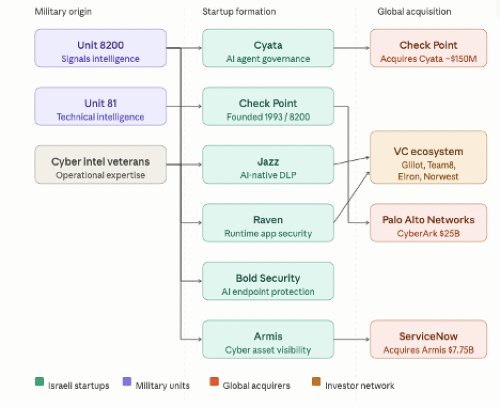
The strategic consequence — visible only when the five articles are read as a sequence rather than as isolated events — is saturation. Every layer of enterprise security architecture is now occupied by at least one company produced by this pipeline. The American platform consolidators — Palo Alto Networks with CyberArk at $25 billion, ServiceNow with Armis at $7.75 billion, Check Point in its organic expansion — are not simply acquiring technology. They are acquiring the last available positions in an edifice that Israeli founders systematically built. At these prices, the buyers understand that what they are purchasing will not be reproduced elsewhere, because the conditions that produced it — a mandatory military intelligence passage combined with a dense alumni network and a culture of operational urgency — are not replicable by institutional design.
For the next generation of Israeli cyber founders, the map is largely drawn. The classical enterprise security categories are covered. The open frontier lies elsewhere: the security of autonomous physical systems, sovereign AI infrastructure, space-based communications. These may be the next theaters where Israeli military intelligence capital seeks expression — before the market has named them.