Google's GTIG report confirms AI has crossed from cybercrime convenience to zero-day creation- 223

May 14, 2026
Google's Threat Intelligence Group has documented the first case it can trace of a functioning zero-day exploit built with AI assistance and aimed at a planned mass-exploitation event — a threshold this publication has watched analysts warn about for months, now confirmed with a name, a malware family, and a state-actor list attached. The report, covered here through Security Affairs' technical breakdown and CyberWire's Caveat Briefing, marks less a discovery of new capability than a formal acknowledgment that the capability already exists and is already being used.
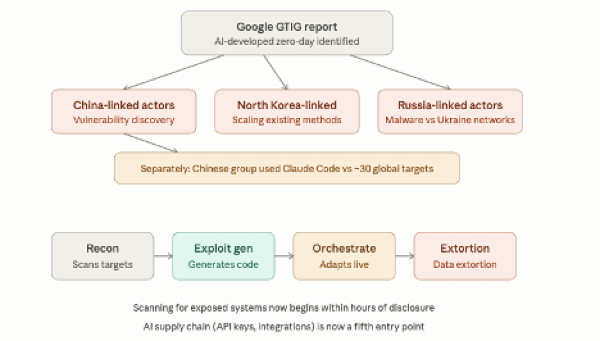
GTIG's central finding is a shift in how AI functions inside an intrusion: not as a productivity aid bolted onto human-run operations, but as an increasingly autonomous participant across the attack lifecycle, from reconnaissance through exploit generation to post-compromise activity. The report singles out AI-enabled malware such as PROMPTSPY, describing a move toward attack orchestration in which models interpret the state of a compromised system and generate commands dynamically, rather than executing a pre-scripted playbook. Google also disclosed that the zero-day it flagged as AI-developed was tied to a threat actor's plan for mass exploitation, one Google says its own detection efforts likely disrupted before deployment. GTIG chief analyst John Hultquist's assessment — that this single traceable case almost certainly represents a larger, undetected pattern — reframes the finding less as an anomaly than as a visible fraction of activity already underway.
The state-actor picture spans a familiar set of geopolitical fault lines. China-linked and North Korea-linked groups show sustained interest in using AI specifically for vulnerability discovery, according to Google's researchers. CyberWire's coverage adds detail Security Affairs did not carry: Russian-linked hacking groups have been observed using AI models to develop malware targeting Ukrainian networks, while North Korean operators are using the same class of tools to refine and scale existing methods rather than invent new ones. Separately, Google's report references Anthropic's own disclosure of an AI-orchestrated cyberattack it attributed to a Chinese state-sponsored group, in which attackers manipulated an earlier version of Claude's coding tools to conduct reconnaissance, credential theft, and data exfiltration against roughly thirty targets spanning large technology firms, financial institutions, government agencies, and chemical manufacturers, with confirmed success in a small number of cases.
The report's second major thread concerns infrastructure rather than technique: attackers are increasingly targeting the AI supply chain itself — exposed API keys, insecure model integrations, and vulnerable third-party tooling — as an initial-access vector, with one adversary group Google tracks as UNC6780 using compromised AI environments as a pivot point into broader networks for ransomware deployment and extortion. Google's researchers were careful to note that AI has not displaced conventional intrusion methods; misconfigurations, unpatched software, and weak access controls remain behind most breaches. What has changed is the compression of time between vulnerability disclosure and exploitation, with criminals now scanning for exposed systems within hours of a technical write-up going public — a timeline that leaves defenders with a shrinking window to patch before attackers arrive.
The policy dimension, drawn from CyberWire's broader framing, is where the story's geopolitical stakes surface most clearly. The report lands as Washington weighs a shift in its AI oversight posture, with reporting that the current administration is considering a new review committee for AI models ahead of public release. Findings like GTIG's — alongside continued scrutiny of newer, more capable models — are likely to weigh directly on how that oversight question gets resolved, sharpening a dilemma regulators cannot avoid indefinitely: AI is compressing the gap between vulnerability discovery and exploitation fast enough that the traditional patch-and-defend model may no longer hold, but heavy-handed regulation risks slowing the same capability development that defenders also depend on.