From Signatures to Behavior: How Real-Time AI Attacks Disrupted Global Cyber Defense- 224
May 4, 2026
A retail chain in Hungary lost €15.5 million because an AI-polished email looked exactly like an internal instruction. A finance employee in Hong Kong authorized a $25.6 million wire transfer to a video call where every face, including the CFO's, was a live deepfake.
A Chinese state-sponsored group let an AI coding agent run 80 to 90 percent of an intrusion campaign autonomously across finance, chemical manufacturing, and government targets, with humans stepping in only at a handful of decision points. These are not hypothetical scenarios from a threat forecast — they are documented 2024–2026 incidents, and they share a single underlying mechanism: AI has collapsed the cost, skill, and time barrier that used to separate a capable attacker from an amateur with a grudge.
The shift is visible across the entire intrusion lifecycle, not confined to any one technique. On the social-engineering side, generative models have eliminated the broken-grammar phishing email as a detection signal, scraping professional profiles and mirroring internal writing styles to produce lures indistinguishable from legitimate correspondence — and voice cloning has moved from novelty to operational tool, with the FBI issuing a public alert in May 2025 over a campaign using AI-cloned voices to impersonate senior federal and state officials, part of a year in which the Bureau logged over 22,000 AI-related complaints and roughly $893 million in losses. A parallel criminal marketplace has formed around the technology itself: dark web forums now sell subscription access to jailbroken LLM wrappers marketed as tools purpose-built for phishing and malware generation, with one such service's leaked customer database exposing more than 19,000 subscribers.
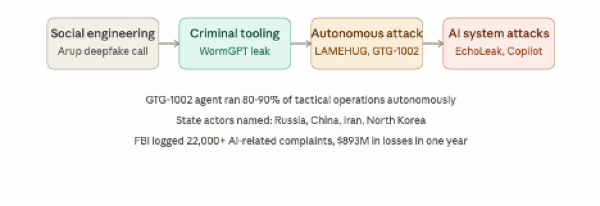
On the technical side, the malware itself has begun to change shape mid-execution. Ukraine's CERT-UA attributed a malware family called LAMEHUG to Russia's GRU-linked APT28 in mid-2025 — a Python-based tool that queries an open-weight language model at runtime and executes whatever commands the model returns, meaning the actual malicious payload does not exist as static code until the moment of execution, defeating signature-based defenses by design. That same logic scales upward into fully agentic operations: the Chinese state-sponsored intrusion campaign disclosed by a major AI vendor in November 2025, tracked as GTG-1002, wired an AI coding agent directly into an end-to-end attack chain — reconnaissance, exploit generation, credential harvesting, lateral movement, and exfiltration — with the agent executing the substantial majority of tactical operations without human direction.
The geopolitical dimension runs throughout rather than sitting in a single category. Russian, Chinese, Iranian, and North Korean state actors are documented using commercial LLMs as productivity tools across their kill chains — target research, vulnerability triage, phishing-lure translation — prompting a joint Microsoft-OpenAI disclosure identifying and disrupting five state actors abusing large language models, with a separate analysis of Gemini misuse finding Iranian government-backed actors accounting for the largest share of AI use linked to advanced persistent threat activity. The same acceleration extends into influence operations: OpenAI's own threat reporting disclosed disruption of more than 20 covert influence campaigns in a single year spanning Russian, Chinese, and Iranian operations, alongside a documented case of AI voice-cloning used to impersonate a sitting U.S. president in a robocall reaching thousands of primary voters.
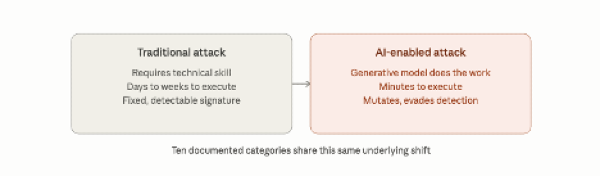
The newest attack surface is the AI systems themselves. Prompt injection now sits atop OWASP's risk list for large language models precisely because these systems cannot reliably distinguish trusted instructions from untrusted data inside the same context window — a structural weakness demonstrated in June 2025 by EchoLeak, the first documented zero-click prompt injection against a production system, in which a single crafted email pulled into Microsoft 365 Copilot's context instructed the assistant to exfiltrate sensitive Outlook and SharePoint data with no user interaction required. Taken together, the pattern across all ten categories argues for the same conclusion this publication has drawn from other AI-enabled campaigns this batch: the defensive posture required is no longer prevention against a known signature, but continuous behavioral validation against an adversary whose tools now adapt in real time.