Chinese Advanced Cyber Espionage Across the Dutch-Taiwanese Semiconductor Axis- 170

May 20,2026
The global semiconductor supply chain has become the primary geopolitical battleground of the 21st century. As Western export controls tighten around critical lithography and advanced fabrication technologies, the People's Republic of China (PRC) has intensified its covert operations to bypass these restrictions. This intelligence report examines the highly sophisticated, state-sponsored cyber campaigns targeting key semiconductor hubs in the Netherlands and Taiwan. By analyzing the integrated collection strategies of actors like Salt Typhoon, this document provides security engineering teams and stakeholders with critical technical insights into the evolving tactics, techniques, and procedures (TTPs) threatening the silicon ecosystem.
The global battle for technological dominance is increasingly being fought on a hidden front, targeting the very foundation of the modern digital world: semiconductors. Recent, stark warnings from European defense officials, corroborated by deep threat intelligence, have exposed a multi-year, strategic cyber espionage campaign orchestrated by the People's Republic of China (PRC). This operation, described as a "whole-of-society" mobilization, is laser-focused on acquiring critical advanced knowledge from the world’s most sophisticated semiconductor ecosystems—specifically the research and equipment giants in the Netherlands and the mass-production foundries of Taiwan.
While traditional espionage targets isolated secrets, this campaign seeks structural dominance. Beijing views semiconductor technology not merely as a commercial asset but as the essential bedrock for 21st-century military power and national security. The tightening web of Western export controls, designed to deny China access to cutting-edge chips and manufacturing equipment like advanced photolithography tools, has not stopped the PRC’s ambition. Instead, it has supercharged its cyber apparatus, compelling its hacker collectives to bypass these restrictions through stealth and innovation. The strategy is clear: where they cannot buy, they must steal.
A central player in this escalation is Salt Typhoon, a sophisticated Advanced Persistent Threat (APT) group also tracked as GhostEmperor. While many APTs chase intellectual property directly, Salt Typhoon specializes in a more insidious form of access: the compromise of telecommunications infrastructure and major Internet Service Providers (ISPs). This infrastructure-centric approach provides unparalleled strategic advantage. By infiltrating the routing layer of an ISP in a target region like Eindhoven or Hsinchu, they don’t just steal files; they intercept traffic, hijack legitimate communication sessions, map key executive movements, and harvest the credentials of engineers and researchers. Infiltrating the provider allows them to weaponize the very network a semiconductor firm relies upon, blending their malicious activity into the daily noise of global data flow.
The operational sophistication of these actors has forced Western counter-intelligence to re-evaluate the threat landscape. These are no longer simple phishing attacks; they are patient, engineered operations. The technical intelligence highlights an intense focus on exploiting the edge of the corporate network—routers, firewalls, and VPN gateways from major vendors. These devices are ideal targets because they often operate outside the comprehensive visibility of an organization’s internal endpoint detection systems. If a patch is missed, a zero-day vulnerability exists, or an old administrative configuration is exposed, actors like Salt Typhoon will find and exploit it, using the device as a silent gateway.
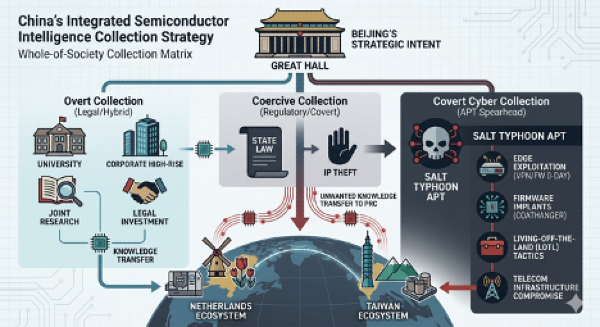
Once inside the network edge, the attackers aim for the deepest, most resilient form of access: the firmware layer. Security researchers have identified highly customized malware, such as the COATHANGER implant, designed specifically for network appliances. These backdoors inject themselves into the operating system of the router, allowing them to survive device reboots, password resets, and standard firmware updates. This renders traditional incident response and cleanup methods nearly useless; standard remediation might "clean" the system, but the backdoor remains buried in the hardware itself, ready to reactivate.
Furthermore, once a secure entry point is established, the adversary embraces extreme stealth through "Living-off-the-Land" (LotL) tactics. This means minimizing the use of unique, detectable malware binaries. Instead, attackers abuse legitimate, built-in system tools—like PowerShell, WMI, or standard network diagnostic utilities—to map the internal structure, move laterally from workstation to server, and exfiltrate data. Malicious actions are engineered to appear indistinguishable from routine IT maintenance by a authorized administrator. To remain hidden, they often modify internal network configurations, discreetly opening non-standard high ports (like 22x22) or tweaking routing tables to create quiet exfiltration paths for stolen intellectual property, blending theft with authorized administration.
The ultimate target is rarely the giant manufacturer’s secure central vault. The campaign understands the vulnerability of the ecosystem. The entire supply chain is in the crosshairs: the academic research partners developing new materials, the specialized niche suppliers manufacturing precise mirrors or lenses, and the software houses developing Electronic Design Automation (EDA) blueprints. A weakness in any single contractor, university partner, or regional ISP is ruthlessly exploited as a stepping stone. This requires a fundamental defensive shift from "fortress building" to the implementation of strict Zero-Trust architectures, where continuous validation is required for every user, device, and network segment, regardless of location. The silence on the wire is not the absence of conflict; it is the sign of an invisible war, the outcome of which will define global power for decades to come.