ZionSiphon: Early-Stage OT Malware Targeting Israeli Water Infrastructure Amid Regional Cyber Escalation- 150

April 20, 2026
The discovery of ZionSiphon highlights a growing convergence between geopolitical conflict and cyber operations targeting critical infrastructure. Emerging in the immediate aftermath of heightened tensions between Israel and Iran, this malware reflects a shift toward more targeted, operationally aware attacks against industrial systems, particularly in the water sector. While still in a developmental phase, ZionSiphon illustrates how threat actors are increasingly experimenting with tools capable of bridging traditional IT intrusion techniques and OT-level disruption, raising concerns about the future trajectory of cyber-physical threats in strategically sensitive environments.
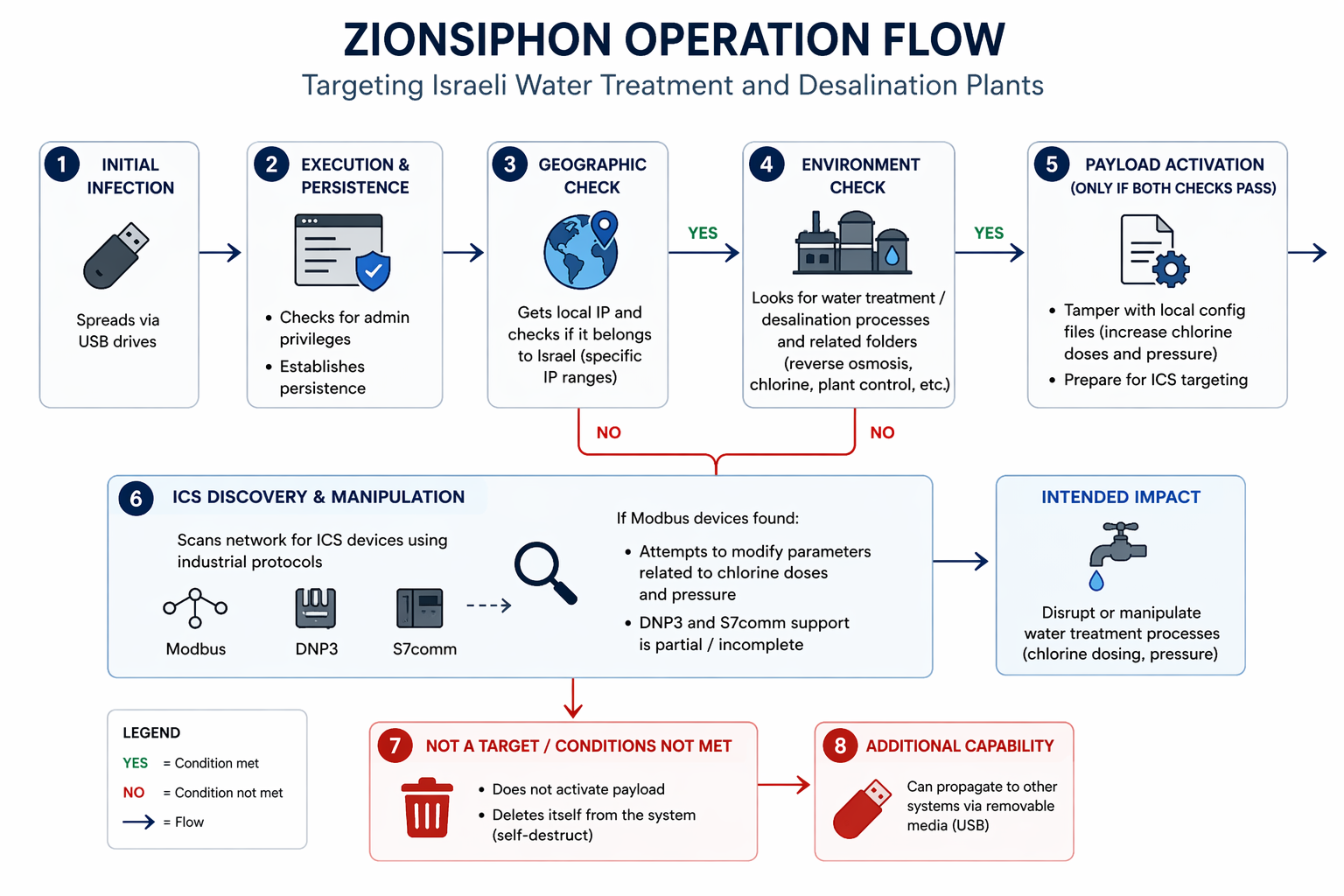
The emergence of ZionSiphon marks a notable development in the evolution of cyber threats targeting critical infrastructure, specifically within the water sector. Identified by Darktrace, the malware appears designed to compromise water treatment and desalination facilities in Israel, combining conventional malware techniques with operational technology (OT)-focused sabotage capabilities.
At a technical level, ZionSiphon integrates a multi-stage operational logic that reflects both intent and experimentation. The malware establishes persistence, escalates privileges, and retrieves the local IP address to verify whether the infected system is located within predefined Israeli IP ranges. It then performs environmental validation by scanning for processes, configurations, and directories associated with industrial water treatment systems—specifically targeting components linked to reverse osmosis, chlorine dosing, and plant control operations.
Only when both geographic and operational conditions are met does the payload activate. In such cases, the malware attempts to manipulate local configuration files and industrial parameters, particularly those governing chlorine levels and pressure. It also probes the network for ICS [Industrial Control System] devices using industrial communication protocols such as Modbus, DNP3, and S7comm, with the Modbus attack path appearing the most developed. This dual-layer targeting mechanism—combining location-based filtering with industrial process validation—demonstrates a clear intent to conduct precision sabotage within critical infrastructure environments.
However, analysis indicates that ZionSiphon remains incomplete and operationally immature. Flaws in its country-validation logic, partial implementation of protocol exploitation, and limited ability to effectively alter real-world industrial processes suggest that the malware is still under development. Despite this, its architecture reveals a deliberate effort to experiment with multi-protocol ICS manipulation, persistence within OT networks, and propagation via removable media—echoing techniques seen in earlier ICS-focused campaigns.
The timing of its discovery is particularly significant. The malware was first observed shortly after the Twelve-Day War, reinforcing its likely connection to ongoing geopolitical tensions involving Israel, Iran, and aligned actors. Embedded strings referencing Israeli cities such as Tel Aviv and Haifa, along with political messaging supportive of Iran, Palestine, and Yemen, further point toward a politically motivated threat actor, potentially operating within or alongside hacktivist or state-aligned ecosystems.
From an operational standpoint, ZionSiphon reflects a broader trend: the convergence of cyber conflict and critical infrastructure targeting, particularly in sectors like water, which remain comparatively under protected. Israeli water infrastructure has long been a focal point for cyber activity, notably from Iranian-linked groups, due to its strategic importance and potential for civilian impact.
The broader implication is not the immediate effectiveness of ZionSiphon, but what it represents. Even in its unfinished state, the malware illustrates a shift toward AI-assisted or semi-automated experimentation with OT disruption, where attackers test capabilities in live environments while iterating on tools. The inclusion of USB-based propagation and self-deletion mechanisms also suggests an awareness of operational security and controlled deployment.
Complementing this development is the parallel emergence of tools such as RoadK1ll, designed to facilitate stealthy lateral movement and persistent access within compromised networks. While not directly linked, such tools highlight an evolving ecosystem where initial access, persistence, and infrastructure targeting are increasingly modular and interoperable.
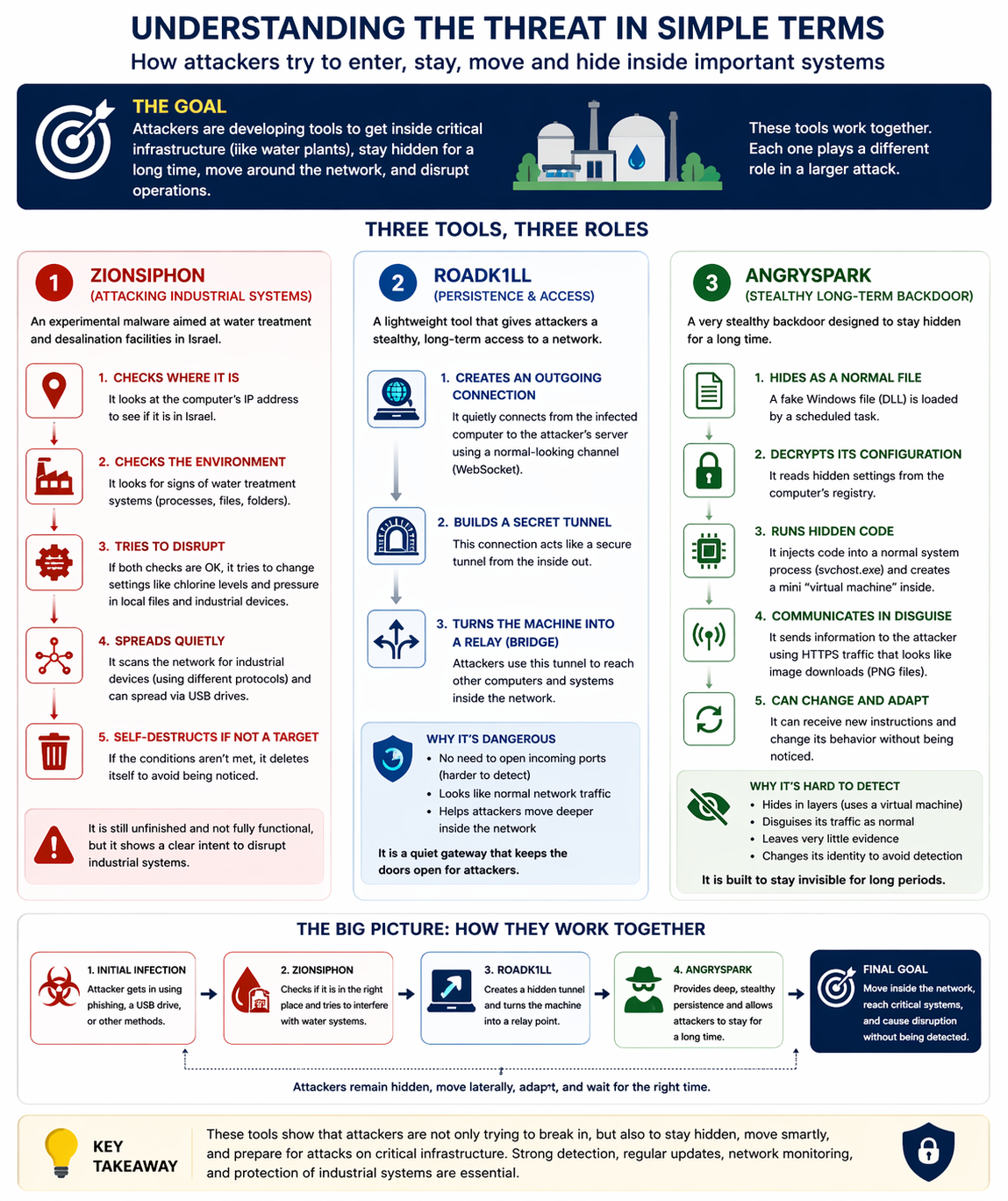
In sum, ZionSiphon should be understood not as a fully operational cyber weapon, but as a prototype within an escalating cyber-physical threat landscape. Its significance lies in the clear intent to bridge IT intrusion techniques with OT disruption capabilities, underpinned by geopolitical motivations. As regional tensions persist, such experimental tools are likely to mature, increasing the risk of effective and scalable attacks against critical infrastructure systems.
Download the Full Report (pdf)