Hacking Like It's 1999: Why Operational Technology Security Plays by Different Rules- 265

July 17, 2026
Operational technology environments occupy a security posture that would be considered obsolete anywhere in modern IT — largely because it has to. (...) confronting security assumptions that IT abandoned a generation ago.
Most OT equipment was never designed around the assumption of an untrusted network: password prompting and input validation are frequently absent, and the compiled, resource-constrained nature of the software leaves no room for modern memory-protection defenses like ASLR or DEP. The result is an environment where nearly any sufficiently curious researcher, using ordinary IT vulnerability-hunting technique, finds themselves confronting security assumptions that IT abandoned a generation ago.
The consequence of that gap is a fundamentally different threat calculus than the one IT security is built around. Where remote code execution and privilege escalation represent the prize outcomes for an IT-focused attacker, the paramount concern in OT is denial of service — because a "temporary" disruption in this context means actuators stop, physical processes freeze, and safety-critical operations halt outside their intended schedule, sometimes with life-safety consequences that have no equivalent in a server crash. That asymmetry extends into disclosure itself: an OT vulnerability's plausible worst-case description routinely reads as "and that's how power delivery to a hospital gets interrupted," a framing that makes even acknowledging a bug's existence fraught, let alone publishing a proof of concept, and that stands in stark contrast to the comparatively routine CVE-and-patch cycle IT security has normalized.
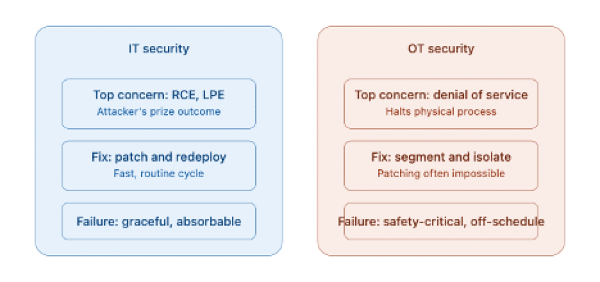
The structural reality compounding all of this is that OT vulnerabilities are frequently unpatchable in any practical sense — vulnerable hardware may sit hundreds of miles from the nearest technician, be governed by regulations restricting unscheduled updates, or require a wholesale hardware replacement with no guarantee of compatibility with the surrounding control architecture. Network segmentation has therefore functioned, in practice, as the sole meaningful OT defense for decades. Beardsley's argument is that this posture is no longer sustainable in isolation: as OT and IT infrastructure converge and frontier AI tooling lowers the barrier to identifying exploitable weaknesses in soft, under-defended targets, unreported OT vulnerabilities represent a widening window of exposure rather than a contained risk, making the case for a disclosure culture — reporting findings to CISA and sector CERT/CCs rather than sitting on them — that OT has historically lacked the incentive structure to embrace.