Hardening the Metal Beneath the Model: Why AI Data Centers Are Outrunning Their Own Security- 266
July 18, 2026
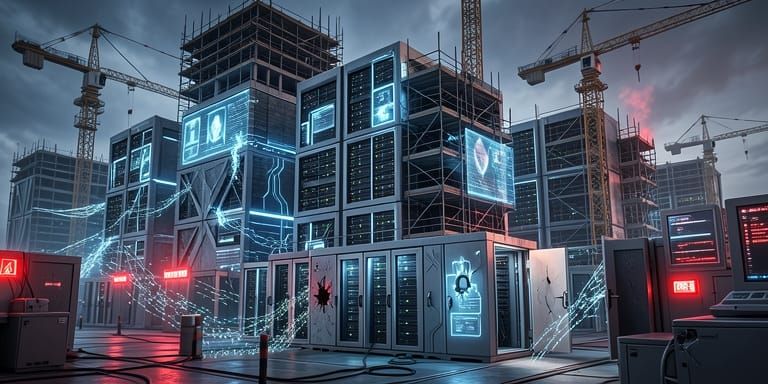
The infrastructure boom feeding the AI industry's compute demand is producing a new class of facility that security research firm Lava Labs argues is being built faster than it is being secured, and the reason is structural rather than incidental.Lava Labs' newly published analysis catalogs ten specific risk categories, designated "Forge," that emerge directly from that shift.
AI data centers are not traditional data centers scaled up, they are a fundamentally different kind of system built on a trust model that no longer holds. Where a conventional data center operates as a collection of independent servers serving a known, largely trusted clientele, an AI data center must function as a single massively parallel compute engine serving high-value, multi-tenant workloads from commercial customers who have no relationship with one another. The report's own sequencing carries an implicit severity argument. The five most dangerous risks — firmware and hardware integrity compromise, network and interconnect vulnerabilities, unsafe multi-tenant isolation, an insecure out-of-band management plane, and AI infrastructure supply-chain compromise — all operate below the operating system layer, are difficult to detect, and carry a blast radius capable of affecting an entire compute cluster rather than a single tenant. The remaining risks, covering facility management systems, data handling, certification transparency, operational infrastructure services, and vendor patch velocity, are comparatively easier to detect and recover from, with vendor patch gaps ranked as the least severe precisely because they are the easiest to identify and remediate once found. The underlying causes cluster around three structural realities: dense GPU clusters introduce unrelated commercial tenants sharing reassignable hardware, while simultaneously demanding complex firmware stacks with extreme thermal sensitivity; the high-performance interconnect fabrics that link GPUs across a cluster — InfiniBand, RoCE, RDMA, NVLink — are frequently unencrypted and poorly monitored despite carrying highly privileged traffic; and heavy reliance on baseboard-management-controller automation, Redfish and IPMI interfaces, and orchestration pipelines concentrates operational privilege in systems that were never designed to be multi-tenant boundaries.
Lava Labs frames its own analysis as serving three functions: surfacing risks unique to AI infrastructure that don't map cleanly onto existing data-center security practice, providing an implicit triage sequence for where defensive investment should go first, and supplying concrete attack scenarios and mitigations rather than abstract risk categories. The report's central argument is one that data-center operators racing to meet AI compute demand may find inconvenient: building an AI data center at the pace the market demands using the traditional data-center security blueprint as a template is not a shortcut, it is a structural mismatch between the trust assumptions embedded in decades of data-center design and the multi-tenant, high-privilege reality that AI compute infrastructure now requires.