Washington Dismantles a Chinese Hacking-as-a-Service Network — Then Walks Back Its Own Words- 333
September 1, 2026
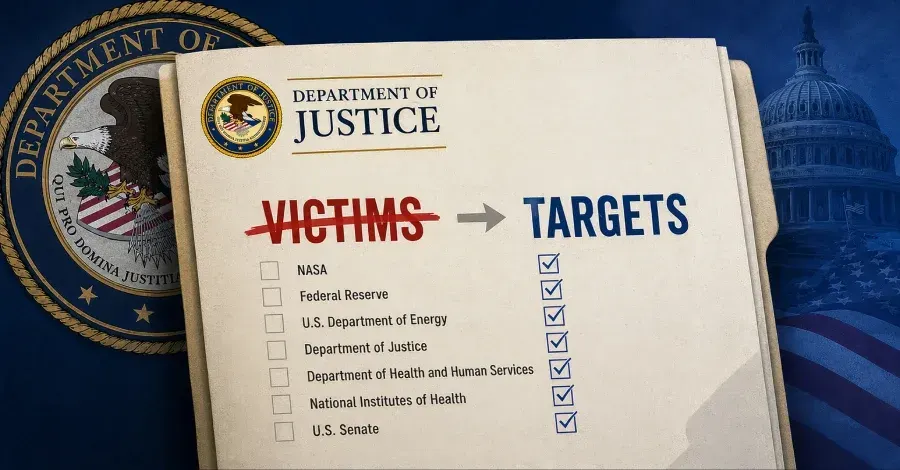
When the Justice Department announced last week that it had seized the infrastructure behind a Chinese state-linked hacking platform, the story briefly became less about the hackers and more about the government's own choice of words. A press release naming NASA, the Federal Reserve, and the U.S. Senate among the "victims" of the intrusion campaign was quietly rewritten days later to say they had been "targets" instead — a one-word edit that reframes how much of Washington's own back yard was actually compromised, as opposed to merely probed.
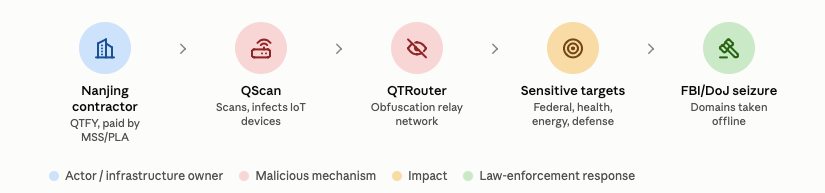
The operation itself is a case study in how far Chinese state-linked cyber activity has moved toward an industrialized, service-based model. According to the unsealed affidavit, the Justice Department and FBI seized domains tied to two complementary tools, QScan and QTRouter, run by a threat actor tracked as QTFY and operated out of a Nanjing-based company, Nanjing Xinjiuwei Network Technology Company. U.S. officials allege the firm functioned as a paid contractor to Beijing, with payments traced to China's Ministry of State Security and, per Indian Express's reporting, the People's Liberation Army as well. QScan's job was reconnaissance and automated exploitation: it scanned the open internet for vulnerable, internet-connected devices — routers, cameras, appliances — and infected them at scale. Those compromised devices, along with commercial proxy servers and rented virtual private servers, fed into QTRouter, which Lumen Technologies' Black Lotus Labs unit has described as an "obfuscation network": traffic routed through it appears to originate from ordinary consumer devices rather than Chinese infrastructure, often from machines sitting close to the actual target. Lumen's researchers characterized QTFY as a "digital quartermaster" — an entity that builds and rents out the infrastructure layer for other operators' campaigns rather than running every operation itself, which is precisely why the seizure targeted the domains hard-coded into the malware for authentication and command-and-control, rather than simply naming the group publicly. Taking the infrastructure away, as one Lumen engineer put it to CNN, is more disruptive than attribution alone, at least until the operators rebuild it.
The target list attributed to the campaign, which dates to 2018, reads as a cross-section of American public and critical-sector infrastructure: NASA, the Federal Reserve, the Departments of Energy, Justice, and Health and Human Services, the National Institutes of Health, and the U.S. Senate, alongside hospitals, telecom operators, power companies, financial institutions, and defense contractors. One confirmed case from 2019 involved an attempted NASA intrusion via a Pulse Secure VPN vulnerability, CVE-2019-11510. The exploitation record disclosed by Security Affairs is notably broad rather than novel: Fortinet SSL-VPN, Citrix ADC, Microsoft Exchange, F5 BIG-IP, Apache Log4j, Atlassian Confluence, Check Point gateways, CrushFTP, Ivanti appliances, and BeyondTrust Remote Support all appear in the group's exploitation history, paired with web shells, remote-access trojans, and both stolen and legitimately obtained credentials. None of these vulnerabilities are exotic; several are years old. The operational point, as with most ORB-style Chinese campaigns, is patience against unpatched infrastructure rather than novel tradecraft.
That is what makes the DoJ's correction analytically significant rather than a footnote. Being listed as a "target" of a reconnaissance-and-exploitation platform that industrialized access to thousands of IoT devices is a materially different claim than being a confirmed "victim" of an actual intrusion — and the government's initial framing collapsed that distinction across seven of the most sensitive institutions in the federal government. The correction doesn't diminish the scale of the campaign; QTFY's infrastructure was built to touch as much of the internet as possible. It does mean that the harder, still-unresolved question — which of those institutions were actually breached, and to what extent — remains open, and U.S. officials have signaled they are unlikely to detail counterintelligence damage assessments publicly.
This disruption also sits inside a documented pattern rather than standing alone. Security Affairs notes it follows the FBI's 2025 removal of PlugX malware from more than 4,000 U.S. systems tied to Mustang Panda, the 2024 dismantling of a Flax Typhoon IoT botnet, and the 2023 action against the Volt Typhoon botnet built to conceal pre-positioning inside U.S. critical infrastructure. Indian Express's reporting adds further texture to that continuity: 2023 accusations that Chinese operators had infiltrated military transport, water, and power networks as potential wartime sabotage staging; a 2024 telecom-intrusion campaign that reportedly reached then-candidate Donald Trump and running mate JD Vance; and a separate 2024 leak of internal files from another Chinese contractor whose client list spanned police, intelligence, and military buyers, with victims including Tibetan exile political groups and hospitals in Taiwan. Beijing has consistently denied all of these allegations, as it has this one. Read together, the QTFY takedown is less a single incident than the latest data point in a now-familiar structure: Chinese state security and military buyers outsourcing infrastructure-scale access to commercial contractors, and U.S. law enforcement responding with domain seizures that degrade — without eliminating — the operators' capacity to rebuild.