Berlin's No: A Ransomware Extortion Collides With a State Election- 332

September 2, 2026
A city-state government's refusal to pay a ransom is rarely news in itself; what makes Berlin's case worth pausing on is the timing, the actor, and what the episode reveals about how a modern capital absorbs an intrusion into its administrative core without ceding its electoral calendar to the attacker. In mid-August, two Berlin Senate departments were quietly compromised, months of internal data exfiltrated, and by month's end the ransomware group Rhysida had turned the breach into a public extortion attempt — timed, whether by design or coincidence, to land three weeks before Berliners went to the polls.
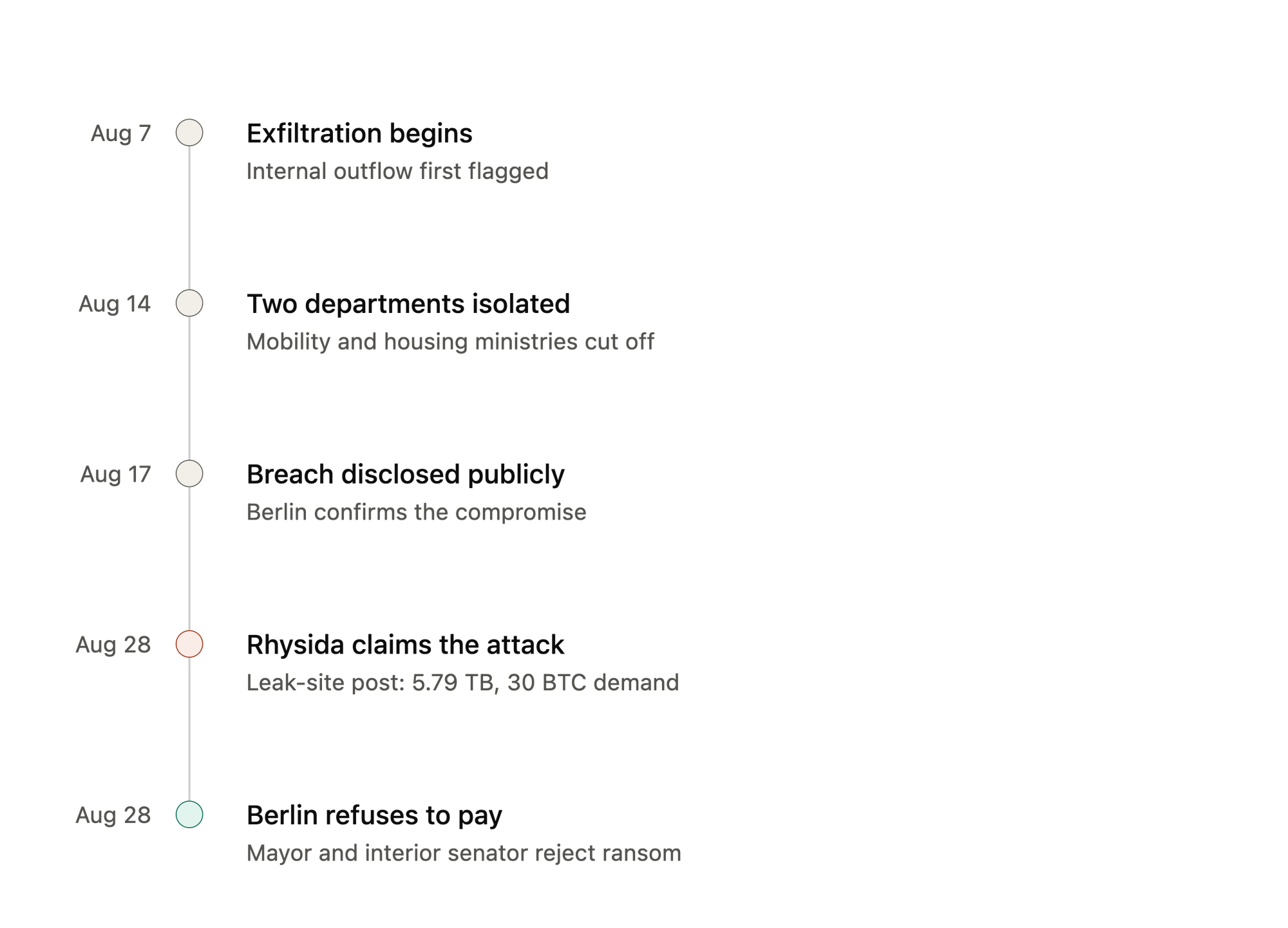
The technical sequence is now reasonably well established across reporting. One of the affected departments — the Senate Department for Mobility, Transport, Climate Protection and Environment — first flagged an internal data outflow on August 7. The exfiltration itself, according to forensic reconstruction, ran through August 12, a full week before the department's network was actually cut off on August 14, alongside that of a second department, the Senate Department for Urban Development, Construction and Housing. Both ministries share IT infrastructure and operate it independently of ITDZ Berlin, the state-owned central IT service provider, which reporting confirms was not itself compromised — a containment detail worth noting, since it means the intrusion did not have a path into the broader municipal IT backbone. German broadcaster RBB, citing government sources, reported that the attackers exploited a vulnerability in one of the two ministries' own systems, consistent with Rhysida's documented tradecraft: a November 2023 joint advisory from CISA, the FBI and the Multi-State Information Sharing and Analysis Center describes the group's typical entry points as compromised VPN credentials on networks lacking multi-factor authentication, exploitation of the Zerologon vulnerability (CVE-2020-1472, patched by Microsoft in 2020), and conventional phishing — none of them novel, all of them still reliably productive against under-hardened public-sector networks.
Berlin did not disclose the compromise publicly until August 17, three days after the isolation. That week-long gap between internal detection and network isolation, and the further gap before public acknowledgment, is the kind of sequencing that tends to draw scrutiny once the immediate crisis has passed — it is also, structurally, unremarkable: incident responders routinely need days to distinguish an ongoing intrusion from a contained one before making containment decisions public. What changed the story's register was Rhysida's move on August 28, when the group posted an entry titled simply "Berlin, Germany" to its Tor-based leak site, claiming roughly 5.79 terabytes of data across some 1.44 million files, including the personal information of 12,076 individuals, more than 16,000 email addresses and close to 12,000 phone numbers. The claimed dataset, per the group's own listing, extends well beyond routine administrative records: complaints and legal documents, financial and payroll files, contracts, human-resources data, plaintext credentials, IBANs, passport and ID information, lawsuit case files, and material described as leadership-level private data. Rhysida further asserted the material could implicate GDPR, German classified-information handling rules, and KRITIS/BSIG critical-infrastructure security requirements — claims that, like the rest of the group's leak-site posting, have not been independently verified by Berlin or by outside investigators. The ransom demand attached was 30 bitcoin, roughly $2.3 million at the time.
Berlin's governing mayor, Kai Wegner, and Interior Senator Iris Spranger issued a joint statement on the same Friday the leak-site entry appeared, stating flatly that the state would not submit to the extortion attempt — a position that predates and does not depend on official attribution, since Berlin has still not formally named Rhysida as the perpetrator despite the group's public claim. That posture tracks longstanding US federal guidance that ransom payment neither guarantees data return nor discourages future targeting, though it leaves the government to manage the downstream consequences if Rhysida follows through on publishing the stolen material. As of the most recent reporting, neither Berlin's data protection office nor the Senate Chancellery had issued specific guidance to the roughly 12,000 individuals whose data the group claims to hold, even as the state's data protection commissioner and the federal cybersecurity agency, the BSI, continue their review alongside the state criminal police and public prosecutor's office.
The political dimension is what elevates this from a routine — if serious — ransomware case to something worth reading geopolitically. Berlin's state parliament election falls on September 20, barely a month after the breach became public. Spranger has stated that preliminary findings show no election-relevant systems or data were touched, and security officials have echoed that assessment; there is, at least so far, no indication this was an operation aimed at electoral infrastructure rather than opportunistic extortion. Rhysida's own history supports the opportunism reading over a targeting thesis: the group has claimed roughly 280 victims since emerging in 2023, nine of them in Germany, with a victim geography weighted toward the United States and rounded out by the UK, Canada and Italy — a spread that reflects target-of-opportunity selection against exploitable infrastructure rather than a state-aligned or politically motivated campaign. That said, a criminal ransomware crew landing a German state capital's administrative network in the middle of an election cycle is exactly the kind of coincidence that state institutions have to treat as a live variable until proven otherwise, regardless of the attacker's actual motive — the disruption to public-facing services (housing-benefit and education-assistance applications went unprocessed at some district offices while staff worked by phone and fax) is itself a demonstration of how a purely criminal intrusion can produce state-level governance friction with no direct political intent behind it at all.
Rhysida's Berlin operation, in the end, tells a familiar story through an unfamiliar lens: a ransomware group using well-worn initial-access techniques against an under-segmented piece of public infrastructure, a government choosing public refusal over quiet payment, and the accidental collision of a criminal timeline with a democratic one. None of the three elements is new. Their convergence, in a G7 capital three weeks from a vote, is what makes the case worth logging.