A Federal Law Enforcement Agency Learns of Its Own Breach From a Leak Site- 331
September 1, 2026
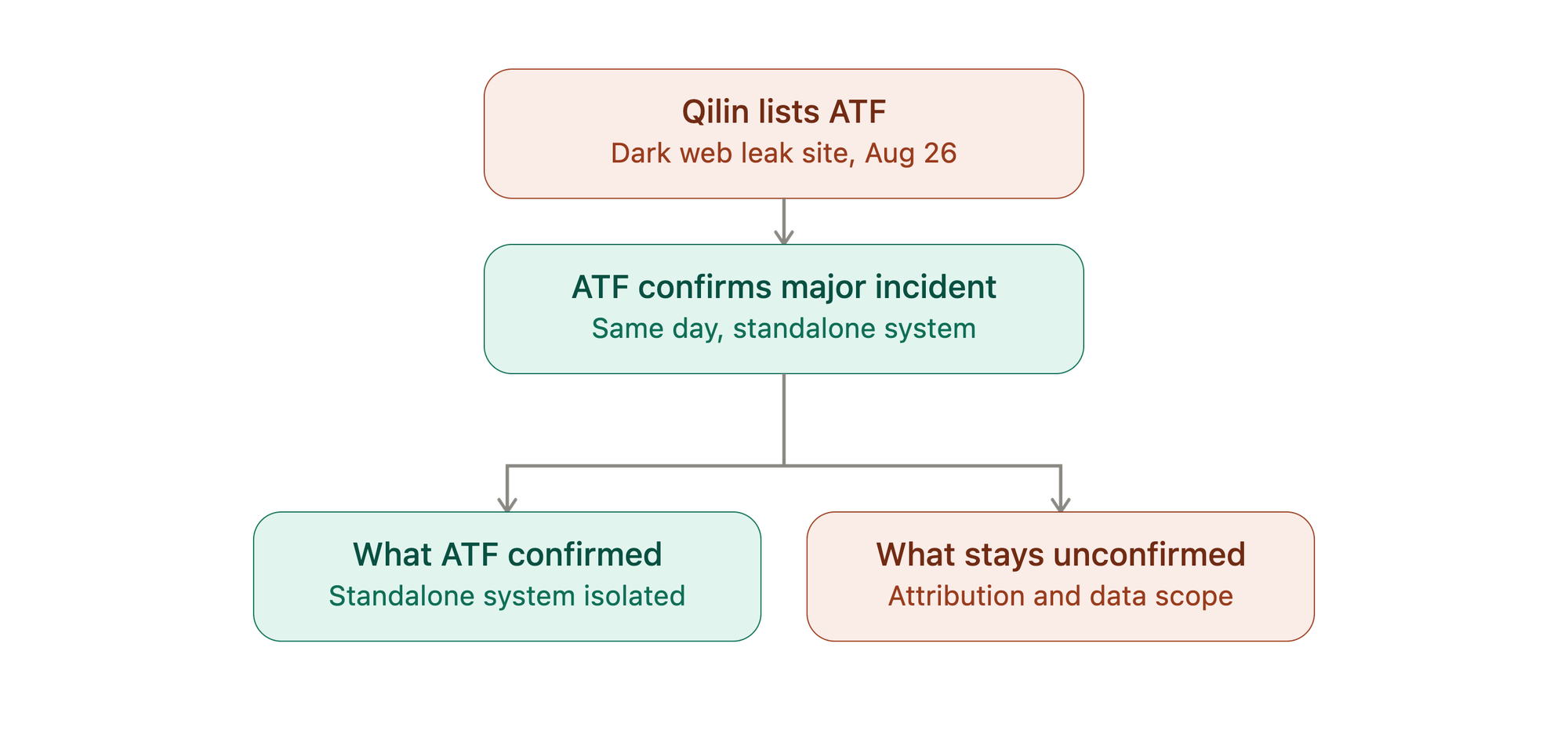
When the Bureau of Alcohol, Tobacco, Firearms and Explosives confirmed on August 26 that it was responding to a cybersecurity incident, the timing told its own story: the agency's public statement landed the same day the Qilin ransomware group added ATF to its dark web leak site. What followed over the next 48 hours was a careful, incremental disclosure from a federal law enforcement agency trying to characterize the scope of a breach while declining to confirm the one detail everyone wanted answered — whether the world's most active ransomware operation was actually inside its network.
ATF's initial statement, issued the same day Qilin's listing appeared, was narrow and procedural: a standalone system had been affected, that system operated separately from the ATF enterprise network, and there was no indication the breach had touched the enterprise network, the eForms system, or any other ATF system. The agency said it had immediately terminated connections to the affected environment and initiated incident-response and forensic activities in coordination with the Department of Justice. Despite the contained framing, senior department officials designated the event a "major incident" — a formal classification under FISMA and OMB guidance reserved for incidents likely to cause demonstrable harm to national security, the economy, public confidence, civil liberties, or public safety, or that affect 100,000 or more individuals. That designation triggers a requirement to notify congressional committees within seven days, with additional reporting obligations to DHS and the agency's Office of Inspector General.
What ATF chose not to disclose is as revealing as what it confirmed. The agency did not name the affected system, state when the incident was discovered, say whether any data was accessed or exfiltrated, or address Qilin's involvement at all — even after being asked directly. "This is an ongoing investigation, and no further details can be shared at this time," ATF's public affairs chief told reporters. That silence carries particular weight given what ATF's core systems hold: the National Firearms Registration and Transfer Record for NFA-regulated items, digitized out-of-business dealer records, active investigative files, informant identities, and crime-gun tracing data through NIBIN. The agency's insistence that the enterprise network and eForms system were unaffected suggests the compromised standalone system sits outside those core repositories — though ATF has offered no detail confirming what the system actually contained beyond later characterizing it as holding information on investigation targets.
Qilin's claim itself remains formally unverified. The group posted ATF to its leak site alongside five other victims, primarily from industrial and manufacturing sectors, without evidence, file samples, data-volume metrics, or a public ransom demand — a pattern consistent with how the group's affiliates sometimes operate, posting minimal information rather than the fuller technical disclosures other affiliates provide. ATF itself has never attributed the incident to Qilin, and the connection between the two events rests entirely on timing coincidence rather than confirmed evidence. Ransomware-as-a-service affiliates are known to occasionally list victims opportunistically or overstate the extent of their access, and until Qilin publishes verifiable samples or ATF issues a formal attribution, the link stays circumstantial.
Qilin's own profile makes the uncertainty more consequential rather than less. Operating since mid-2022 — first as "Agenda," rebranding to Qilin in September of that year alongside a shift from Go-based to Rust-based payloads — the Russian-speaking group runs an affiliate-based ransomware-as-a-service model despite a name drawn from Chinese mythology; researchers assess it as Russian-speaking based on code artifacts and a policy of excluding CIS-country targets. It became one of the most active ransomware brands globally by 2025, according to both Google and the FBI, which listed Qilin among the five most-reported ransomware variants to the Internet Crime Complaint Center last year. The group has formed strategic partnerships with Scattered Spider and Moonstone Sleet and uses infrastructure overlapping with BianLian, and nearly one in four of its claimed targets operate in manufacturing. Sourcing on the scale of its activity diverges: one report puts total claimed victims since 2022 at roughly 2,223 across 99 countries, averaging around 100 new victim listings per month in 2026 alone, while another cites hundreds of victims across more than 60 countries — a gap likely reflecting different tracking windows or methodologies rather than a factual contradiction, but one worth flagging given how central Qilin's scale is to assessing the credibility of its ATF claim.
The ATF incident also does not stand alone. It is the third major US federal law enforcement agency to confirm a significant cybersecurity incident within six months: the FBI disclosed a breach of its Digital Collection System Network earlier in 2026, and DHS disclosed a compromise of the Homeland Security Information Network. Set against that backdrop, a claimed ransomware intrusion at a federal law enforcement agency — one that, if Qilin's involvement is eventually confirmed, would represent a departure from the group's usual manufacturing, healthcare, and financial-services targeting — reads as part of a broader pattern of federal law enforcement infrastructure absorbing repeated, serious cyber incidents in a compressed window, regardless of whether any individual actor's motives in targeting a federal agency they cannot realistically expect to pay a ransom are yet understood.