When Medical Device Makers Become the Third Domino- 330

September 1, 2026
Boston Scientific's disclosure that a cyberattack had cut off its ability to process and ship customer orders worldwide arrived with a familiar shape: a Tuesday intrusion, an 8-K filing, a spokesperson declining to confirm ransomware, and a company unable to say when normal operations would resume. What makes the incident worth attention beyond its own scale is the company it now keeps — the third major medical device manufacturer disrupted by a cyberattack within six months, a pattern that is beginning to look less like coincidence and more like a sector under sustained pressure.
Boston Scientific is among the world's largest medical device makers, reporting $20.07 billion in 2025 revenue and roughly $21 billion over the trailing twelve months; the company said its products — pacemakers, defibrillators, cardiac stents, and neuromodulation implants — treat approximately 48 million patients a year. The intrusion, discovered on Tuesday, August 25, forced the company to sever network communications severely enough that thousands of employees at its three manufacturing and research sites in Ireland were told to work from home the following day. In its SEC filing and public statement, the company said the incident had impacted access to certain operating systems and business applications, including its ability to process and ship customer orders — language that, notably, stops short of confirming what caused the disruption or what, if anything, attackers took.
What Boston Scientific has not said is as significant as what it has. The company declined to confirm whether ransomware was involved, whether data was exfiltrated, or whether the disruption extends to patients with implanted devices. No extortion group had claimed responsibility as of the initial disclosures, and a spokesperson directed reporters back to the published statement rather than answering direct questions about patient impact. Investors were told separately that full restoration could take weeks. The stock fell more than 4% on the news, and the company has said only that it cannot yet assess the full operational and financial impact — the kind of hedging language that typically precedes an amended filing once an investigation matures.
The absence of confirmed patient harm should not be read as absence of risk. Device suppliers typically hold limited on-site inventory at hospitals, meaning a sustained halt to order processing and shipping is less a one-time inconvenience than a slow-building supply concern for any hospital or clinic that depends on a steady flow of Boston Scientific devices — a distinction regulators and hospital procurement teams will likely be watching closely even without confirmation that any single implant or procedure has been directly affected.
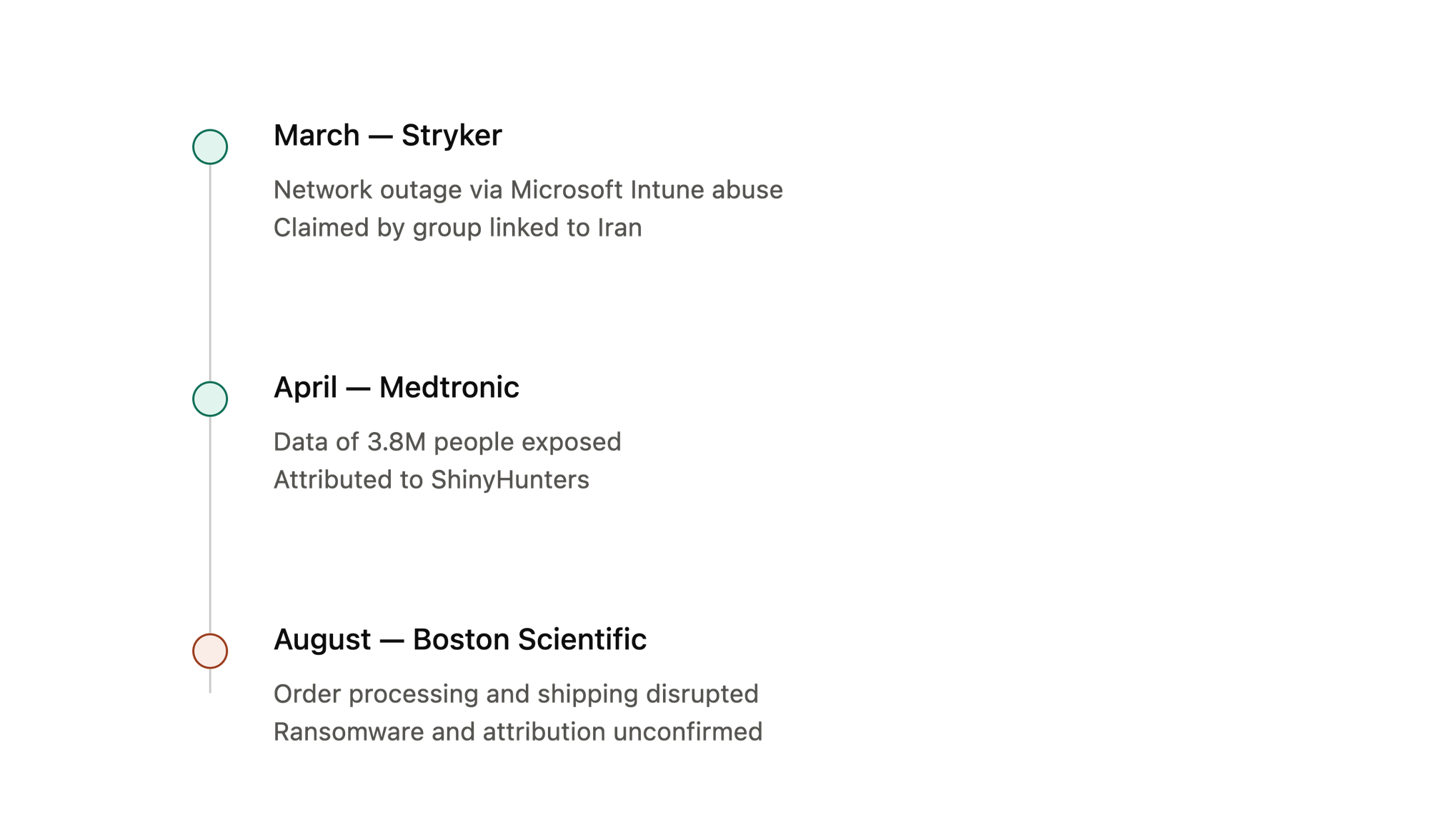
Set against the pattern the article draws out, Boston Scientific is not an isolated event. Stryker suffered a global network outage in March after attackers abused its Microsoft Intune deployment to wipe data from thousands of devices — an incident later claimed by a group connected to the Iranian government, with downstream effects on hospitals and medical facilities in the US, according to the FBI. Medtronic, the world's largest medical device company, disclosed in April that patient names, Social Security numbers, and health information belonging to more than 3.8 million people had been exposed in a breach attributed to the ShinyHunters extortion group. Three of the industry's largest manufacturers, hit inside six months, is no longer a series of unrelated incidents — it is a sector-level signal that critical medical supply chains have become a recurring target, whether for extortion, data theft, or destructive access.
Boston Scientific's Irish operations add a regulatory dimension worth tracking. If personal data proves to have been accessed, notification duties under the General Data Protection Regulation would attach, and medical device manufacturers operating in the European Union are increasingly captured by the NIS2 Directive's incident-reporting regime as member states complete its transposition into national law. That regulatory exposure sits on top of the immediate operational question — how long a global medical device maker can go without shipping product before the disruption becomes a hospital-facing supply problem rather than a corporate IT incident.