The Airport That Underestimated Its Own Breach- 329
September 1, 2026
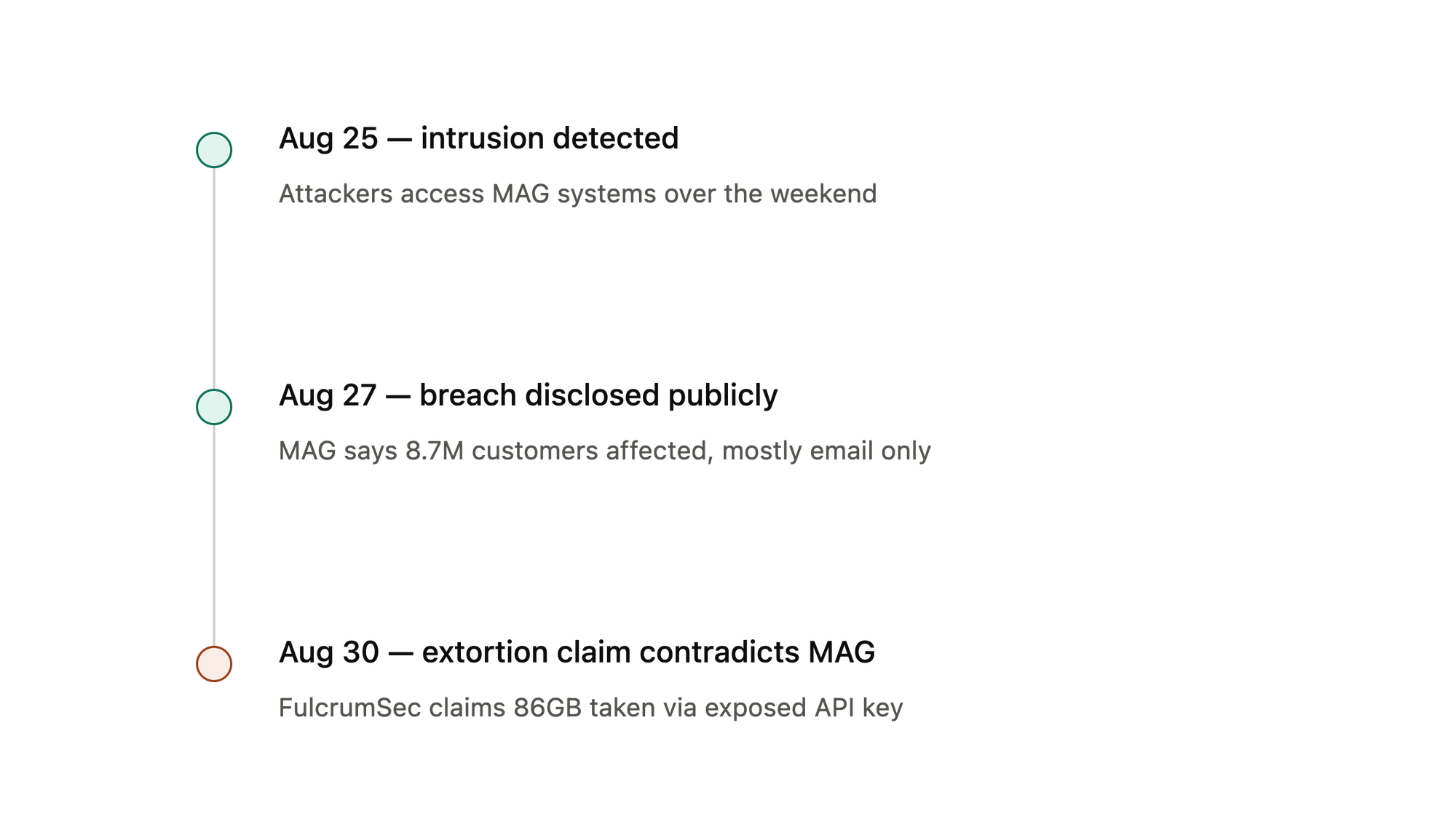
When Manchester Airports Group disclosed on August 27 that a cyberattack had touched the records of 8.7 million customers, the company moved quickly to define the scope of the story for itself: no payment data, no aviation-safety impact, and in the "vast majority" of cases, nothing more sensitive than an email address. Three days later, an extortion group calling itself FulcrumSec offered a very different account — one built not on public relations language but on a sample of stolen data that an independent outlet was able to verify against a real traveler's actual bookings. The gap between those two versions of the same breach says as much about the architecture failures behind modern airport operations as it does about the incident itself.
MAG operates three of England's busiest airports — Manchester, London Stansted, and East Midlands — through a public-private partnership majority-owned by ten Greater Manchester local authorities, with the Australian fund IFM Investors holding a minority stake. The company said it was alerted to the intrusion on Tuesday, August 25, and believes the attackers had already been inside the relevant systems for several days before discovery. The affected data covered car park, lounge, and Fast Track bookings, along with in-airport WiFi sign-ups, and included email addresses, phone numbers, vehicle registration numbers, and postcodes. MAG suspended its Manage My Booking service as a precaution, contained the incident with the help of outside cybersecurity specialists, and notified the relevant authorities. Crucially, the company framed the incident as narrow in practical effect: most of the 8.7 million people affected, it said, had lost nothing more than an email address.
FulcrumSec's claim, surfaced through BleepingComputer on August 30, does not so much contradict that figure as dwarf it. The group says it extracted roughly 86GB of data — considerably more, and considerably more detailed, than MAG's disclosure implied. As proof, it shared a 21.5GB export containing personal identifiers, historical booking details, and marketing information, and BleepingComputer checked one record against a real traveler's purchase history, finding matching Fast Track bookings, arrival times, terminal information, and payment amounts. Most consequential is FulcrumSec's claim to hold nearly 200,000 records tied to upcoming travel through the remainder of 2026 — specific dates, times, and booking details linked to identifiable individuals, which the group says it intends to publish, though it may redact the forward-looking travel records because of the real-world harm they could enable.
The mechanism FulcrumSec describes is unglamorous, which is precisely what makes it significant. The group says it found airport-specific API credentials for Iterable, a third-party marketing platform, sitting inside client-side JavaScript — code that runs directly in a visitor's browser and can be inspected by anyone with basic developer tools. If accurate, no sophisticated intrusion technique was required at all; the credentials were, in effect, sitting in the open on MAG's own website. It is a reminder that the attack surface of modern travel infrastructure increasingly runs through outsourced platforms for booking, loyalty, and marketing functions rather than systems the airport operator directly controls — dependencies that are easy to overlook precisely because they sit outside the perimeter organizations traditionally think of as "their" network.
The UK context sharpens the stakes of what was exposed. Unlike the broad delivery areas covered by American ZIP codes, a full UK postcode typically identifies a small cluster of neighboring addresses, and sometimes a single property, according to the Office for National Statistics. Combined with vehicle registration numbers, parking dates, and specific booking references, that level of granularity gives a plausible phishing operator more than enough raw material to construct a message referencing a real, upcoming trip — one that would be difficult for a recipient to distinguish from a genuine MAG communication. MAG itself acknowledged the risk in its customer notifications, warning that it would never contact customers unexpectedly to request payment or banking information.
The breach also lands inside a broader pattern of pressure on UK and European aviation and infrastructure operators. Earlier in August, Iran-linked hackers were reported to have taken a British power plant offline for four days — the first confirmed instance of Iranian actors disrupting a UK electricity generator. A year earlier, a ransomware attack on Collins Aerospace's check-in software had already grounded systems at Heathrow, Brussels, and Berlin. Set against that backdrop, the MAG incident is less an isolated corporate failure than a recurring test of how transport-sector operators absorb — and communicate — the consequences of compromise, especially when the attacker's own account of the damage is more granular and more alarming than the operator's.
MAG, for its part, has not directly engaged with FulcrumSec's 86GB figure or its account of the exposed credentials, instead reiterating that all affected customers have been contacted and that it believes it has taken effective protective measures. Whether that confidence survives FulcrumSec's promised publication of the data — and the technical writeup the group says will accompany it — remains to be seen.