China-Linked CL-STA-1062 Shifts From Taiwan to Critical Infrastructure Across Southeast Asia- 249

July 1, 2026
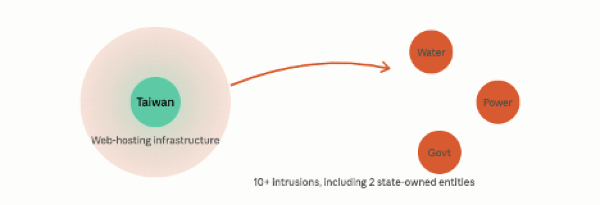
A China-linked threat group that spent years quietly attacking Taiwanese web-hosting infrastructure has, over the past year, redirected its focus toward something far more consequential: electricity and water providers, government agencies, and military organizations across Southeast Asia. Palo Alto Networks has documented more than ten such intrusions, including two against state-owned entities — but the detail troubling researchers most isn't what the group has stolen. It's that in several cases, they stopped right after getting in, leaving analysts genuinely unsure whether that restraint reflects a change of plan or simply someone else's turn to act.
Palo Alto Networks' Unit 42 tracks the group as CL-STA-1062, and assesses with high confidence that it's the same actor Cisco Talos previously identified as UAT-7237 during its earlier Taiwan-focused campaigns. Yoni Allon, senior vice president of software engineering at Palo Alto Networks, frames the shift in target profile as the specific reason this group now warrants more concern than comparable Chinese APT activity: successfully compromising critical infrastructure providers, rather than web infrastructure or conventional espionage targets, changes the practical stakes of every subsequent intrusion. In one documented case, the group conducted vulnerability scanning directly against a water utility, though researchers were unable to confirm whether that specific attempt succeeded — a reminder that visible reconnaissance against physical infrastructure providers is itself a data point worth tracking, independent of confirmed compromise.
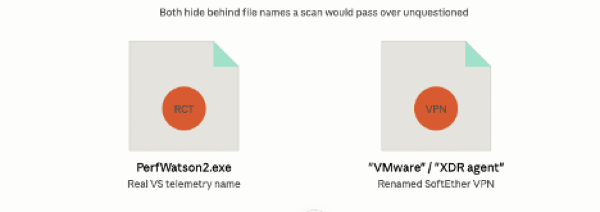
The group's toolkit reflects real engineering investment rather than reused Chinese APT infrastructure. TinyRCT, the backdoor Unit 42 first detected in 2025, is a lightweight C# remote-access trojan built with deliberate anti-forensic design: a self-destruct command the operators can trigger the moment they suspect detection or active investigation, alongside a broader set of anti-analysis maneuvers meant to defeat sandboxed inspection. Allon's team concluded after thorough analysis that TinyRCT shares no meaningful code lineage with any other tool in the known Chinese APT ecosystem — a genuinely custom-built implant, not a rebranded or forked existing tool. Its disguise strategy leans on camouflage rather than obfuscation: the backdoor masquerades as PerfWatson2.exe, a real Visual Studio telemetry component, while a separate tool used in the same intrusions, SoftEther VPN, runs under binary names designed to resemble VMware executables or an extended detection and response agent — the kind of file names a defender scanning a process list would glance past without a second look. A C2-parsing code comment written in simplified Chinese is one of the few concrete attribution threads tying the tool back to its likely origin.
What remains genuinely unresolved is the group's actual role in whatever larger operation this serves. In at least one case, a victim remained under sustained attack for many months, with the intrusion chain running the full distance from initial access through exfiltration and pivoting laterally from one government entity to a related one in the same country. But in other cases, CL-STA-1062 stopped immediately after gaining access and fingerprinting the local environment — no further activity, no observed exfiltration of electricity-related data, and no malware specifically targeting operational technology systems at all. That inconsistency is exactly what leads Allon's team toward a low-confidence assessment that CL-STA-1062 may function as an initial access broker: establishing a foothold and characterizing the environment, then handing that access off to a separate group better positioned to exploit it further. Activity overall has measurably dropped compared to late 2025, though Allon is careful not to read that decline as necessarily good news — it could reflect genuinely reduced operational tempo, or it could mean the group has simply gotten better at not being seen, continuing the same pre-positioning strategy this publication has tracked in Volt Typhoon and comparable Chinese campaigns: quietly establishing latent access inside critical infrastructure now, for use at a moment of the operator's choosing later.