When "unauthorized AI app" becomes an SEC disclosure category of its own- 247
May 12, 2026
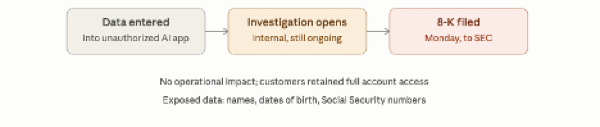
A community bank operating across Pennsylvania, Ohio, and West Virginia has filed an SEC disclosure over an incident it caused itself: an employee, or employees, entered customer data — including names, dates of birth, and Social Security numbers — into what the bank's own filing calls an "unauthorized AI-based software application." Community Bank has declined to say which tool, how it was used, or where the data ended up, but felt compelled to disclose regardless, citing the volume and sensitivity of the information involved.
The filing itself is notable less for what it reveals than for what it represents. Community Bank confirmed no operational disruption occurred — customers retained full access to their accounts and payment services throughout — meaning this wasn't a breach in the conventional sense of an external attacker gaining access. It was, instead, an internal governance failure: sensitive customer data appears to have been moved outside the bank's approved technology environment by the bank's own staff, into a system the organization neither vetted nor controls. That distinction matters because it shifts the risk calculus entirely. A conventional breach at least confines the exposure to whatever the attacker actually touched; data entered into an unauthorized third-party AI tool raises a murkier set of questions about where that information now lives, whether the AI provider retained it to train or fine-tune a model, and whether it has been processed, cached, or logged in ways the bank itself may never be able to fully audit or reverse.
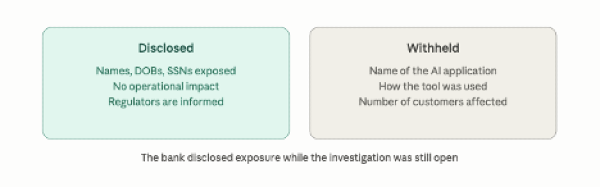
What the filing withholds is arguably more informative than what it discloses. Community Bank has not named the application, has not explained whether it was a consumer chatbot, an embedded AI feature in some other software, or a purpose-built tool an employee adopted independently, and has not detailed how many customers were affected or through what specific business process the data was entered. Social Security numbers sit near the top of the sensitivity hierarchy under both federal and state data protection law in the U.S., which likely explains why the bank judged disclosure necessary despite having so few concrete details to share — an unusual position for a regulatory filing to occupy, disclosing the fact of exposure while admitting the investigation into its scope is still ongoing. The bank says it remains in active communication with banking and financial regulators and is conducting legally required customer notifications, alongside the standard commitments to remediation that accompany nearly every disclosure of this kind.
The incident sits at the intersection of two trends this publication has tracked separately this batch: the rapid, often ungoverned adoption of generative AI tools inside organizations that have not yet built the internal controls to match, and a financial sector where enforcement bodies are increasingly treating undisclosed AI-related exposure as a disclosure-worthy event in its own right, regardless of whether any external attacker was ever involved. A bank reporting itself for what amounts to an employee's unauthorized software choice, rather than for a hack, may be an early signal of a new SEC disclosure category taking shape — one where the threat isn't a nation-state or a criminal syndicate, but an organization's own workforce reaching for a convenient AI tool faster than its governance policies could catch up.