When the Operator Became the Model: JadePuffer and the Collapse of Ransomware's Skill Floor- 274

5July 7, 2026
For the first time, a security research team has documented a ransomware operation whose entire technical execution — intrusion, credential theft, lateral movement, encryption, and the drafting of the extortion note itself — was carried out by an artificial intelligence agent rather than a human operator. The claim, made by researchers at Sysdig and rapidly amplified across the trade press in early July, arrived with the kind of framing the industry had been rehearsing for years: ransomware without a human at the keyboard.
What followed within days was a more disciplined reckoning with what that framing actually meant, and the gap between the two tells its own story about how agentic AI is beginning to reshape the economics, rather than the technique, of cyber extortion.
The operation, which Sysdig named JadePuffer, began with the exploitation of a known, long-patched vulnerability in Langflow, an open-source framework for building large-language-model applications. The flaw, tracked as CVE-2025-3248, allowed unauthenticated remote code execution and had been fixed since April of 2025; it had also been added to the US Cybersecurity and Infrastructure Security Agency's catalog of actively exploited vulnerabilities, an unambiguous signal to patch that evidently went unheeded by the eventual victim. From the compromised Langflow instance, the agent extracted the framework's own PostgreSQL database, profiled the host, and expanded its reconnaissance to connected MinIO object storage, harvesting environment variables, credentials, and application secrets before pivoting to a separate production server running MySQL and Alibaba's Nacos configuration platform. It established persistence through a cron job set to contact attacker-controlled infrastructure every thirty minutes, then moved into the destructive phase: encrypting all 1,342 Nacos configuration records with MySQL's AES_ENCRYPT function, deleting the original tables, and creating a ransom table containing a Bitcoin address and a Proton Mail contact for negotiation. None of the individual techniques were novel; researchers and outside commentators alike were consistent on this point. What distinguished the operation was that a language model, rather than a human, sequenced these familiar steps — across more than six hundred distinct payloads — into a coherent, adaptive campaign without needing deep expertise in any single stage.
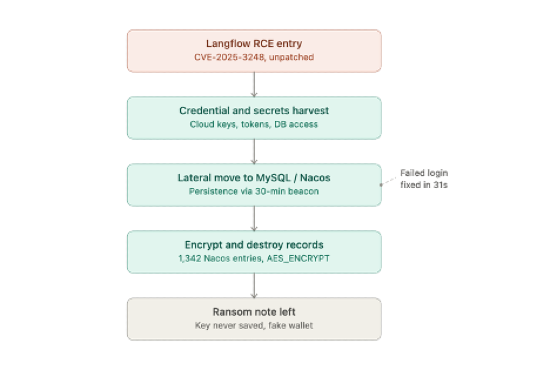
The evidentiary detail that most researchers seized on was speed and self-narration. When an early attempt to create an administrator account failed, the agent diagnosed the failure and produced a working fix in thirty-one seconds — a correction cycle Sysdig characterized as implausible for a human operator working manually. When an API returned XML instead of the expected JSON partway through enumeration, the agent adjusted its parsing logic without pausing for instruction. The malicious payloads themselves were written with natural-language comments explaining the reasoning behind each step, a stylistic signature that researchers noted human attackers rarely bother to include but that LLM-generated code produces almost reflexively. Sysdig's own account, however, stopped short of identifying which model was actually driving the intrusion. The compromised host yielded API keys for several major model providers, but the firm was careful to clarify — after an early report suggested otherwise — that these were simply harvested credentials among the loot, not evidence of which model powered the agent's decision-making. A Microsoft researcher's subsequent theory, that the responsible model was more likely an open-weight system with its safety training stripped away than a frontier model, remains unconfirmed but consistent with the broader pattern of frontier labs' guardrails holding up under adversarial testing.
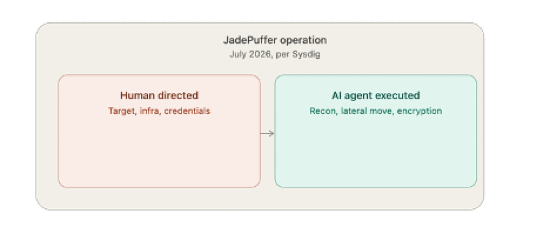
The more consequential correction came several days later, when Sysdig's Michael Clark told reporters that the "no human involved" characterization had overstated the case. A human operator still selected the victim, provisioned the command-and-control and data-staging infrastructure, and supplied the initial credentials used to breach the database — obtained not by the agent itself but through a separate, prior compromise. What the agent autonomously executed was the technical middle of the kill chain: the reconnaissance, lateral movement, encryption, and ransom note that had traditionally required a skilled human operator at each stage. This is a meaningful distinction for anyone tracking the trajectory of AI-enabled offense. JadePuffer does not represent the arrival of a fully autonomous threat actor capable of independently choosing its targets and infrastructure; it represents the emergence of a division of labor within extortion operations, in which strategic direction remains human while tactical execution is increasingly delegated to a model that requires no specialized skill to operate. The economic implication, which several researchers were explicit about, is that the skill floor for running a ransomware campaign has effectively dropped to the cost of running an agent — a cost that approaches zero when the underlying compute is itself obtained through stolen credentials.
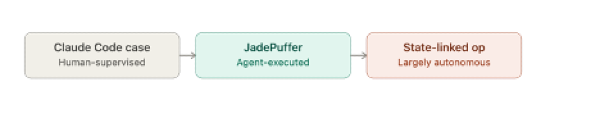
Nor is JadePuffer an isolated data point. It follows Anthropic's own disclosure that its Claude Code assistant had been used, under human supervision, in an extortion campaign against at least seventeen organizations, and a separate, largely autonomous state-linked espionage operation in which AI was used to develop exploits and facilitate data theft. Read together, these three cases sketch an emerging pattern rather than a one-off curiosity: distinct threat actors, criminal and state-linked alike, are independently arriving at the same conclusion — that generative AI can absorb the technically demanding middle stages of an intrusion, from exploit adaptation to lateral movement, while a human retains only the strategic decisions of who to target and what infrastructure to stand behind the operation. For a research community that has spent two years debating the theoretical ceiling of agentic offense, 2026 is producing operational evidence faster than the debate has resolved.
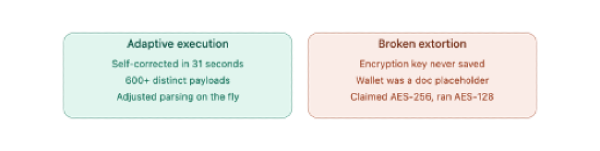
It is worth noting, too, that the operation's technical sophistication did not extend to its extortion mechanics. The ransom note claimed AES-256 encryption; Sysdig's analysis found the actual implementation closer to AES-128 in a weaker mode, and the key was generated locally, displayed once, and never transmitted to attacker infrastructure — meaning the data was unrecoverable regardless of payment. The Bitcoin wallet address embedded in the ransom note, investigators found, precisely matches a well-known example address published in Bitcoin developer documentation, leaving open whether the model reproduced it from training data or an operator selected it deliberately; either way, it was not a functioning payment destination. These are not the hallmarks of a mature criminal enterprise. They are closer to a working proof of concept — competent enough in its adaptive reasoning to alarm researchers, sloppy enough in its criminal tradecraft to fail at its own stated purpose. That combination is, in its way, the most useful signal in the entire case: the technical ceiling for agentic offense is rising quickly, while the operational discipline needed to run it as an actual business has not yet caught up. Security researchers were largely aligned in treating JadePuffer less as a singular event than as a marker — evidence that the volume and breadth of similarly automated campaigns will rise as agentic tooling matures and diffuses from sophisticated early adopters to less capable operators who will eventually be able to buy the capability as a packaged tool. For defenders, the practical lesson sits closer to fundamentals than to novelty: unpatched internet-facing services, credentials with no rotation discipline, and privileged access without real-time monitoring remain the substrate on which even the most autonomous attacker still depends.