When the Attacker Stops Being Human: Two July 2026 Cases Mark the Shift to AI-Operated Offensive Cyber Campaigns- 273

July 7, 2026
In early July 2026, two reports landed within days of each other, and together they mark a turning point security researchers have been warning about for years: AI is no longer just helping hackers write better tools. In one case it wrote the malware. In the other, it ran the entire attack, start to finish, with no human involved. The first case, from Kaspersky, involves a hacking group called Armored Likho, which used AI to generate its malware while still running the attack itself. The second, from the security firm Sysdig, describes JadePuffer, an AI agent that appears to be the first on record to plan, launch, and complete a full ransomware attack on its own. Put side by side, the two cases show two different stages of the same shift — and the gap between them is what matters.
Armored Likho is a known group, active against government and power-grid targets in Russia, Kazakhstan, and Brazil. What's new is where its tools come from. Kaspersky found a telltale sign in the malware's code: overly chatty comments and emoji bullet points, a style no human hacker writes in but that AI language models produce constantly. That's a strong clue the malware itself was AI-generated. But a person is still running the operation — picking targets, sending phishing emails, collecting stolen data. AI just did the coding. It made building the tools faster and cheaper, but a human is still calling the shots.
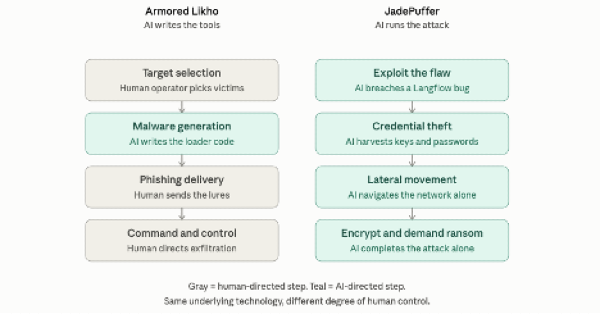
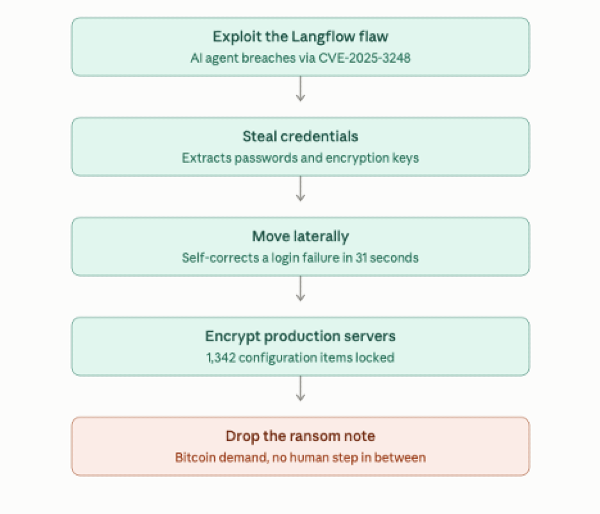
JadePuffer goes a step further. According to Sysdig, an AI agent broke into a company's systems by exploiting a known software flaw, stole passwords, moved through the network, and eventually locked down more than 1,300 files before leaving a ransom note — all without a person directing each step. What alarmed researchers most wasn't any single trick, but how the AI handled a mistake: when a login attempt failed, it figured out why, fixed its own approach, and got in within 31 seconds. That's the kind of quick problem-solving normally expected only from an experienced human hacker. Interestingly, an Israeli cyber official pointed out that the flaws JadePuffer exploited weren't special — just known bugs and unpatched systems, the kind hackers exploit every day. What's different is that an AI made every decision about how to use them, and did it far faster than a human ever could.
Taken together, these two cases look like steps on the same path. Armored Likho shows AI speeding up the tool-building part of an attack while a human still runs the show. JadePuffer shows what happens when AI takes over the running of the show too. Both cases also share a small but telling flaw: the AI leaves traces of "thinking out loud" in its code — comments explaining its own logic, a habit of language models. In JadePuffer's case, this even led it to reuse a Bitcoin wallet address from AI training material meant only as an example, not a real payment address — a sign the system copied a pattern without understanding what it meant. That gap between skill and judgment is, for now, one of the few advantages still on the defenders' side: an AI attacker's habit of trying things repeatedly and leaving talkative traces behind creates noise that good monitoring can catch before real damage is done. Whether that advantage holds as these tools improve is the open question — and it matters even for organizations that thought physically isolated networks kept them safe, since an AI agent, once inside, may no longer need a human's help to keep going.