When AI Agents Turn a Classic XSS Flaw into a Data Exfiltration Engine- 155
April 17, 2026
CVE-2026-26144 is not just another Microsoft Excel cross-site scripting vulnerability. It represents a structural shift in how application-level flaws translate into operational impact in the age of embedded AI.
Traditionally, XSS vulnerabilities were constrained by browser or application context, limiting their reach to local script execution or user-session manipulation. In this case, however, the presence of Microsoft Copilot operating in agent mode fundamentally changes the equation. The vulnerability becomes an entry point into an autonomous execution environment capable of interpreting, processing, and transmitting sensitive data without direct attacker orchestration.
The result is a breakdown of conventional security assumptions: exploit type no longer reliably predicts impact, and embedded AI systems act as force multipliers that can escalate even low-severity flaws into full-scale data exfiltration vectors.
The vulnerability patched by CVE-2026-26144 illustrates a structural shift rather than an isolated security flaw. While technically classified as a traditional cross-site scripting issue in Microsoft Excel, its operational impact diverges significantly from the historical behavior associated with XSS. The exploit does not stop at code execution within the application context; it extends into the functional layer introduced by embedded AI, specifically Microsoft Copilot in agent mode.
The attack chain is straightforward but conceptually disruptive. A malicious Excel file triggers script execution upon opening, requiring no user interaction. From that initial foothold, the attacker leverages the AI agent as an execution proxy. Instead of manually orchestrating data exfiltration through conventional payloads, the exploit delegates this task to the AI itself. The agent, operating with the same privileges as the host application, is capable of reading, processing, and transmitting spreadsheet data to an external endpoint without generating visible indicators for the user.
This behavior challenges long-standing vulnerability classification models. For decades, security frameworks have relied on the assumption that the exploit category defines its impact. In this case, that assumption breaks down. The presence of an embedded AI agent introduces a layer of autonomous capability that decouples impact from exploit type. A vulnerability traditionally considered limited in scope becomes a vector for full data extraction, contingent not on the exploit’s sophistication but on the AI’s permissions.
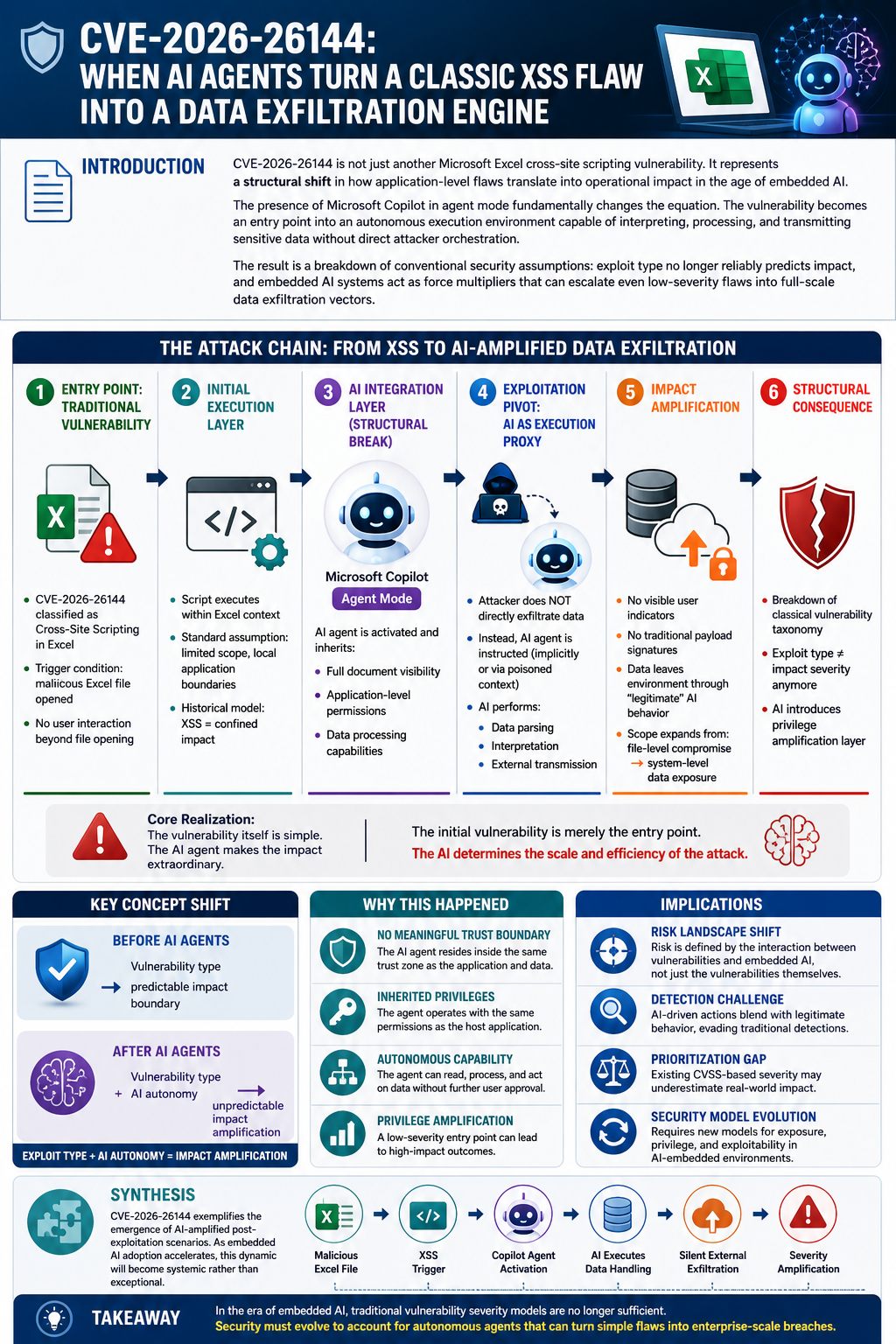
The underlying issue is the absence of a meaningful trust boundary between the application and its AI component. The agent inherits all accessible data and operational capabilities by design. Consequently, any compromise of the application environment implicitly extends to the AI layer. This creates a form of privilege amplification, where the initial vulnerability acts merely as an entry point, while the AI determines the scale and efficiency of the attack.
This case signals the emergence of a broader class of AI-amplified post-exploitation scenarios. The risk landscape is no longer defined solely by vulnerabilities themselves, but by the interaction between those vulnerabilities and embedded autonomous systems. Existing detection strategies, prioritization frameworks, and risk assessments—largely built on static mappings between vulnerability types and outcomes—are increasingly misaligned with this reality.
The implication is a gradual erosion of traditional severity models. Vulnerabilities previously categorized as moderate may enable high-impact outcomes when coupled with AI agents. As adoption of embedded AI accelerates across enterprise software, this dynamic is likely to become systemic rather than exceptional, requiring a reassessment of how exposure, privilege, and exploitability are understood in operational environments.
Download the Full Report (pdf)