Morpheus Spyware linked to Italian surveillance firm — When the System Becomes the Weapon- 156

April 30, 2026
The Morpheus case illustrates a quiet but decisive shift in mobile surveillance operations: compromise is no longer achieved by breaking into a system, but by operating through it. Uncovered by Osservatorio Nessuno, this Android spyware demonstrates how deception, interface manipulation, and the abuse of trusted system features can deliver full device control without exploits or rooting.
Rather than targeting technical vulnerabilities, Morpheus targets user perception and platform trust. A simple message, a convincing interface, and a sequence of seemingly legitimate actions are enough to transform a secure device into a persistent surveillance node. In this model, the operating system itself becomes the attack surface, and the user becomes the entry point.
What emerges is not just a piece of malware, but a reflection of a broader ecosystem—one where commercial surveillance capabilities are increasingly accessible, modular, and difficult to attribute. Morpheus is not an outlier. It is a signal.
Morpheus emerges as a discreet but highly capable Android surveillance tool operating at the intersection of social engineering and system-level abuse. Its deployment does not rely on technical exploits in the traditional sense. Instead, it leverages a controlled infection chain in which the user is gradually maneuvered into granting the very permissions that ultimately compromise the device.
The initial access vector is deliberately unsophisticated. Targets receive an SMS impersonating an internet service provider, introducing a fabricated service disruption. The message redirects to a spoofed website, where the victim is encouraged to download what appears to be a legitimate update. This stage reflects a broader trend in mobile intrusion operations: minimizing technical complexity while maximizing psychological plausibility.
Once installed, the application operates as a dropper. Its role is transitional and largely invisible. It verifies whether the core payload is already present and, if not, deploys a second-stage component embedded within the package. At this point, the compromise shifts from user-driven to system-driven.
The payload adopts the appearance of a trusted system application. Its real power lies in its interaction with Android’s Accessibility framework and overlay capabilities. These features, originally designed to enhance usability, are repurposed here as instruments of control. The spyware initiates a permission workflow masked behind a simulated system update. A full-screen overlay is displayed, often mimicking a reboot sequence, while user interaction is partially suppressed. The temporary loss of control is not incidental—it is engineered to create a window during which the system can be reconfigured without resistance.
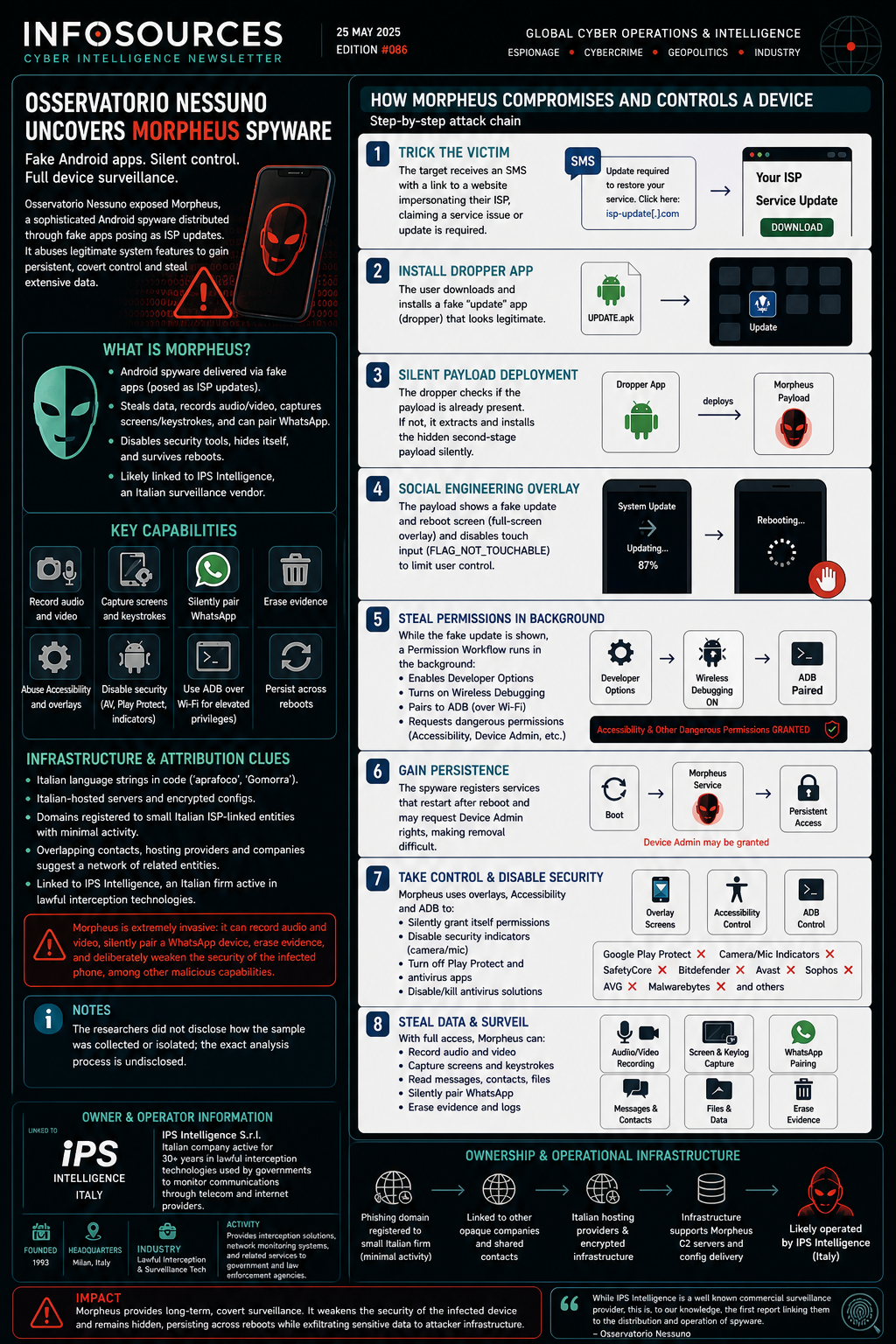
Behind this visual deception, a series of critical actions are executed. Developer options are enabled, wireless debugging is activated, and a local pairing is established with the Android Debug Bridge. This sequence is particularly notable. It allows the spyware to escalate privileges and issue system-level commands without requiring root access, effectively bypassing one of the main barriers traditionally associated with deep device compromise.
From this point onward, the device is no longer operating under its original security assumptions. Morpheus proceeds to neutralize defensive layers by disabling security tools, including well-known antivirus solutions and native protections such as Play Protect. Indicators designed to alert users to sensitive activity, such as microphone or camera usage, are also suppressed. The strategy is not stealth through invisibility, but stealth through normalization—everything appears functional while protections quietly disappear.
Persistence is ensured through a combination of service registration and privilege escalation. The spyware configures itself to restart after reboot and may obtain device administrator rights, complicating removal efforts. Unlike more fragile malware strains, Morpheus is built for continuity.
With control established, the operational phase begins. The spyware enables continuous surveillance across multiple channels: audio, video, screen activity, and messaging platforms. Its ability to silently pair a WhatsApp session is particularly indicative of its intent to bypass end-to-end encryption by accessing communications at the device level. Data collection is complemented by anti-forensic capabilities, including log deletion and evidence suppression.
Elements of attribution embedded in the code and infrastructure suggest an Italian nexus. Language artifacts, domain registrations, and hosting patterns converge toward a network of small, opaque entities with overlapping connections. These characteristics are consistent with an ecosystem designed to obscure ownership while maintaining operational cohesion. The reported link to IPS Intelligence places Morpheus within the broader landscape of commercial surveillance vendors, where the boundary between lawful interception and covert deployment becomes increasingly ambiguous.
What distinguishes Morpheus is not technical sophistication in isolation, but the efficiency of its model. It operates entirely within the logic of the operating system, transforming legitimate features into vectors of compromise. No exploit is required. No root access is needed. The system is not broken—it is persuaded.
This reflects a deeper evolution in mobile threat design. The attack surface is no longer limited to code vulnerabilities. It extends to user behavior, interface trust, and the implicit assumptions embedded in modern operating systems. In this environment, compromise is achieved not by force, but by orchestration.
Download the Full Report (pdf)