When the Basics Fail: FSB Center 16's Router Campaign and the West's First Joint Cyber Sanctions Response- 269
July 15, 2026
A joint advisory issued this month by cybersecurity and intelligence agencies from twelve allied nations laid out, in unusually granular detail, how Russia's FSB Center 16 has spent years compromising the least glamorous layer of critical infrastructure: the routers and network devices that most organizations assume are too mundane to be a target. The disclosure arrived alongside an equally significant milestone — the first joint sanctions regime the UK and EU have ever imposed together on Russian cyber actors — and together the two developments mark a shift from quiet technical warnings toward coordinated political and legal consequence.
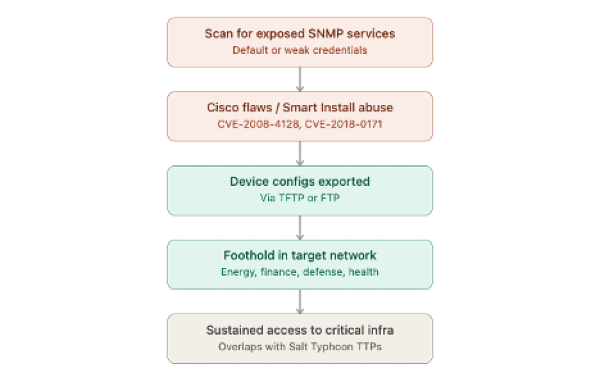
The technical picture painted by the advisory, co-signed by agencies from the United States, United Kingdom, Australia, Canada, and eight European states, is notable less for its sophistication than for its persistence. FSB Center 16 — tracked across the security industry under a sprawling list of aliases including Energetic Bear, Berserk Bear, Crouching Yeti, Dragonfly, Ghost Blizzard (Turla), and Static Tundra — gains initial access primarily by scanning for network devices still running factory-default or easily guessed SNMP credentials, then instructing compromised devices to export their configuration files to attacker-controlled infrastructure over TFTP or FTP. Where credential abuse alone is insufficient, the actors fall back on long-known Cisco vulnerabilities, including CVE-2008-4128 and CVE-2018-0171, and misuse of the Cisco Smart Install feature — techniques that have been public knowledge for over a decade. The advisory notes that many of these tactics overlap with those employed by Salt Typhoon, the Chinese state-nexus actor whose telecommunications intrusions have drawn separate scrutiny, suggesting either parallel tradecraft convergence or a shared pool of exploitable weaknesses that both nations' operators have independently learned to exploit. Targeted sectors span the defense industrial base, energy, financial services, government, healthcare, and communications — the full spread of what allied governments now classify as critical infrastructure.
The advisory's own framing is notably blunt about why this campaign continues to succeed: not through novel tradecraft, but through the persistence of fundamental security failures that organizations have had the means to fix for years. That assessment carries particular weight given what the campaign has already produced. UK and EU officials used the sanctions announcement to formally attribute a previously unattributed incident — a failed January attack on Poland's energy grid — to FSB Center 16, describing it as a reckless operation that could have left half a million Polish citizens without electricity in the depths of winter. The sanctions themselves, targeting 24 Russian individuals and entities including senior GRU officers and cybercriminal proxies, cover not only infrastructure attacks but election interference and Ukraine-related disinformation, and bring the UK's total Russia-linked sanctions designations since the war began to 3,400. Read together, the technical advisory and the sanctions announcement describe two sides of the same posture: allied governments are simultaneously telling defenders exactly how the intrusions work and telling Moscow, for the first time with a unified voice, that the political cost of conducting them has changed.