Cyber Cargo Theft — Hijacking the Invisible Layer of Logistics- 157
April 30, 2026
The transformation of cargo theft underway across North America does not begin on highways or in warehouses. It begins inside inboxes, platforms, and identity systems that quietly underpin modern logistics. What the Federal Bureau of Investigation and researchers at Proofpoint are documenting is not simply a tactical evolution, but a structural shift: the relocation of theft from the physical domain into the digital coordination layer that governs the movement of goods.
For those unfamiliar with the sector, modern logistics operates as a distributed, trust-based ecosystem linking shippers, brokers, and carriers through digital marketplaces and constant electronic communication. This model prioritizes speed and flexibility, but it also centralizes a critical vulnerability: identity. In such an environment, controlling a legitimate identity — or convincingly imitating one — is often sufficient to influence the entire transport chain.
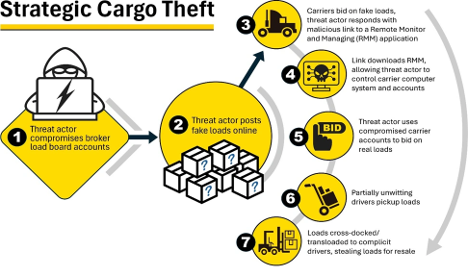
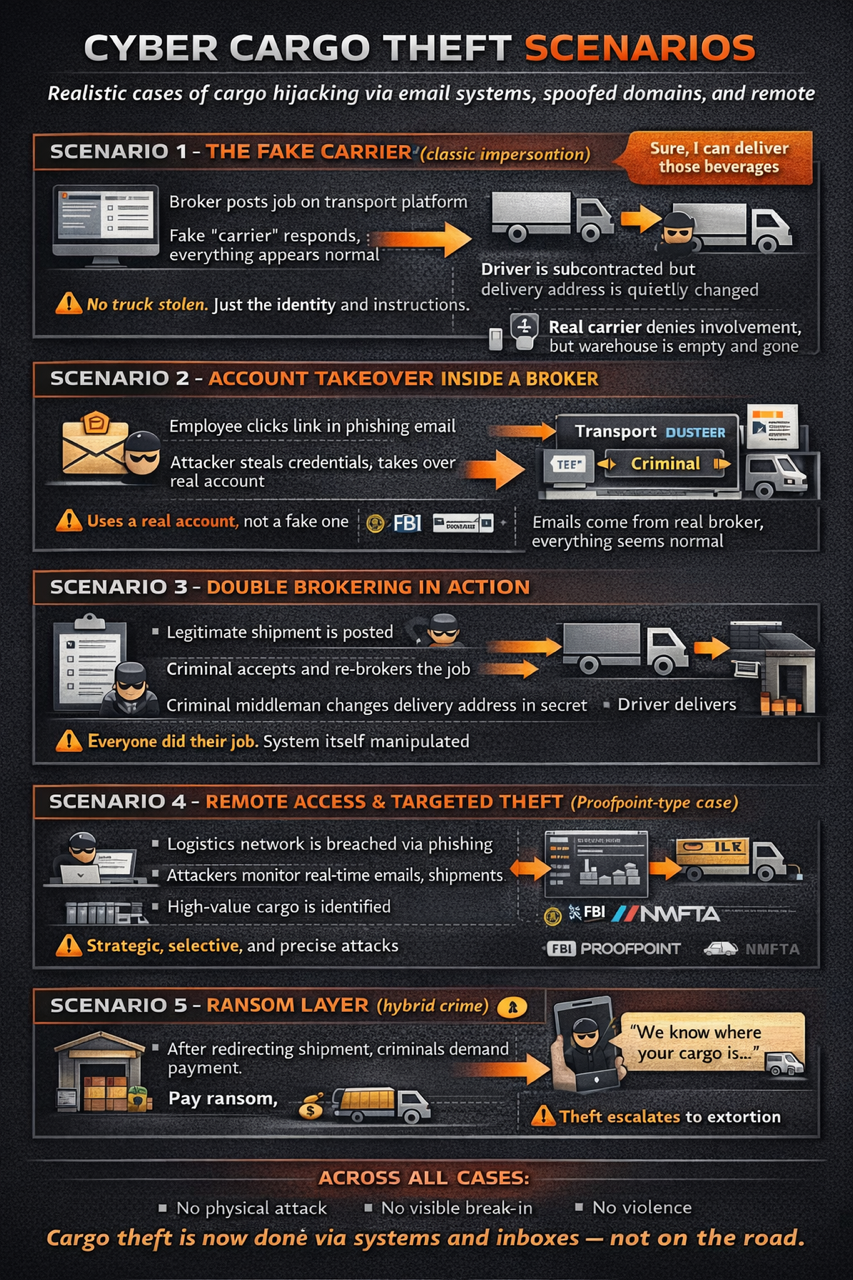
Cyber-enabled cargo theft exploits precisely this weakness. Attackers begin by compromising accounts through phishing campaigns, spoofed domains, or credential theft. In some cases, they deploy remote monitoring and management tools to maintain persistent access inside logistics companies. Once embedded, they do not disrupt operations; they blend into them. They operate through real accounts or highly convincing impersonations, making detection difficult because activity appears legitimate at every stage.
From this position, attackers manipulate the allocation of freight. They post fraudulent listings on load boards, intercept genuine shipment opportunities, or respond to existing offers while posing as trusted partners. A central technique is double brokering, in which a malicious actor accepts a shipment as a supposed carrier and then quietly reassigns it to an unsuspecting driver. During this process, key details — delivery addresses, contact points, or instructions — are subtly altered.
The physical movement of goods continues without interruption. Drivers follow instructions they believe to be legitimate. Brokers observe expected confirmations. Shippers see no immediate anomaly. Yet the cargo is ultimately delivered to a location controlled by criminals, where it is rapidly offloaded and integrated into resale channels. In some instances, attackers extend the operation into extortion, demanding payment to disclose shipment locations or release information.
The scale and acceleration of this phenomenon are reflected in recent data. In 2025, reported cargo theft losses in the United States and Canada reached approximately $725 million, representing a 60 percent increase compared to 2024. At the same time, the number of incidents rose by around 18 percent, while the average loss per theft climbed to roughly $273,990, an increase of 36 percent. This combination of moderate incident growth and sharply rising loss per event indicates a strategic shift toward fewer but significantly higher-value targets.
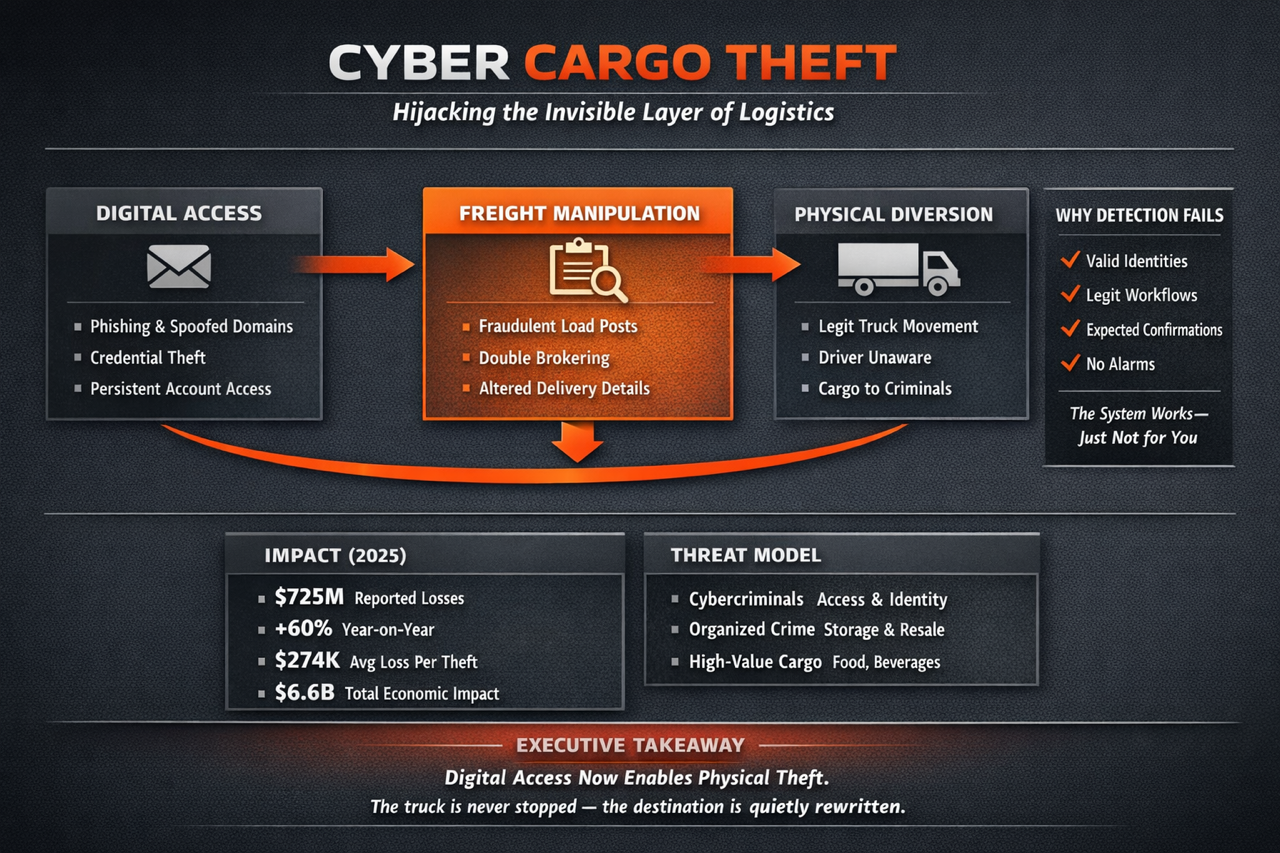
Broader industry estimates suggest the problem is even more extensive. Total losses linked to cargo theft across North America have been assessed at $6.6 billion in 2025, illustrating the widening gap between reported incidents and the full economic impact. These figures point to a model that is both scalable and increasingly efficient, where each successful operation yields substantial returns.
This evolution is reinforced by observations from National Motor Freight Traffic Association and Proofpoint, which highlight the growing use of coordinated campaigns and persistent access tools. Rather than opportunistic attacks, threat actors are now able to monitor logistics operations in real time, identify high-value shipments — particularly in sectors such as food and beverages — and intervene selectively. The result is a level of targeting and precision that traditional cargo theft rarely achieved.
Attribution remains complex but suggests convergence between cybercriminal networks and organized crime structures. The digital intrusion phase, involving credential theft and system access, appears increasingly specialized, while the physical handling and resale of stolen goods relies on established criminal logistics. The overlap between these domains reflects a hybridization of capabilities rather than a replacement of one by the other.
Indicators identified by authorities further underscore the centrality of identity manipulation. Slight alterations in email domains, unexpected shipment communications, unauthorized load postings, or the appearance of new mailbox rules such as automatic forwarding all point to compromised accounts operating within legitimate workflows. These signals are subtle by design. They do not break the system; they operate within it.
What emerges from this pattern is a redefinition of cargo theft itself. The act is no longer centered on intercepting goods in transit, but on controlling the decisions that determine their destination. The truck is not stopped, the route is not blocked, and no physical confrontation occurs. Instead, the system that directs the movement of goods is quietly altered.
In this model, digital access becomes the primary vector of physical theft. Control over information translates directly into control over assets. The logistics chain, once seen as a purely operational function, becomes an attack surface where cyber intrusion and real-world criminal activity converge.
Download the Full Report (pdf)