Following the Money: Inside the Takedown of a €140 Million Iberian Fraud Network- 262

July 17, 2026
Spain's national police disrupted, on July 13, a criminal network whose scale illustrates a pattern increasingly common in cybercrime: the technical attack is often the least labor-intensive part of the operation, while laundering the proceeds requires an entire shadow economy of its own. The gang, responsible for stealing at least €140 million through man-in-the-middle attacks, CEO impersonation schemes, and fraudulent investment platforms, employed more than 70 people, the overwhelming majority of whom existed not to hack anything but to move money through 19 registered companies, 120 merchant accounts, and roughly 800 bank accounts.
The operation's structure reflects a division of labor that has become a signature of financially motivated cybercrime at scale: only four individuals were identified as running the actual malicious cyber activity, while the remaining sixty-plus participants functioned as money mules, frequently recruited from among international citizens whose likely deportation upon arrest, rather than prosecution, insulates the operation's core leadership from ever facing the authorities investigating them. That structural insulation is precisely why financial-infrastructure dismantlement, rather than technical takedown alone, has become the more consequential half of modern cybercrime enforcement; as one security researcher noted in coverage of the case, criminal groups can replace servers and domains within days, but rebuilding a trusted network of shell companies, mule accounts, and layered bank transfers takes considerably longer; and it's this financial architecture, more than the hacking itself, that determines how quickly a disrupted group can resume operating.
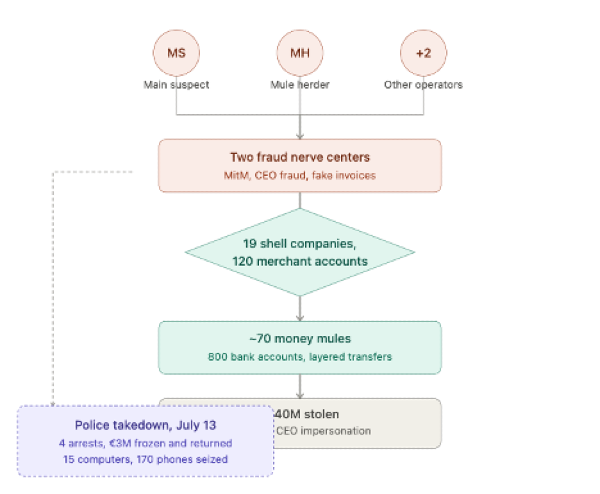
Whether the Spanish takedown produces a lasting reduction in fraud, rather than a temporary disruption before the network's remnants rebuild elsewhere, will depend on what authorities do with the financial intelligence seized alongside the arrests, which included seized computers, phones, and roughly €3 million in funds that were frozen before reaching the fraudsters and recovered for victims. Analysts who study cybercrime enforcement broadly caution against reading any single takedown, however large, as a structural turning point: attackers, infrastructure, and victims routinely span multiple jurisdictions, and the resulting fragmentation of legal authority means that even a successful arrest wave, as one industry researcher put it, addresses symptoms without resolving the underlying asymmetry between how quickly criminal infrastructure can be rebuilt and how slowly cross-border law enforcement can respond to it.