Mustang Panda’s Multi-Domain Cyber Campaign Against India’s Financial and Strategic Ecosystem- 154
April 22, 2026
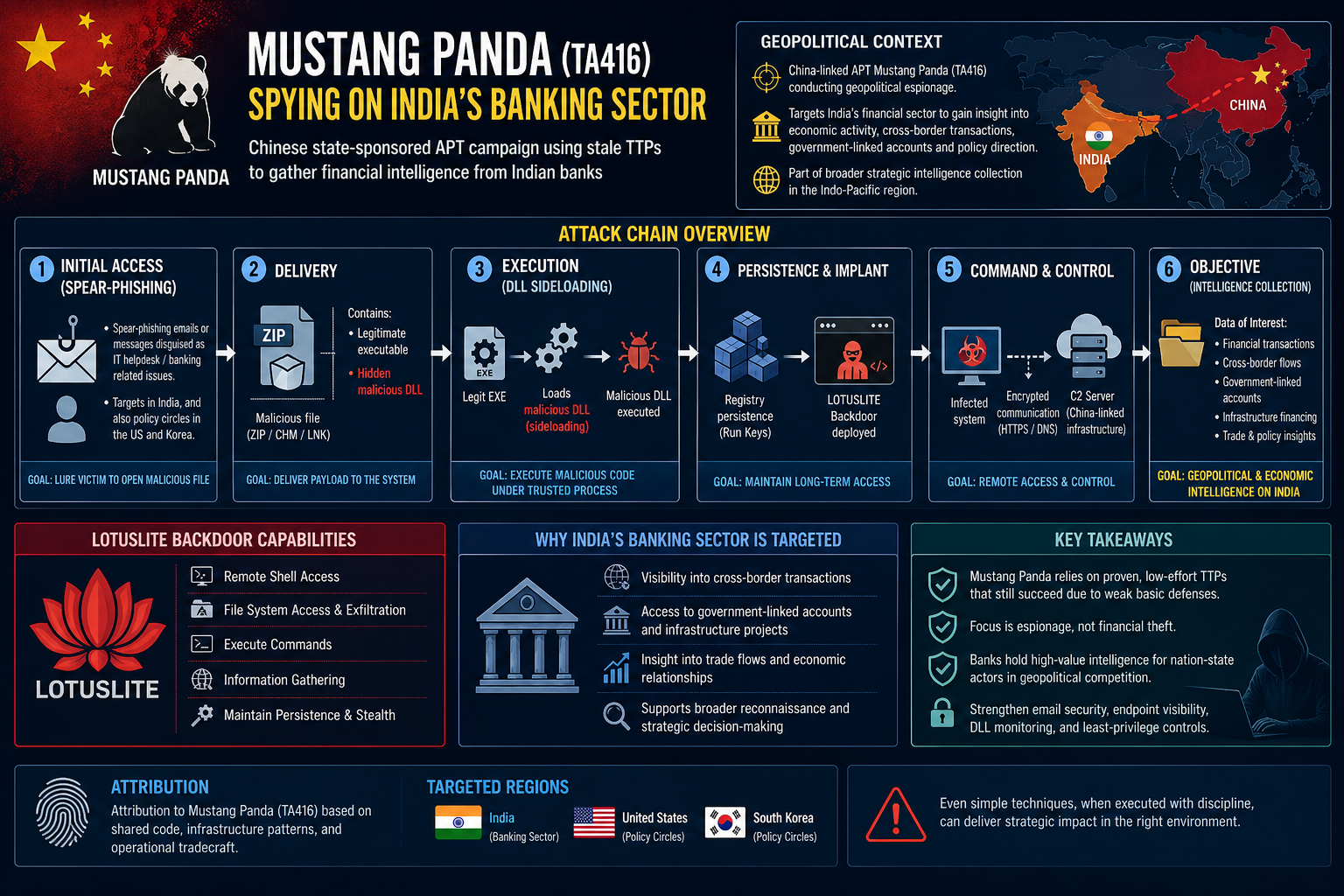
The reported activity attributed to Mustang Panda illustrates a continued blurring of lines between classic geopolitical intelligence gathering and economically oriented cyber operations. While the group has long been associated with iterative refinement of its intrusion techniques rather than technical novelty, this campaign highlights a consistent operational pattern: the use of familiar, low-complexity access vectors such as spear-phishing and DLL sideloading to achieve persistent footholds. The deployment of the LotusLite backdoor further reinforces continuity in tooling, suggesting an emphasis on reliability and stealth over sophistication.
What makes this cluster of activity particularly notable is not its technical profile, but its targeting logic. Alongside impersonation efforts linked to U.S. and Korean policy and security figures, the campaign extends into Indian financial institutions, including lures referencing HDFC Bank. This convergence of diplomatic, strategic, and financial themes points to an intelligence requirement that spans multiple domains of the Indo-Pacific environment, rather than a single operational objective.
Within this context, the targeting of India’s banking sector appears less connected to immediate disruption or financial theft, and more aligned with structured economic intelligence collection. Financial institutions represent high-density information nodes, capable of revealing patterns in trade flows, infrastructure financing, and state-linked economic activity. The campaign therefore fits into a broader trajectory in which financial systems are increasingly treated as strategic intelligence environments, reflecting the growing centrality of economic data in geopolitical competition.
The activity attributed to Mustang Panda reflects a subtle but meaningful evolution in Chinese state-linked cyber operations, where traditional geopolitical espionage increasingly intersects with economic intelligence collection. While the group is historically known for rapidly evolving its tactics, this campaign stands out specifically for its operational simplicity—relying on well-established methods such as spear-phishing and DLL sideloading—paired with the deployment of the LotusLite backdoor. Despite the lack of technical sophistication, attribution remains consistent due to recognizable code overlaps and behavioral patterns identified by Acronis.
At first glance, the campaign appears fragmented, targeting policy circles linked to the United States and Korea—including impersonation efforts involving Victor Cha—while simultaneously focusing on financial institutions in India. However, this dual targeting aligns with a broader Indo-Pacific intelligence posture, where diplomatic, security, and economic dimensions are increasingly interdependent. The use of India-themed lures, including references to HDFC Bank, further indicates deliberate contextualization aimed at increasing credibility within the targeted environment.
The most significant dimension of this campaign lies in its geopolitical implications. The targeting of Indian banks is unlikely driven by immediate financial gain, but rather by the strategic value of financial intelligence. India’s banking sector operates as a critical node within the country’s economic architecture, offering visibility into cross-border capital flows, infrastructure investments, government-linked transactions, and broader trade dynamics. For a state actor such as China, access to this ecosystem provides a powerful lens into India’s economic resilience, strategic partnerships, and policy direction.
In this context, cyber espionage against financial institutions becomes an extension of geopolitical competition. As India continues to position itself as a major economic and strategic counterweight in the Indo-Pacific, monitoring its financial systems enables adversaries to map influence networks, anticipate policy shifts, and potentially identify vulnerabilities in critical infrastructure financing. The campaign therefore reflects a broader trend: the expansion of state-sponsored cyber operations beyond traditional government and military targets into the economic backbone of rival states.
Ultimately, the reliance on “low-effort” techniques is not a weakness but a calculated choice. As highlighted by researchers, many organizations still struggle with basic security controls, allowing even unsophisticated methods to succeed. For actors like Mustang Panda, this lowers operational costs while maintaining effectiveness, enabling rapid redeployment and sustained intelligence collection. In geopolitical terms, this reinforces an uncomfortable reality: strategic advantage in cyberspace does not always depend on technical sophistication, but on persistence, timing, and the ability to exploit systemic weaknesses in high-value sectors.
Download the Full Report (pdf)