The Certificate Authority's Blind Spot: How a Trusted Signing Chain Became a Weapon- 255

July 18, 2026
In April 2026, a routine support interaction at DigiCert — a customer service chat, a screenshot-disguised ZIP file — became the opening move in an attack that exposed a structural weakness at the heart of the internet's trust infrastructure. The intrusion, now attributed to CylindricalCanine, a subgroup operating within the Chinese cybercrime network GoldenEyeDog, did not exploit a software flaw. It exploited a permission.
The mechanics of the breach reveal something more consequential than a single vendor's oversight. DigiCert's support portal allowed authenticated analysts to view customer accounts to facilitate legitimate service requests — a design assumption that treated internal access as inherently trustworthy. Once the attackers compromised two analyst workstations, that assumption collapsed: possession of an initialization code plus an approved order proved sufficient to mint EV code-signing certificates, the digital credentials that browsers and operating systems use to distinguish legitimate software from malware. Of the sixty certificates DigiCert ultimately revoked, twenty-seven were confirmed weaponized, used to sign a data-theft tool called Zhong Stealer with the imprimatur of a trusted certificate authority.
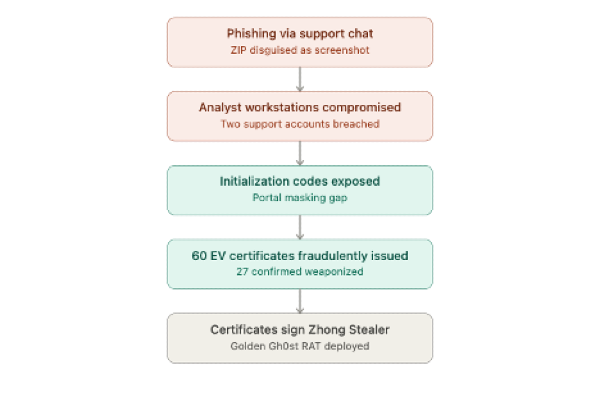
The broader significance lies in what GoldenEyeDog represents. Active since at least 2015 and long associated with gambling- and gaming-sector fraud, the group has evolved a modular toolkit — Golden Gh0st RAT, delivered through the RONINGLOADER loader chain — sophisticated enough to sustain parallel operating cells, one apparently dedicated to certificate-authority infiltration, another to Web3 customer-support targeting. This specialization inside a single criminal ecosystem mirrors patterns more commonly associated with state-directed operations: division of labor, infrastructure reuse across campaigns, and a deliberate targeting of chokepoints — certificate authorities, support portals — where a single compromise cascades trust failures downstream to every customer relying on that authority's signature. For an internet security model built on the premise that a valid signature implies a vetted publisher, the DigiCert episode is a reminder that the weakest link is rarely cryptographic.