The Student Who Stopped the Trains: TETRA, SDR, and the Infrastructure Vulnerability Nobody Fixed- 206
June 18, 2026
A university student with a software-defined radio bought online and eleven handheld radios stopped four high-speed trains in Taiwan for 48 minutes. He did not break into any system. He did not exploit a zero-day. He intercepted a radio signal, decoded it, and replayed it — using the same authentication parameters that had not been changed in nineteen years. The technology he attacked was designed in the 1980s. The hardware he used cost less than a weekend trip.
On a holiday weekend in late April, four high-speed trains in Taiwan came to an unexpected halt. The emergency braking was triggered by a general alarm — a life-or-death priority signal in THSR's safety protocols, one that requires trains in the affected zone to switch immediately to manual emergency stop mode. Operators checked their equipment, found no assigned device matching the signal source, and called the police. The disruption lasted 48 minutes. The attacker, it turned out, was a 23-year-old university student named Lin, equipped with a software-defined radio, a laptop, and eleven handheld radios — all purchased online.
What Lin did was technically straightforward. He used an SDR receiver to intercept and decode the signal parameters used by THSR's TETRA radio communications system. He analysed the signal structure, programmed the same parameters into his handheld radios, and transmitted a general alarm as if it were a legitimate THSR beacon. The system accepted it. The trains stopped. TETRA's parameters, investigators found, had not been rotated in nineteen years.
The nineteen-year figure is the incident's most analytically significant detail, and it connects the Taiwan case to a global vulnerability rather than a Taiwanese one. TETRA — the Terrestrial Trunked Radio standard developed in Europe during the 1980s and 1990s as a secure replacement for unencrypted FM two-way radio — is used by critical services across more than a hundred countries. Police, fire brigades, emergency medical services, rail operators, and military logistics rely on it. When TETRA was designed, software-defined radio did not exist as a consumer technology. The radio landscape it was built for — one in which sophisticated signal analysis required specialised hardware costing hundreds of thousands of dollars — no longer describes the world. A HackRF SDR device capable of receiving, decoding, and retransmitting radio signals across an enormous frequency range can be purchased today for less than the cost of a mid-range mobile phone. The 2023 TETRA vulnerability disclosures prompted an accelerated remediation programme in several jurisdictions, but the global installed base is old, over-the-air security updates are absent from much of it, and upgrade cycles in public infrastructure are measured in decades rather than quarters.
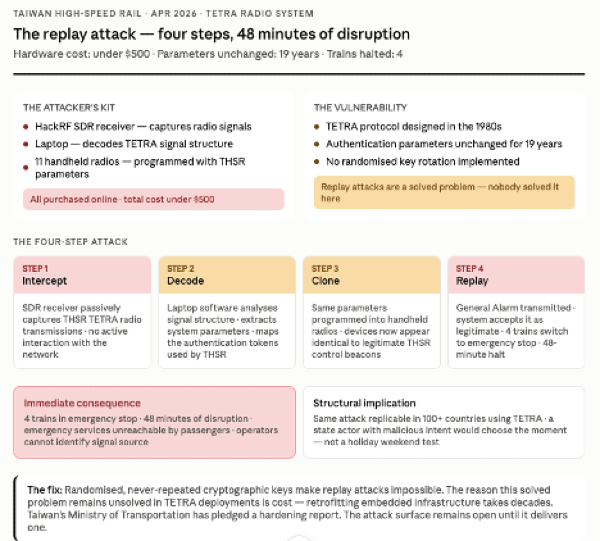
Replay attacks — the technique Lin used, intercepting a valid transmission and retransmitting it without modification — are, as The Register notes, a solved problem. Randomised, never-repeated cryptographic keys make them impossible. The reason this solved problem remains unsolved in operational TETRA deployments is cost: retrofitting embedded systems with new authentication logic is expensive, operationally disruptive, and competes with every other capital demand on public institutions that are perpetually underfunded for security. Taiwan's THSR ran the same parameters for nineteen years not through negligence but through the ordinary calculus of infrastructure organisations that prioritise availability over remediation until something forces their hand. Something has now forced their hand.
The geopolitical framing is unavoidable. Taiwan is uniquely exposed: a country dependent on functioning infrastructure for both civilian life and military response, facing the most capable state cyber adversary in the region, now publicly demonstrating that its high-speed rail communications can be disrupted by a student with consumer electronics. A state actor with resources, patience, and malicious intent would approach the same vulnerability differently: not a general alarm on a holiday, but a coordinated disruption at a moment of strategic decision, against multiple systems simultaneously. The student's arrest, his bail set at NT$100,000, and the Ministry of Transportation's pledge to submit a hardening report are the appropriate institutional responses to what was, in the end, an act of curiosity rather than sabotage. What the incident demonstrated is that the attack surface exists, and that the cost of finding it is now trivially low.