Patient by Design: FrostyNeighbor's Return and the Human Operator as Evasion Mechanism- 205

June 19, 2026
Most malware tries to avoid detection by being technically sophisticated. FrostyNeighbor avoids detection by being patient. Its latest campaign, active since March 2026, is built around a simple operational discipline: the malware does as little as possible until a human operator decides the victim is worth pursuing. Outside Ukraine, analysts see nothing. Inside Ukraine, a carefully staged infection chain waits — fingerprinting hosts every ten minutes, reporting back, and going no further until someone on the other end makes a decision. The evasion is not in the code. It is in the restraint.
A group that has been running cyberoperations since at least 2016 does not survive by being spectacular. FrostyNeighbor — also known as Ghostwriter, UNC1151, and UAC-0057, aligned with the government of Belarus and oriented toward Russian strategic interests since its earliest documented disinformation campaigns against NATO — has returned to active operations against Ukrainian governmental targets in 2026 with a campaign that ESET researchers began tracking in March. What distinguishes the campaign analytically is not the target set, which is consistent with nearly a decade of Eastern European operations, but the operational discipline embedded in the infection chain: a multilayered evasion architecture that uses geofencing, staged validation, and a human operator's judgment to ensure that the malware reveals itself only to victims worth the risk of revealing itself to.
The campaign opens with a spear-phishing email carrying a PDF that impersonates Ukrtelecom, one of Ukraine's principal telecommunications providers. The document is deliberately blurred — legible enough to suggest official communications, indistinct enough to encourage clicking a download button embedded in the design. That button leads to a delivery server that immediately checks the requesting IP address. If the connection originates from outside Ukraine, the server returns a clean, genuine document from Ukraine's national telecommunications regulatory body — the kind of unremarkable PDF that would satisfy a curious analyst and produce no alerts. An investigation launched from a non-Ukrainian network finds nothing to investigate.
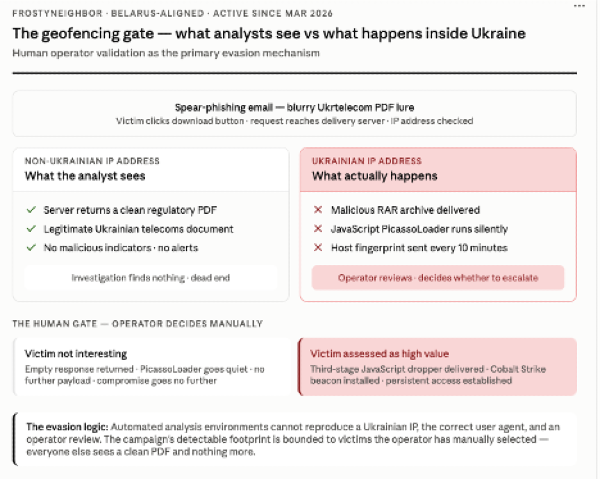
For victims connecting from a Ukrainian IP address, the server delivers a RAR archive containing a JavaScript file. Execution displays the same decoy PDF to maintain the pretense of a legitimate download, while simultaneously launching a JavaScript variant of PicassoLoader in the background. PicassoLoader — previously documented in .NET, PowerShell, and C++ implementations, the JavaScript version being the newest iteration of a long-running downloader — profiles the compromised host systematically: username, machine name, operating system version, boot time, current time, and the full list of running processes. Every ten minutes, this fingerprint is posted to an attacker-controlled command-and-control server concealed behind Cloudflare on .icu and .buzz domains, with responses formatted as apparent image files to obscure the actual XML configuration data they carry.
The next stage does not happen automatically. According to ESET's analysis, the decision to deliver a further payload is very likely made manually by operators reviewing the host fingerprint data. Victims assessed as high-value receive a third-stage JavaScript dropper that deploys a Cobalt Strike beacon, establishing the persistent access the campaign ultimately aims for. Victims who do not meet the operators' threshold receive an empty response, and the compromise goes no further. The malware achieves persistence through a registry Run key, with rundll32.exe disguised as ViberPC.exe to limit detection.
The insertion of human judgment at the critical escalation point is the campaign's most analytically interesting feature. It means the volume of detectable activity — the Cobalt Strike traffic, the C2 beacon cadence, the network indicators that threat intelligence feeds would capture — is deliberately bounded to the subset of victims that operators have manually selected. Automated analysis environments that cannot reproduce the full chain — the correct Ukrainian IP geolocation, the correct user agent, the operator review — see only a blurry PDF and nothing further. The operational surface that defenders can observe is smaller than the actual footprint of the operation by design.
The geographic targeting follows the conflict's logistical and intelligence contours. Ukrainian targeting focuses on military, defense, and government entities. In Poland and Lithuania — both NATO members deeply embedded in the logistics infrastructure supporting Ukraine — the targeting is broader: industrial and manufacturing companies, healthcare and pharmaceutical organizations, logistics firms, and government bodies appear across ESET's telemetry. The pattern reflects a Belarus-aligned actor working across the full range of organizations relevant to a prolonged military conflict, collecting intelligence on both the primary theater and the alliance infrastructure that sustains it.
FrostyNeighbor has been doing this for nearly a decade. The JavaScript PicassoLoader is new; the patience and discipline are not.