The Implant That Outlives the Patch: FIRESTARTER and the Persistence Problem- 204
June 20, 2026
For network defenders, the standard playbook for responding to a network device compromise has long been straightforward: identify the vulnerability, apply the vendor patch, and verify remediation. However, a sophisticated new backdoor known as FIRESTARTER has been explicitly engineered to shatter this paradigm. Discovered on the network of a US federal civilian agency and disclosed in a joint advisory by CISA and the UK's NCSC, FIRESTARTER achieves a level of persistence that completely evades traditional firmware updates and device reboots. If an edge device was breached before Cisco's September 2025 updates were applied, the implant likely remains active today—rendering standard patch-and-forget strategies entirely obsolete.
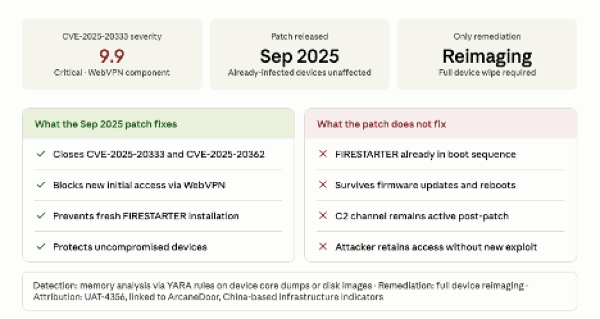
The standard playbook for responding to a network device compromise is straightforward: identify the vulnerability, apply the patch, verify remediation. FIRESTARTER was built to break that playbook. The backdoor, discovered on the network of a US federal civilian agency and disclosed in a joint advisory by CISA and the UK's NCSC, targets Cisco Adaptive Security Appliance and Firepower Threat Defense devices and achieves persistence through a mechanism that neither firmware updates nor device reboots will remove. Devices that were breached before Cisco's September 2025 patches were applied may still be running the implant today. The only path to clean remediation is full device reimaging — an operationally expensive proposition for network security appliances embedded in government and critical infrastructure environments where availability is a mission-critical requirement.
FIRESTARTER is a Linux ELF binary designed to operate as a command-and-control channel on Cisco firewall hardware. It exploits two vulnerabilities — CVE-2025-20333, rated 9.9, and CVE-2025-20362, rated 6.5 — both in the WebVPN component of ASA and FTD software. Once established, the malware registers itself against the device's boot sequence and implements a self-relaunching mechanism that detects termination signals and restores itself automatically. The design makes the implant invisible to the patch cycle: an administrator who applied Cisco's patches in September 2025 closed the vulnerability that allowed initial access, but any device already carrying FIRESTARTER at that point continued running it through every subsequent update. CISA notes the malware was detected through routine continuous network monitoring — the kind of behavioral detection that static patch verification would miss entirely.
Cisco attributes FIRESTARTER to UAT-4356, the same threat cluster it associates with the earlier ArcaneDoor campaign — a series of intrusions against Cisco firewall platforms globally that drew coordinated Five Eyes warnings in 2025. Cisco has consistently declined to formally attribute UAT-4356 to a specific nation-state, describing the group as government-backed without naming the government. Censys researchers, examining ArcaneDoor's command-and-control infrastructure, identified characteristics consistent with a China-based actor. CISA's advisory landed on the same day that ten countries, including all Five Eyes members, issued a second warning in as many weeks about China's construction of covert proxy networks through compromised consumer-grade routers — the same edge-device targeting doctrine that FIRESTARTER instantiates at the firewall layer.
The persistence-by-design capability is the finding that warrants the most serious attention from network defenders. State-sponsored actors targeting edge network devices are not a new threat — this publication has documented the pattern across Volt Typhoon, the Dutch NCSC's FortiGate disclosures, and Salt Typhoon's telecom intrusions. What FIRESTARTER adds to that picture is the explicit engineering of remediation failure: a malware whose authors anticipated that patches would be applied and built the implant to survive them. Organizations that consider their Cisco ASA or FTD deployments remediated by the September 2025 patches without having verified the absence of FIRESTARTER through memory analysis or disk imaging should revisit that assumption. CISA has published YARA rules for detection through device core dumps or disk images, and both agencies have requested that any confirmed compromise be reported for intelligence purposes. The advisory covers all US and UK organizations, not only the federal agency at the center of the disclosed incident, reflecting the agencies' assessment that this is a wider campaign rather than a targeted single-victim operation.