The ShinyHunters Playbook: One Extortion Crew, Four Industries, One Spring- 214

May 20, 2026
A convenience store chain. A cruise line. A video platform. The learning management system behind nearly nine thousand schools. Four organizations, four industries, no obvious link between them — except that the same crew hit all four within six weeks, using close to the same method each time, and in at least one case walked away with a payment estimated in the tens of millions. ShinyHunters did not need to innovate to run that table. It needed only patience, a working template, and victims still unprepared to say no.
The method rarely involved breaking directly into a hardened perimeter. At 7-Eleven, the entry point was a system storing franchisee documents, exposing names, addresses, and Social Security numbers tied to thousands of the chain's roughly ten thousand US franchise locations. At Carnival Corporation, the exposure ran through the Mariner Society loyalty program at subsidiary Holland America, with Have I Been Pwned cataloguing millions of records even as the company's own account of the incident described something far more contained. At Vimeo, the crew never touched the platform's core systems at all — it went through Anodot, a third-party analytics vendor, extracting technical metadata and roughly 119,000 customer email addresses through an integration Vimeo did not directly control. Three different companies, three different products, one recurring lesson: modern extortion increasingly targets the vendor relationship, not the front door.
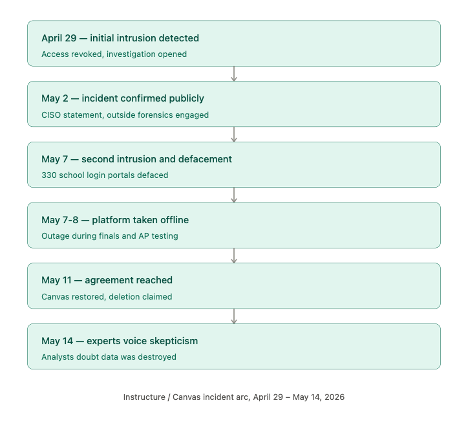
The fullest expression of the method came at Instructure, the company behind the Canvas learning platform. What began as a single disclosed intrusion in late April became, within two weeks, an acknowledged double breach exploiting a vulnerability in Canvas's Free-for-Teacher tier, followed by the defacement of roughly 330 school login portals and a platform-wide outage during final exams. ShinyHunters claimed 3.65 terabytes of data covering some 275 million student, teacher, and staff records across nearly 8,800 institutions, including several of the country's most prominent universities. Instructure's eventual public statement — that it had "reached an agreement with the unauthorized actor" and received "digital confirmation of data destruction" — read, to nearly every security professional who examined it, as confirmation that a ransom had been paid, with independent estimates placing the figure between five and thirty million dollars.
That outcome sits inside what threat analysts have taken to calling the ransomware trust paradox: extortion groups must occasionally honor a claimed deletion, or the entire threat of future payment collapses, and yet every available body of evidence suggests stolen data rarely if ever disappears. Analysts pointed to ShinyHunters' own history of resurfacing previously "resolved" datasets months later, and pointed as well to sector-specific dynamics that make schools an unusually soft target — concentrated in a handful of vendors, locked into long-term contracts, sitting on precisely the kind of minor's data that turns a breach into a public-relations and child-safety crisis simultaneously. That same pressure, analysts argued, is what continues to push institutions toward payment even as federal guidance explicitly counsels against it.
The Instructure episode also reopened a harder question about who exactly ShinyHunters is. A representative of the group, contacted directly, denied any affiliation with The Com, the loosely organized network of English-speaking hackers and extortionists linked to coercive tactics including swatting and the targeting of minors — while conceding that some tactics overlap. Whether or not the organizational lines are as clean as the group claims, the throughline across all four incidents is unmistakable: a single, patient actor, exploiting the weakest link in an organization's vendor or product stack, in an environment where paying quietly remains, for many victims, the least costly option on the table.